A watch does not need to be round to tell time, but choosing another shape changes much more than its silhouette. The case can create space for a protective mechanism, become the centre of a bangle or flow into a bracelet. In those watches, shape is part of the original idea.
Reverso, Baignoire and Panthère tell three different stories. The first uses a rectangle to house a case that turns over. The second develops an oval into a jewellery watch. The third makes an articulated bracelet inseparable from the design. Their continuing presence offers a better explanation of shaped watches than a sweeping claim that the whole industry abandoned them and later returned.
Reverso’s rectangle made room for a moving case
Jaeger-LeCoultre traces Reverso to a challenge posed to businessman César de Trey in 1930: protect a polo player’s watch glass during a match. The solution was a case that could slide in its support and turn over. An application for the design’s patent reached the Paris office on 4 March 1931, and the Reverso name was registered that November.
The construction gave the watch two aspects before it had two dials. On one side was the time display; on the other was metal that could face outwards to shield the glass. That reverse surface also offered room for personal engraving. A protective idea opened a separate decorative possibility.
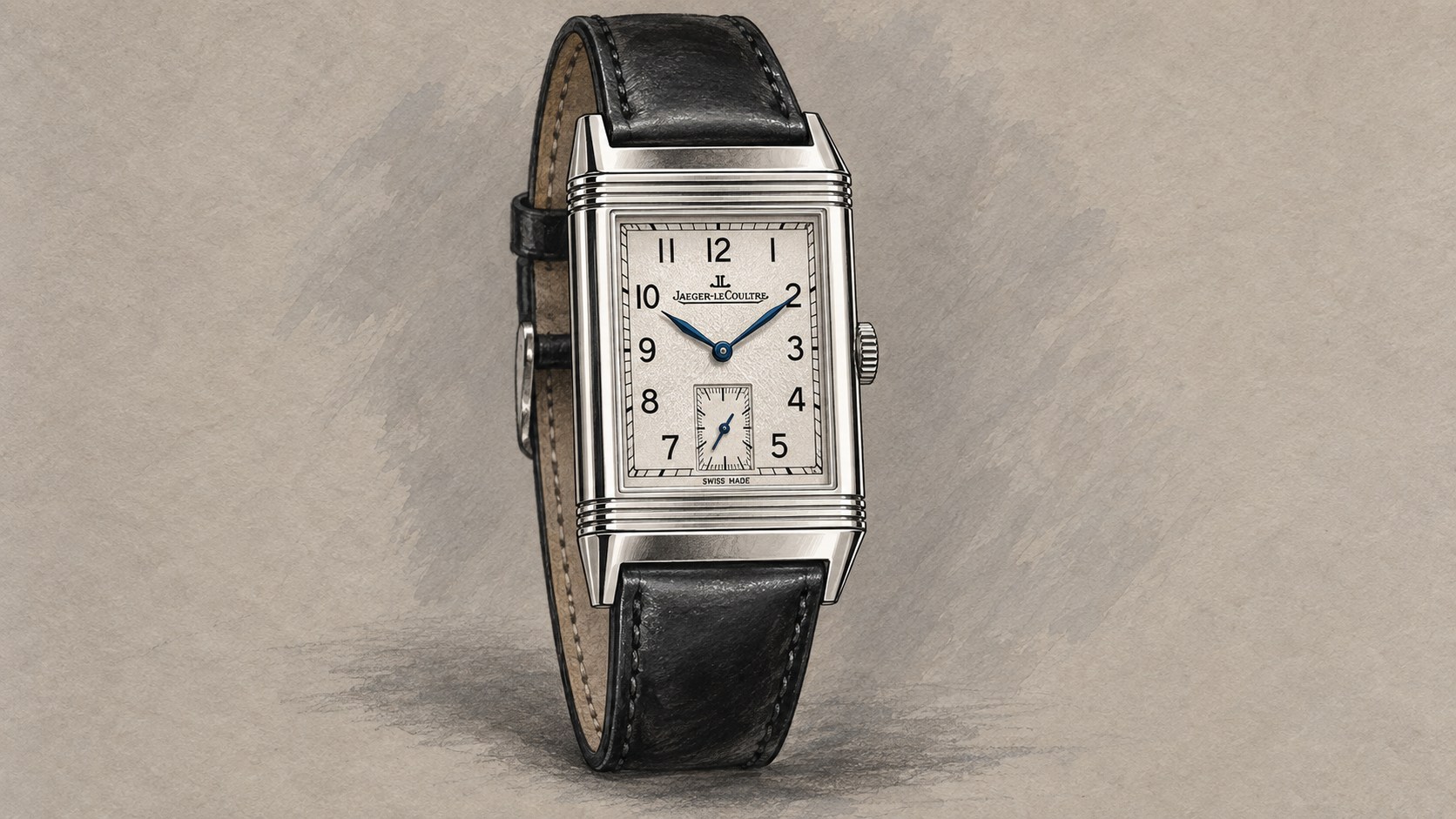
This remains an important distinction when looking at current references. Q3858524 is a Monoface Small Seconds: one time display and a reversible case. It should not be described as a Duoface or assumed to show another time zone simply because the case turns over.
The modern watch uses manual calibre 822 with a 42-hour reserve. Its silvered-grey dial combines different finishes around the hour display and small seconds. The functional origin is recognisable, but a current 3-bar watch on calfskin should be understood through its present specifications and care instructions, rather than treated as a licence to recreate its origin story.
Baignoire’s oval acquired its name in stages
Cartier’s history is easy to compress too far. The brand connects Baignoire’s ancestry to a 1912 design, dates the Ovale cintré to 1958 and places the Baignoire name in 1973. These are distinct points in the development of a form, rather than three interchangeable launch dates.
The current WGBA0025 shows how strongly that form can organise the whole object. Its elongated oval sits on a rigid yellow-gold bangle, with a silvered dial, blue hands and a sapphire cabochon in the crown. The case is a framed opening within a piece of jewellery, not merely a place to secure the movement.
It is also an oval, not a rectangle with the corners slightly softened. That difference changes how the numerals occupy the dial and how the case meets the bracelet. Putting it beside Reverso makes their purposes clearer: one emphasises a framed mechanism, while the other makes a continuous curved outline the main event.
Panthère made the bracelet part of the subject
Cartier dates the Panthère watch to the 1980s and explains its name through the bracelet’s flexible structure, which evokes the movement of the animal. The association is less literal than a panther-shaped case. It resides in the repeated links and the way the entire watch is conceived as a piece of jewellery.
The steel WSPN0013 uses a compact case with a silvered dial, Roman numerals and blued sword-shaped hands. Its quartz movement displays hours and minutes. Against the Baignoire’s rigid bangle, the articulated bracelet becomes the key difference. Both place the case within a larger wrist object, but they arrive at different forms and fitting questions.
There is no reason to rank them by which offers more machinery. A manual Reverso invites regular winding and provides visible small seconds. The two Cartier references simplify the display and use quartz. Those choices support different experiences without deciding which shape is more legitimate.
Dimensions make more sense when their direction is named
| Modern watch and reference | Published length × width × thickness | Movement and display | How the case meets the wrist |
|---|---|---|---|
| Jaeger-LeCoultre Reverso Q3858524 | 45.6 × 27.4 × 8.51 mm | Manual 822; 42 hours; small seconds | Reversible steel case; black calfskin strap |
| Cartier Baignoire WGBA0025, Small | 31.4 × 23.1 × 6.9 mm | Quartz; hours and minutes | Oval yellow-gold case; rigid gold bangle |
| Cartier Panthère WSPN0013, Small | 30.3 × 22 × 6.05 mm | Quartz; hours and minutes | Steel case and articulated bracelet |
The first number here is length, not a round-watch diameter. Reverso’s 45.6 mm runs along the wrist, while its width is 27.4 mm. Calling it a 45.6 mm watch without that distinction would create a misleading comparison with a large circular sports case.
Nor are family size labels standard measurements. The Small Panthère WSPN0013 measures 30.3 by 22 mm in Cartier’s technical specification. The Medium WSPN0015 is a different reference at 36.5 by 26.7 mm and 6.44 mm thick. A preference for the Small Baignoire says little about which Panthère size will suit the same wrist.
The bracelet adds another variable. A rigid bangle needs the appropriate circumference and shape; an articulated bracelet has its own sizing process. A leather strap offers adjustment, but it cannot shorten the fixed length of a Reverso case. These are reasons to assess the complete watch rather than choose from dial width alone.
The shape carries the history forward
These three families endure because their outlines remain meaningful. Reverso’s rectangle explains its reversible architecture. Baignoire’s oval supports a sculptural jewellery design. Panthère connects a compact dial to the bracelet that gives the watch its identity.
Choose among them by considering the whole object: what you want to read, how you want it to fasten and which outline feels right beside your other clothes and jewellery. Shape is not an alternative to watchmaking history. In these examples it is one of the clearest ways that history becomes visible.
Based on manufacturer information. Specifications checked on 8 September 2026.
Sources: Current Reverso Classic Large specifications; Reverso design and 1931 history; Baignoire Small bangle specifications; Current Panthère Small specifications; Current Panthère Medium specifications; Cartier: Ovale cintré in 1958 and the Baignoire name in 1973; Cartier: Panthère collection origins and bracelet identity.
Image: AI-generated editorial illustration of the Jaeger-LeCoultre Q3858524. Fine dial details and finishing may differ from the production watch.