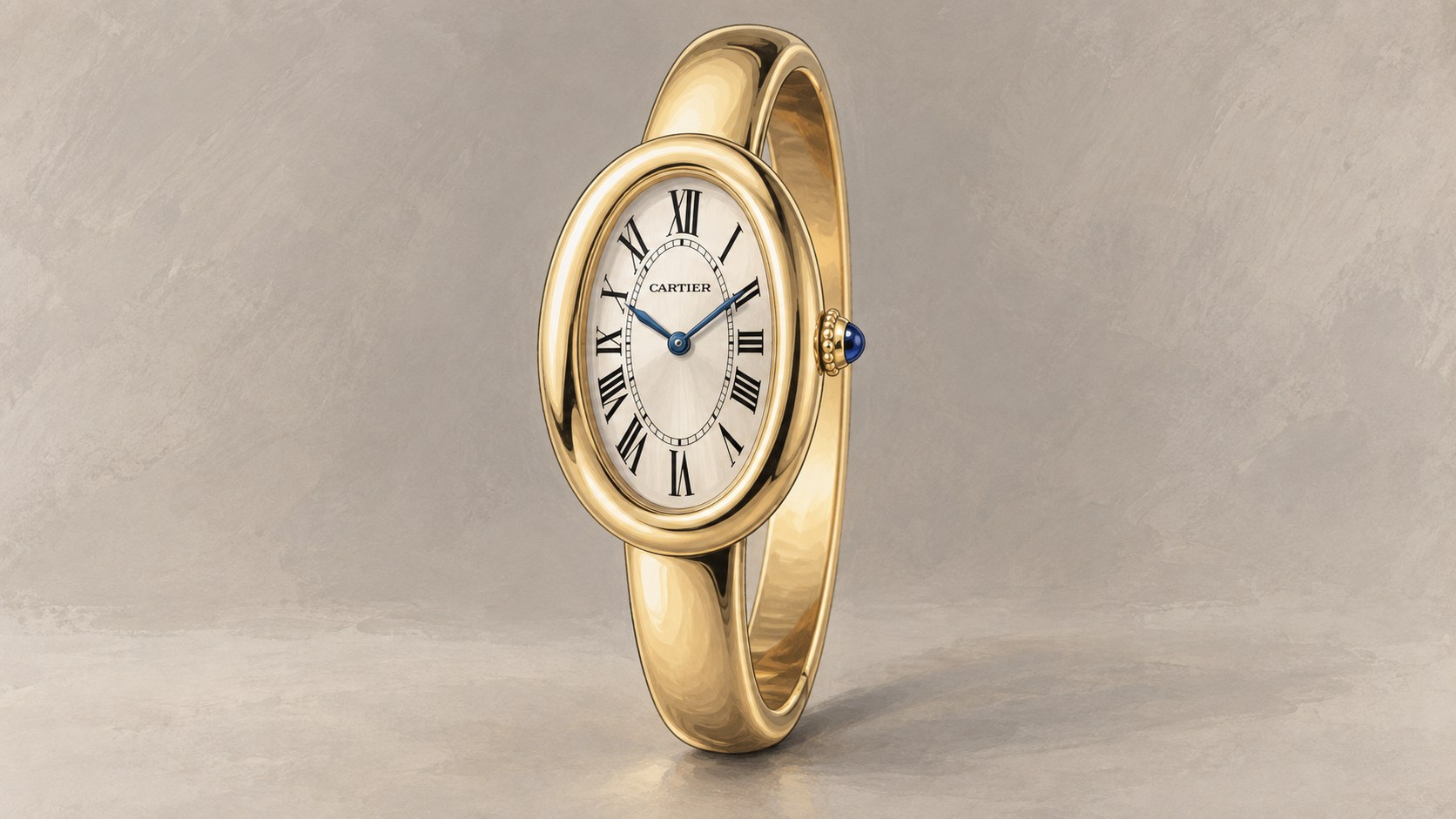
The Baignoire on a rigid gold bangle makes its priorities obvious. The oval face is part of a piece of jewellery, and the continuous metal structure matters as much as the hands. Buying it as though it were simply a small watch with an unusual strap would miss the point.
Reference WGBA0025 is the yellow-gold Small model, with a silvered dial and quartz movement. It is a considered choice for someone who wants the watch and bangle to read as one object. Its limitations are closely related to that appeal: this is a specific composition, not a platform for constantly changing straps and functions.
The history behind the choice
The Baignoire’s history needs more than one date. Cartier’s product account traces an early oval design to 1912; the collection history identifies the Ovale cintré of 1958 as a further defining stage, followed by the Baignoire name in 1973. These describe a developing shape rather than one unchanged reference launched under its final name. The modern bangle version takes that oval vocabulary in a jewellery-led direction. Instead of using leather to isolate the watch head, it joins the gold case to a rigid gold structure. That development is consistent with Cartier’s wider interest in the relationship between watches and jewellery. The historical continuity resides in the ellipse and surrounding form, while the bangle creates a particular modern way to enjoy them.
The exact reference
| Specification | Published detail |
|---|---|
| Reference | WGBA0025 |
| Case | 18K yellow gold; small model |
| Dimensions | 31.4mm long by 23.1mm wide |
| Thickness | 6.9mm |
| Dial | Silvered |
| Hands | Blued steel; sword-shaped |
| Movement | Quartz; hours and minutes |
| Crystal | Sapphire |
| Crown | 18K yellow gold; sapphire cabochon |
| Water resistance | 30m |
| Bracelet | Rigid 18K yellow-gold bangle |
The oval changes the relationship with the wrist
An oval concentrates length along one axis while keeping the face relatively narrow. On this Small reference, the 31.4 by 23.1mm dimensions describe that relationship more clearly than a size name. The case’s surrounding gold is a visible component, not merely a thin boundary intended to maximise dial area.
That makes the Baignoire different from buying the largest readable face available within a certain width. The oval frame is part of the pleasure, and increasing the dial until it dominates could upset the effect. Someone who wants a watch to make a strong circular statement may prefer the Ballon Bleu. Someone attracted to an elongated, enclosed face has a stronger reason to begin here.
A rigid bangle creates a different kind of object
The bracelet is rigid and made from 18K yellow gold. It therefore follows a different approach from the Panthère’s articulated links or a conventional leather strap. The case and bangle form a closely related metal composition which does not rely on repeated small links for its character.
That distinction should guide the choice. If you like the fluidity of an articulated bracelet, the Panthère is the more direct Cartier comparison. If you want the watch embedded in a cleaner gold arc, this Baignoire offers a more concentrated result. Neither design needs to imitate the other. Their shared jewellery appeal conceals a substantial difference in structure.
Blue and silver keep the face distinct
The silvered dial provides a cooler interior against the yellow-gold case. Blued sword-shaped hands add another point of separation, while the sapphire cabochon repeats Cartier’s blue crown accent. The palette is limited, but it gives the eye more than a uniformly gold surface to follow.
There are only hours and minutes. No seconds hand, date window or subsidiary counter competes with the oval arrangement. That leaves the surrounding case and bangle unusually prominent in the overall experience. It is a sensible design if you want the watch to function as jewellery which tells the time. It is a less natural choice if watching a moving seconds hand or using a calendar is central to the pleasure of your current watch.
Quartz supports the occasional-wear possibility
The quartz movement fits the Baignoire’s restricted display brief. The watch need not be wound before each period of wear, allowing the case and bangle to remain the primary interest. A mechanical movement would provide another relationship with the object, but it would not automatically improve the design you see.
The published thickness is 6.9mm and the water-resistance rating is 30 metres. These figures define this reference more usefully than treating all gold Cartiers as interchangeable formal watches. Its attraction is an oval, two-hand composition carried by a rigid bracelet. Additional technical functions would change that brief rather than simply perfecting it.
Size the bangle as carefully as you choose the case
Cartier offers the bangle in different sizes. A proper fitting should establish the suitable circumference and how the oval sits on your wrist, rather than treating the Small case label as sufficient. Because the bangle is such a large part of the object, its line and position deserve the same attention as the face.
Choose WGBA0025 when the continuous yellow-gold structure is what you want to own. Choose an articulated Panthère when linked-metal movement is more appealing, or another Baignoire configuration when you prefer the oval isolated on a strap. The Small bangle succeeds as a specific jewellery-watch idea. Its clarity is the reason to buy it, rather than something to overcome by imagining additional functions.
Specifications and sources checked on 8 September 2026. Baignoire Small bangle specifications; Baignoire collection history; Cartier shaped-watch design; Panthère bracelet comparison.
Image: AI-generated editorial illustration of the Cartier WGBA0025. Fine dial details and finishing may differ from the production watch.


