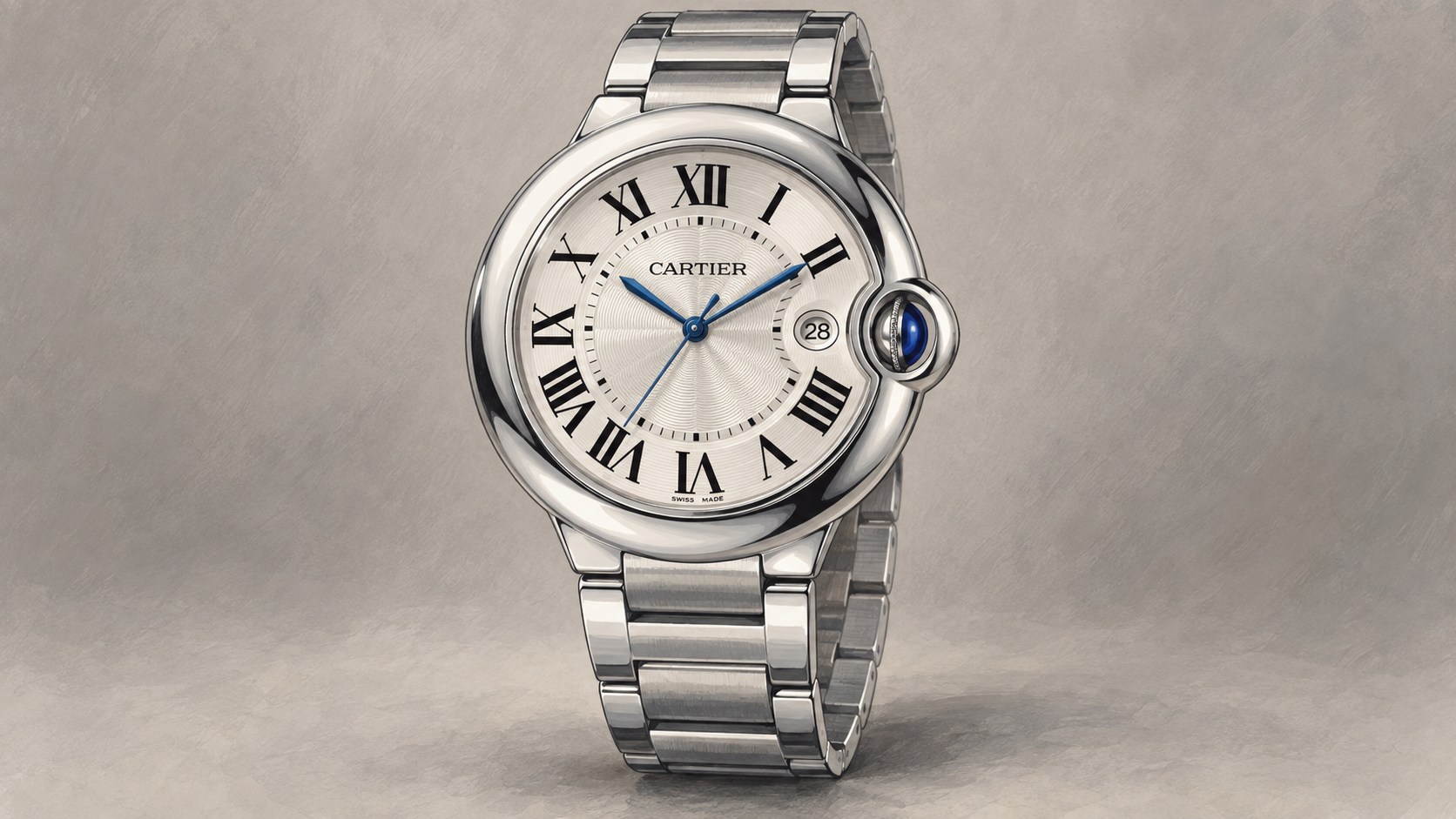
The Ballon Bleu is the round Cartier for someone who wants the case itself to carry the idea. The blue crown sits inside a curved shelter instead of simply projecting from the side, and the watch’s rounded surfaces make that unusual detail feel part of a complete shape. It is distinctive before you read the name.
The steel WSBB0040 adds a date and automatic winding to that design. Its 40mm label should not suggest a thin formal watch: the published profile is over twelve millimetres. Choose it because you enjoy the volume and the displaced dial geometry, rather than hoping a Cartier signature will make those features disappear.
The history behind the choice
Cartier introduced the Ballon Bleu in 2007, much later than the Santos or Tank. Its historical significance lies in extending the company’s interest in shaped watches into a fresh interpretation of roundness. Cartier describes a case domed at both front and back, with a protected blue crown and a dial track which accommodates that interruption. The result shows how recognisable brand details can be reorganised without repeating an early-twentieth-century silhouette. Roman numerals, blued hands and a decorated dial remain familiar, but their relationship to the case changes. That is the useful context for a buyer. The Ballon Bleu’s comparatively recent origin is not a weakness to explain away; it is evidence that Cartier’s design identity can support a genuinely different modern form.
The exact reference
| Specification | Published detail |
|---|---|
| Reference | WSBB0040 |
| Case | Steel; nominal 40mm |
| Detailed diameter / thickness | 39.9mm / 12.44mm |
| Dial | Silvered guilloché; date at 3 |
| Hands | Blued steel; sword-shaped |
| Movement | Automatic calibre 1847 MC |
| Crystal | Sapphire |
| Crown | Fluted; synthetic blue spinel cabochon |
| Water resistance | 30m |
| Bracelet | Interchangeable steel |
The crown changes the whole composition
Most round watches let the crown interrupt the outer edge while leaving the dial’s geometry untouched. The Ballon Bleu makes the interruption a defining feature. The rounded enclosure gives the blue cabochon its own space and draws the right-hand side into the visual story.
That creates a more sculptural result than a simple circular bezel. It also means the crown area is not an incidental detail you can ignore once the watch is on. If you enjoy the slightly displaced symmetry, the design has a strong reason to exist. If you keep imagining the same dial inside an uninterrupted circle, another round watch will answer that preference more directly.
Guilloché provides a second scale of interest
The silvered guilloché dial gives the watch something to inspect after the case shape becomes familiar. Its texture sits beneath blued sword-shaped hands, continuing recognisable Cartier details within the more unusual outline. The calendar at three adds everyday information near the crown side.
The interplay is important: a plain case with a textured face would be a different watch, as would this curved case surrounding a completely bare dial. Here, the larger shape and smaller surface detail reinforce the decorative brief. Someone seeking the quietest possible time display may prefer a simpler Tank configuration. Someone who enjoys noticing different aspects at different distances may find the Ballon Bleu more rewarding.
Forty millimetres is not the full measurement
Cartier’s detailed fields give 39.9mm across and 12.44mm in thickness, while the product description uses the nominal 40mm size and a rounded thickness. The case’s volume is therefore a central feature. It should be compared with other rounded automatics, not automatically with flat rectangular quartz Cartiers.
The 36mm Ballon Bleu offers another proportion, but it is not simply this reference reduced without further changes. Cartier’s current 36mm listing omits the date and identifies a different movement. During a fitting, compare the complete profiles and crown shelters. That single comparison should settle whether you want the larger object’s presence; a size label alone cannot describe the difference.
An automatic movement with a modest complication brief
The 1847 MC supplies automatic winding and the calendar. It supports the rounded everyday-watch proposition without filling the dial with additional displays. The steel bracelet is interchangeable, but the watch’s identity remains centred on the case rather than on an elaborate strap-changing mechanism.
This is a useful distinction from choosing a Santos principally for its bracelet-and-leather versatility. The Ballon Bleu’s mechanism is there to keep a recognisable design in regular use. If mechanical spectacle is the main attraction you seek, a watch with more emphasis on its movement may be a better choice. If the case and dial are the reason you want to look at the time, this arrangement is coherent.
The Pasha reveals the alternative
The steel Pasha 41 uses the same named automatic calibre in a very different Cartier design. Its chained crown cap, Arabic numerals and square-within-circle motif are more overtly assertive. It also carries a 100-metre rating, compared with the Ballon Bleu’s 30 metres. Shared movement terminology therefore does not establish equivalent ownership briefs.
Choose the Ballon Bleu when its rounded enclosure, silver texture and blue crown form the composition you prefer. Consider the Pasha when you want a bolder sporting shape, or the smaller Ballon Bleu when the family design appeals but the 40mm volume does not. This watch is strongest as a deliberate choice of form, with its automatic date display giving that form an everyday purpose.
Specifications and sources checked on 8 September 2026. Ballon Bleu 40 exact specifications; Cartier Ballon Bleu history and design; Ballon Bleu 36 comparison; Pasha 41 comparison.
Image: AI-generated editorial illustration of the Cartier WSBB0040. Fine dial details and finishing may differ from the production watch.


