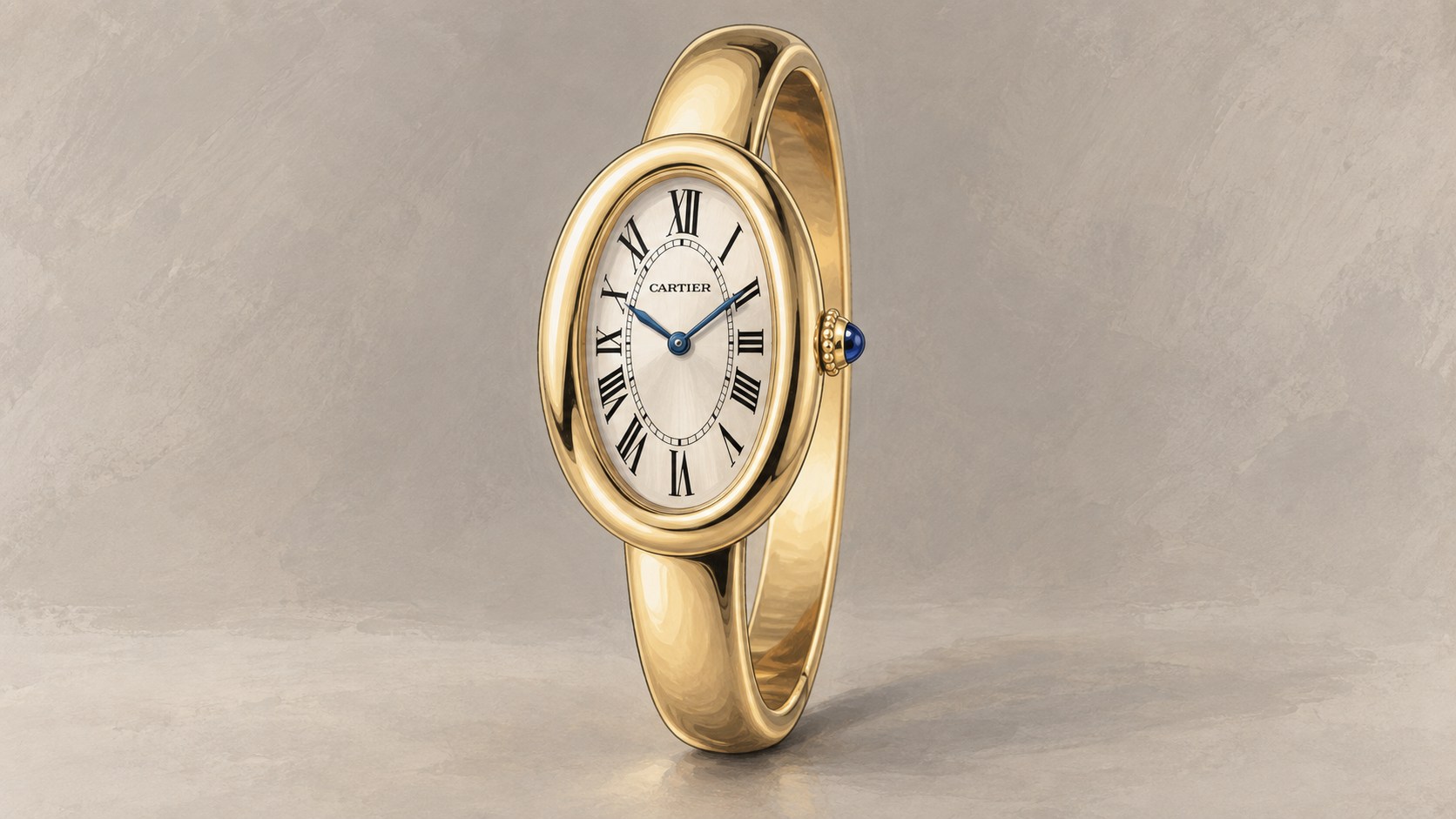
The most important difference between these Cartiers is not that one face is squarer and the other oval. It is that the Panthère is an articulated bracelet watch, while this Baignoire is a rigid gold bangle with a watch built into its form. Choosing between them starts with that physical structure.
The small steel Panthère and small yellow-gold Baignoire share two-hand quartz displays and similar case dimensions. Their material, attachment and surrounding shapes make them distinct jewellery propositions. Begin with the Panthère if linked steel is the attraction. Begin with the Baignoire if you specifically want the continuity of a gold oval and rigid bangle.
The references compared
| Feature | Panthère Small | Baignoire Small Bangle |
|---|---|---|
| Reference | WSPN0013 | WGBA0025 |
| Material | Steel | 18K yellow gold |
| Case dimensions | 30.3 × 22.0mm | 31.4 × 23.1mm |
| Thickness | 6.05mm | 6.9mm |
| Dial | Silvered; rounded square frame | Silvered; oval frame |
| Movement | Quartz; two hands | Quartz; two hands |
| Water resistance | 30m | 30m |
| Bracelet | Articulated steel links | Rigid gold bangle |
Two histories behind the decision
Cartier associates the Panthère bracelet watch with the 1980s, while the panther motif itself appeared much earlier in a watch decorated in 1914. The Baignoire’s oval history includes an early 1912 design, the Ovale cintré of 1958 and adoption of the Baignoire name in 1973. Those dates describe developing design languages rather than unchanged current references. The modern Panthère expresses its identity through fluid bracelet links and a compact frame. The bangle Baignoire takes the oval into a different relationship with gold jewellery. Comparing them is therefore a choice between two ways of making a watch part of an ornament, rather than a contest over which shape has the older date attached to it.
The bracelet is the main event
The Panthère’s small links let the bracelet change direction repeatedly around the wrist. Its polished steel case sits within that articulated chain, sharing the bracelet’s repeated edges and bright surfaces. The watch head is recognisable, but it is not the entire object.
The Baignoire’s rigid bangle creates a more continuous structure. Its gold case and surrounding rim contribute to the same jewellery composition as the attachment. That makes the correct bangle size particularly important: this is not simply a link bracelet waiting to have another section removed. If the appeal is specifically a gold bangle, choosing the Panthère for a similar case measurement would miss the reason for the purchase.
An oval and a rounded square organise the face differently
The Panthère gives its silvered Roman-numeral dial a compact frame with visible corner details. The Baignoire stretches the same broad Cartier vocabulary into an ellipse, surrounded by a more conspicuous gold rim. Their blue hands and cabochon crowns connect them stylistically without erasing the difference.
The Baignoire’s curve makes the surrounding gold especially important to the appearance. The Panthère’s case shares more of its geometry with the rows of steel links. If you are comparing close-up photographs, step back enough to include the whole attachment. A cropped dial image understates the feature which most clearly separates these two designs.
Quartz supports the jewellery brief
Both references show hours and minutes without a running seconds hand. Their quartz movements allow the choice to centre on the case and bracelet without introducing a manual-winding preference or an automatic reserve comparison. That simplicity is useful for watches selected as jewellery as well as timekeepers.
There is no need to treat the shared movement type as a shortcoming which one of the designs must overcome. The decision is whether the two-hand display suits the watch you want. Someone who actively wants to see a mechanical seconds hand should broaden the shortlist, because neither reference is attempting to deliver that experience.
Small is a collection label, not a fitting result
The case measurements are close, but the attachments make the full objects behave differently. A fitting should establish the Baignoire bangle size and the Panthère bracelet adjustment independently. Cartier also offers a Medium steel Panthère, WSPN0015, with larger published dimensions; it should not silently replace the Small in a comparison photograph.
Choose the Panthère when articulated steel, a compact Roman dial and repeated polished links form the watch you want. Choose the Baignoire WGBA0025 when the gold oval and rigid bangle are the central attractions. Neither design needs a gendered rule to explain who should wear it. The useful questions concern shape, material, sizing and whether the complete object feels like a piece of jewellery you would choose even before its hands are noticed.
Specifications and sources checked on 8 September 2026. Panthère Small specifications; Panthère design history; Baignoire Bangle specifications; Baignoire history.
Image: AI-generated editorial illustration of the Cartier WGBA0025. Fine dial details and finishing may differ from the production watch.


