The ring of tiny numbers around a pilot’s watch can look like a designer’s shorthand for complicated. On a slide rule watch, those numbers have an actual job. Rotate one scale against another and the relationship between them performs a calculation. The hands can remain completely still while it happens.
That independence is the key to the slide rule’s history. A chronograph measures an interval. A slide rule can use an interval, distance or consumption rate to calculate something else. Putting the two together gave a pilot access to complementary tools on the wrist. It also created a dial style that outlived the cockpit conditions in which it became famous.
Navitimer adapted an existing idea for pilots
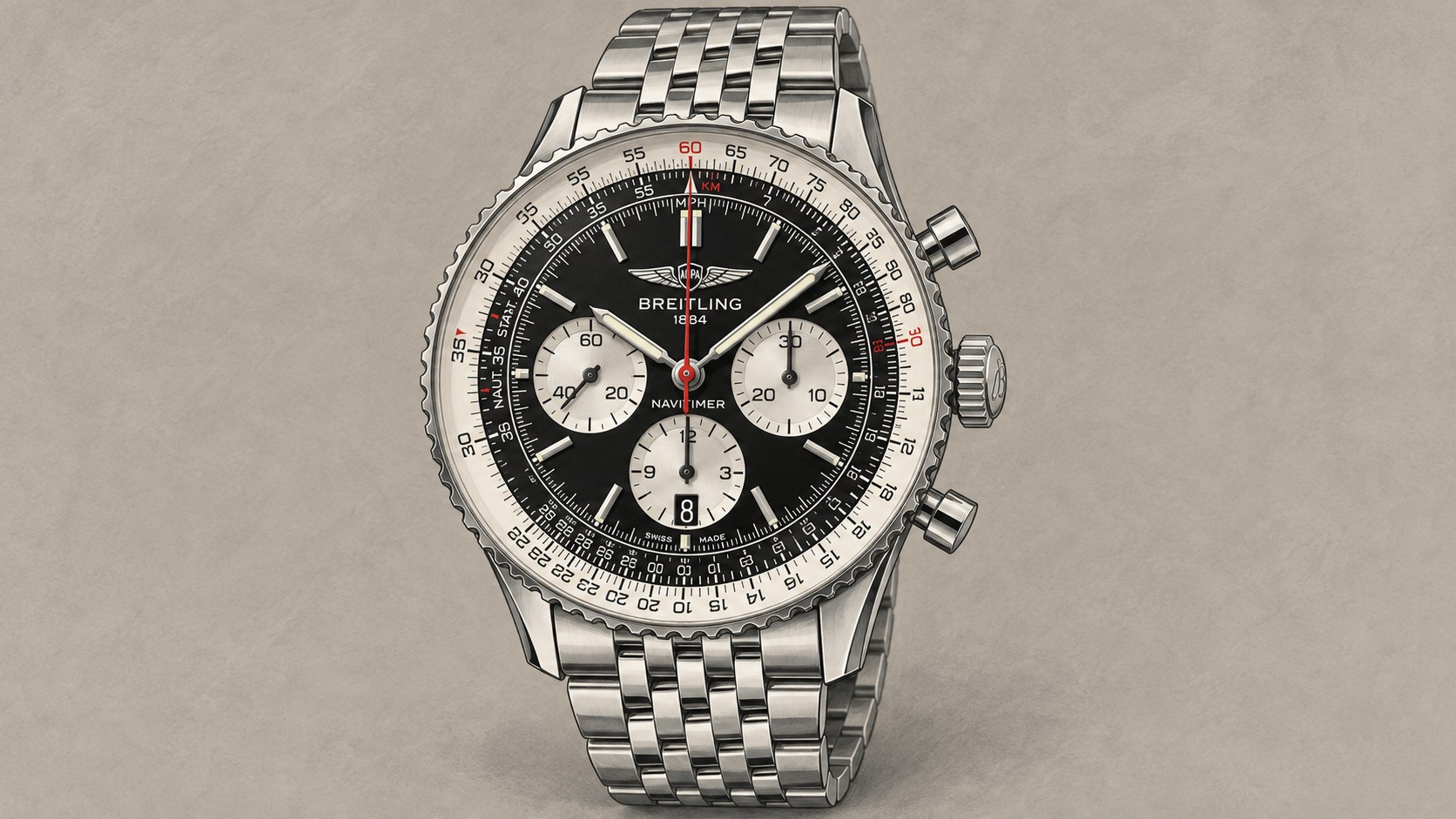
Breitling places the start of Navitimer’s development in 1952, when the Aircraft Owners and Pilots Association asked Willy Breitling for a chronograph for its members. He adapted the logarithmic slide rule used on the company’s earlier Chronomat watches of the 1940s to aviation calculations.
The rotating bezel made the scale accessible, while a large dial and contrasting markings supported reading it. Breitling’s account distinguishes the original AOPA-distributed watch from the public version released in late 1955 with Breitling branding. The early reference became known as 806. Development, distribution to a particular group and general release are separate milestones in that story.
What mattered was the relationship between functions. The chronograph could supply elapsed time; the calculating scale could relate it to speed or distance. The watch did not need to sense either quantity automatically. Its owner supplied the known values and interpreted the result.
What the logarithmic scales actually do
A slide rule spaces its numbers logarithmically, so adding a distance along the scale corresponds to multiplying numerical values. Wrapping the scales into a circle makes one rotate against the other. The mechanism is the positioning of the scales themselves, not a gear train hidden inside the movement.
Citizen’s U680 instructions give a simple multiplication example. Align 20 on the outer scale with 10 on the inner scale. The inner 15 then corresponds to an outer reading of 30; after assigning the decimal place, 20 multiplied by 15 gives 300. That last step is essential. The scale does not decide whether a reading represents 3, 30 or 300.
This makes the bezel an approximate calculating aid with a skill requirement. You need to know the operation, keep the units consistent and judge the scale reading. It is satisfying precisely because the arithmetic becomes a visible relationship. It does not acquire the precision of an electronic calculator merely by being attached to an expensive watch.
Timing and calculation remain separate in a modern Navitimer
Reference AB0139211B1A1 places the circular slide rule around a contemporary automatic chronograph. Its Breitling 01 movement offers approximately 70 hours of reserve, with elapsed-time counters for 30 minutes and 12 hours. The 41 mm steel case is 13.6 mm thick and has a sapphire display back.
The stopwatch pushers operate the chronograph. Turning the bidirectional bezel operates the calculating scale. Learning which task belongs to which control makes the busy display much easier to understand, even if the owner mostly uses the watch to tell the time.
Its 30-metre water-resistance specification also shows why a functional-looking bezel should not be confused with diving equipment. The Navitimer’s scale is not an elapsed-time dive bezel. Its markings and freedom to rotate in both directions serve a different purpose.
Citizen combines an analogue calculator with electronic timekeeping
Citizen’s Promaster history provides another route into the multifunction aviation watch. The brand was launched in 1989, and its 1994 Navihawk combined analogue and digital time displays with world-time functions. That history helps explain the layered display of later Skyhawk watches without claiming that every later feature belonged to the first model.
The Blue Angels Skyhawk A-T JY8078-52L uses the U680 Eco-Drive movement, adding light charging and radio-controlled time adjustment to an analogue/digital layout. Its rotating slide rule remains a separate, manually positioned calculating tool. Electronic time correction does not read the bezel or select the decimal place for its owner.
Citizen’s UK page lists a 46 mm case diameter, while its Canadian page lists 45 mm for the same reference. The table uses the UK figure; the discrepancy is worth checking when comparing an actual watch. Both pages identify a steel watch with anti-reflective sapphire and 200-metre water resistance.
Two current watches preserve the calculating idea
| Modern watch and reference | Case and crystal | Movement and timing | Slide rule and water resistance |
|---|---|---|---|
| Breitling Navitimer B01 Chronograph 41 AB0139211B1A1 | Steel; 41 × 13.6 mm; sapphire | Automatic Breitling 01; approximately 70 hours; 30-minute and 12-hour counters | Bidirectional circular slide rule; 30 metres |
| Citizen Blue Angels Skyhawk A-T JY8078-52L | Steel; 46 mm diameter in UK listing; AR sapphire | U680 Eco-Drive; analogue/digital; radio-controlled; approximately 6 months normal reserve | Rotating slide rule; 200 metres |
Their power arrangements differ considerably. Navitimer stores energy in a mainspring. Skyhawk stores light-generated energy in a rechargeable cell; Citizen quotes about six months of normal operation when fully charged, with a longer period possible under power-saving conditions. Neither source of power performs the slide rule’s arithmetic. The owner still moves one printed scale against the other.
For a prospective owner, the decisive question is whether those scales invite use or simply crowd the dial. Try a few harmless calculations from the manufacturer’s instructions and see whether the operation makes sense to you. A pilot-themed appearance can be enjoyed without pretending the watch replaces current flight planning or navigation equipment.
The slide rule survives because it is both a tool and an unusually legible piece of technical history. On Navitimer it sits beside a mechanical chronograph; on Skyhawk it shares the dial with solar and radio technology. The calculating principle remains visible in either setting, waiting for the wearer to turn the bezel.
Based on manufacturer information. Specifications checked on 8 September 2026.
Sources: Navitimer B01 41 specifications and origins; Citizen UK: JY8078-52L specifications and price; Citizen Canada: JY8078-52L specifications; Citizen: Promaster brand history; Citizen U680 instruction manual, including slide-rule calculations; Breitling: Navitimer development, AOPA and the 1955 public release.
Image: AI-generated editorial illustration of the Breitling AB0139211B1A1. Fine dial details and finishing may differ from the production watch.