A second time zone is easy to understand until you ask how a watch should be set. Should the ordinary hour hand move when you land somewhere new? Should the extra hand be the one you adjust? Could rotating a scale do the job without changing either hand? The history of the GMT watch includes answers to all three questions.
That makes it more interesting than a straightforward progression from professional equipment to luxury accessory. A rotating bezel, a separate 24-hour indication and an independently adjustable local hour hand are related ideas, but they did not all arrive together or become universal features.
Dual time existed before the familiar GMT bezel
Longines links the name of its current Spirit Zulu Time to a dual-time wristwatch it made in 1925. That earlier watch carried the Zulu flag on its dial. The connection is specific to Longines’s own history; it should not be turned into a claim that the modern L844 movement or the current Spirit case already existed a century ago.
The modern Spirit Zulu Time arrived in 2022, followed by the 39 mm version in 2023. Its historical name therefore joins two distinct periods: an early experiment in displaying more than one time and a contemporary mechanical travel watch. The present L3.802.4.63.6 combines a ceramic rotating bezel, a silicon balance spring and an independently adjustable local hour hand.
The 1955 GMT-Master made the bezel part of the display
Rolex introduced the GMT-Master in 1955 during the expansion of intercontinental air travel. Its additional hand completed one circuit of the dial in 24 hours. Read against a correspondingly graduated rotating bezel, that hand could show another time zone alongside the conventional hour and minute hands.
On the original movement, the ordinary hour hand and the 24-hour hand were linked. Rotating the bezel changed the relationship between the extra hand and its scale, allowing another zone to be read. The distinction between moving a hand and moving the scale beneath it is central to understanding the original arrangement.
A 24-hour display also carries information that an ordinary twelve-hour display leaves ambiguous. Six on the extra scale can mean morning and eighteen evening, without needing a separate day/night indication. The two-colour bezel became a recognisable visual feature, but the practical system depends on the graduations and the hand’s rate of rotation.
In 1982 the local hour became easier to change
Rolex dates the next major change to 1982. A new movement allowed the conventional hour hand to be adjusted independently of the minute and 24-hour hands. The watch using it became the GMT-Master II. A traveller could change local time in one-hour steps while leaving the reference time intact.
This changed the interaction more than the basic question the watch answered. It still displayed time elsewhere, but crossing a time zone no longer required the wearer to reorganise all the indications together. The current calibre 3285 in 126710BLNR-0002 preserves that principle, with the date linked to local time.
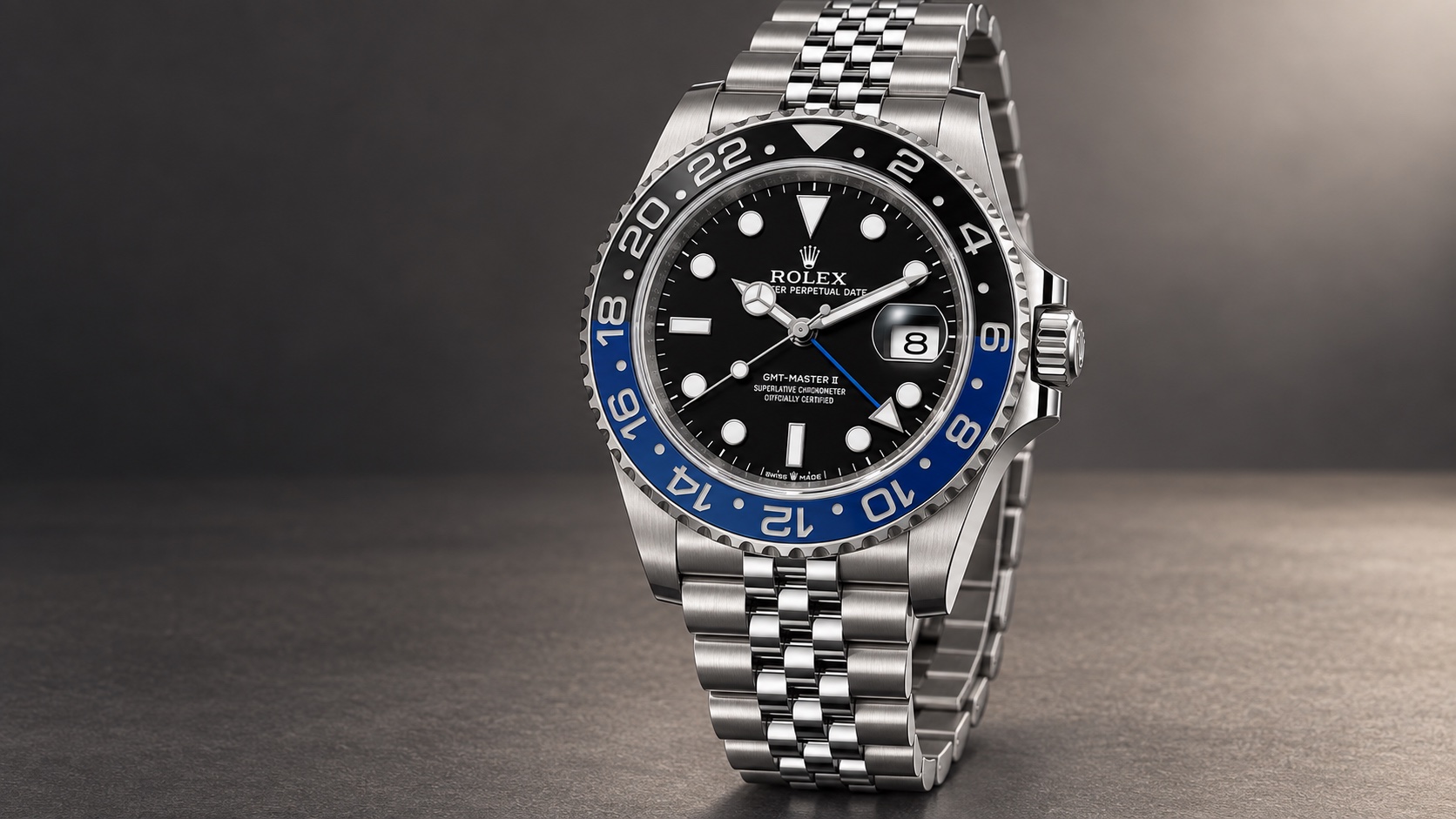
The bezel also continued to evolve as a physical component. Rolex introduced a Cerachrom ceramic insert to the GMT-Master II in 2005, with two-colour versions following in 2013. The selected modern reference uses blue and black ceramic. That material development is separate from the earlier change in how the hands could be set.
| Modern reference | Diameter | Movement | Independent adjustment | Reserve |
|---|---|---|---|---|
| Rolex 126710BLNR-0002 | 40 mm | 3285 automatic | Local hour hand | About 70 hours |
| Longines L3.802.4.63.6 | 39 mm | L844 automatic | Local hour hand | Up to 72 hours |
| Seiko SSK001K1 | 42.5 mm | 4R34 automatic | 24-hour hand | About 41 hours |
Another useful route: adjust the extra hand
Seiko’s 2022 introduction of the SSK GMT models brought the 4R34 to Seiko 5 Sports. On the SSK001K1, the 24-hour hand adjusts independently. This arrangement is convenient when the wearer stays in one place and wants to set another zone as a reference, perhaps for family or colleagues abroad.
It does not make the watch unable to travel. It means that changing the local time involves a different sequence from the independently jumping local hour of the Rolex or Longines. Calling one arrangement a traveller GMT and the other a caller GMT can be useful shorthand, provided those labels explain the setting method rather than prescribe who may own the watch.
The Seiko also shows that extra-zone information does not imply one standard package of materials or reserve. Its case is 42.5 mm across, the crystal is Hardlex and its stated reserve is approximately 41 hours. The 39 mm Longines lists up to 72 hours, while the 40 mm Rolex lists approximately 70. Their shared purpose should not conceal their different proportions and constructions.
Why the idea still makes sense
A GMT can remain useful without being the only available source of world time. It makes one chosen relationship visible whenever the wearer looks down. That can be home during a trip, a distant office during a working day or a reference zone used in a regular routine.
The historical development is therefore about reducing different kinds of effort: carrying two times on one wrist, distinguishing day from night, changing the reading with a bezel and eventually moving local time without disturbing the reference. Modern watches preserve different combinations of those solutions. Knowing which action each mechanism simplifies gives the history a practical meaning beyond the colour of the bezel.
Based on manufacturer information. Specifications checked on 8 September 2026.
Sources: Rolex BLNR specifications; Longines UK: Spirit Zulu Time L3.802.4.63.6; Longines L844 instruction manual; Seiko UK SSK001 specifications; Seiko 2022 GMT launch; Seiko 4R34 instruction manual; Longines 2023 release: Spirit Zulu Time 39 mm; Rolex GMT-Master history and independent local hour; Rolex GMT-Master development timeline; Rolex brochure: original linked hands and later adjustment; Rolex GMT-Master II setting instructions.
Image: AI-generated editorial illustration of the Rolex GMT-Master II 126710BLNR-0002 on Jubilee bracelet. Fine dial details and finishing may differ from the production watch.