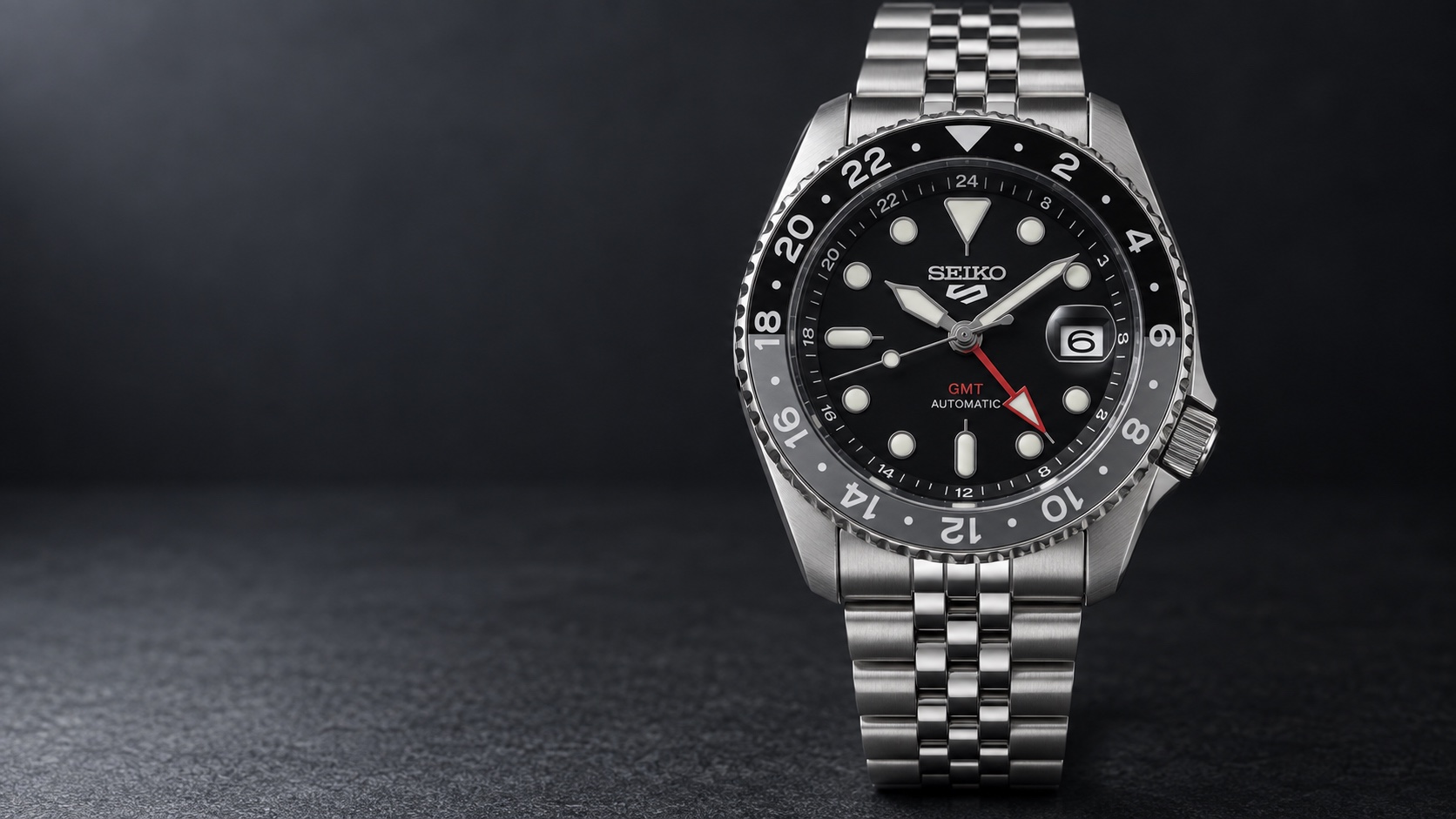
A second time zone does not require a flight. If your family lives overseas, your colleague starts work while you are eating dinner, or you regularly check whether it is too early to call, a GMT hand has a straightforward job. The Seiko SSK001 puts that information on an ordinary mechanical sports watch.
Its appeal is the combination, rather than one headline specification. You get a black dial, a conspicuous red extra hand and a steel bracelet, with enough visual detail to feel like a deliberate watch purchase. The important question is whether its particular way of setting two times matches how you will use them.
Based on Seiko’s published information. Specifications checked on 8 September 2026.
The reference at a glance
| Movement | 4R34 automatic with manual winding and stop seconds |
|---|---|
| Reserve | Approximately 41 hours |
| Case | Stainless steel; 42.5 mm diameter; 13.6 mm thick |
| Lug-to-lug | 46.0 mm |
| Lug width | 22 mm |
| Crystal | Hardlex with date magnifier |
| Water resistance | 10 bar |
| Weight | 161 g |
| Display | Hours, minutes, seconds, date and 24-hour hand |
| UK listed price | £430, checked 8 September 2026 |
Specification source: Seiko UK SSK001 specifications.
Why the GMT arrived in a familiar shape
Seiko announced this GMT series in June 2022, with availability from July. Its launch explanation connects the case and dial to the earlier SKX sports-watch family. The five-row bracelet was newly designed but also drew on that lineage, using polished central rows against the outer links. The result was a new complication inside an immediately recognisable visual language, rather than an attempt to invent a travel-watch identity from scratch.
That history helps explain the SSK001’s priorities. The rotating 24-hour bezel and contrasting GMT hand add information to an established everyday sports format. The older silhouette is a design reference, however, not a reason to assume identical water resistance or diving credentials. Seiko’s original announcement describes the actual 2022 watches and their specification.
Understand the hand before buying the watch
The 24-hour hand circles the dial once per day. Set it to the place you want to follow, then read it against a 24-hour scale: 18 means six in the evening. That makes the display more informative than an ordinary extra hour hand because it distinguishes morning from evening. Start with two places and a fixed bezel position before experimenting with additional offsets.
The key operational distinction is at the crown. Seiko’s 4R34 instructions put date and 24-hour-hand adjustment at the first click, and ordinary time adjustment at the second. The independently adjusted hand is the GMT hand. You do not get an independently jumping local hour hand that lets you change destination time while leaving the rest running undisturbed.
For someone following another country from home, that is a sensible arrangement. For frequent travel across zones, it means a little more setting work. Neither use makes the watch wrong; decide which operation you will actually repeat most often.
A broad watch with relatively short reach
Do not reduce the fit decision to 42.5 mm. The published 46.0 mm lug-to-lug length is a separate and useful measurement: it describes the case’s reach along your wrist. The 13.6 mm thickness describes something else again, particularly relevant if your sleeves fit closely. A wrist circumference alone cannot tell you how those proportions will sit.
When trying it on, look at the bracelet’s first links as well as the case. Check whether they bend where your wrist begins to curve, then look at the clasp underneath. The listed weight is for the supplied watch, not a personal measurement after sizing. Removing links will change it.
The date magnifier is another preference to settle in person. It deliberately interrupts the otherwise symmetrical crystal surface. Some buyers want that visual emphasis; others would rather have an unobstructed view of the whole dial. Product photographs cannot settle that choice for your eyes.
The ownership compromise is time, not just money
A fully wound 41-hour reserve covers an overnight break comfortably on paper, but it is shorter than a typical Friday-evening-to-Monday-morning gap. If this is your weekday watch, expect occasional winding and resetting after a weekend off. That includes checking the date and the second time zone, not merely moving the minute hand.
Hardlex is the specified crystal, and 10 bar is the stated water resistance. Buy those actual specifications rather than upgrading them in your mind because the watch resembles a diver. A mechanical movement also means that displaying two zones does not make it an automatically synchronised travel instrument. The GMT hand follows the same timekeeping mechanism as the ordinary hands.
The simpler alternative, and the verdict
If the extra hand is mainly an attractive red detail, compare the Seiko SRPK29 before committing. Its 38 mm case and day-date display offer a smaller, simpler version of the Seiko 5 Sports idea. Seiko lists it at £310 against £430 for the SSK001, both UK figures checked on 8 September 2026. The difference buys a function and a different physical package, not just another dial design.
Choose the SSK001 if a second time zone will earn its place on your wrist and you like the broader bracelet-watch format. Choose the smaller Seiko if you want the style without another setting to maintain. Frequent travellers who specifically want an independently adjustable local hour should establish that requirement first, then shop for that mechanism. The SSK001 makes the most sense when its extra hand answers a question you already ask.
Image: AI-generated illustration. Fine details may differ from the watch.


