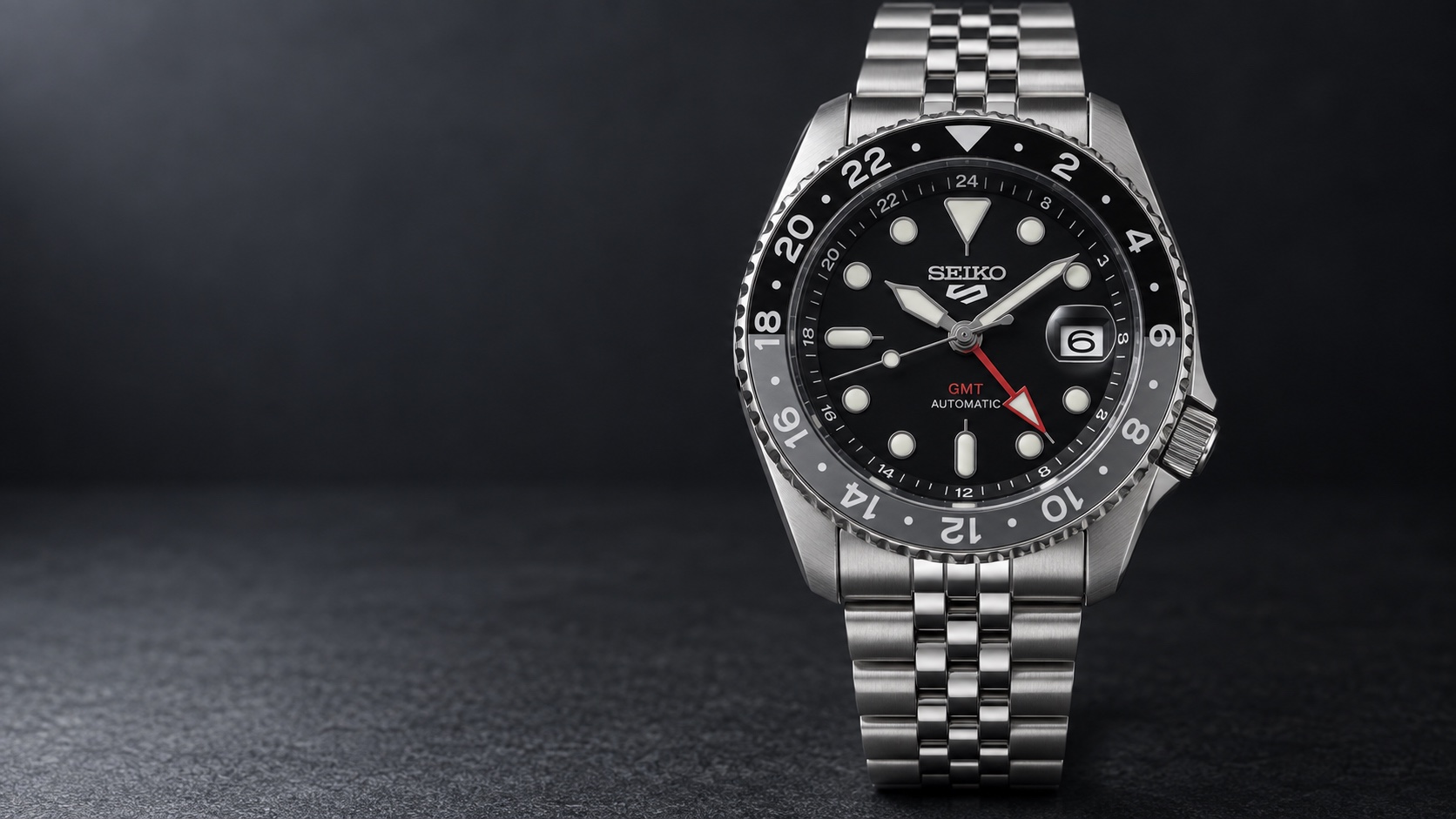
A GMT answers a question that keeps changing while you do nothing: what time is it somewhere else? A chronograph answers a question you deliberately start asking: how long has this taken? That distinction is more helpful than deciding which complication looks more sophisticated.
If you regularly work with colleagues overseas, the extra hand of a GMT may earn its place every weekday. If you want to measure short activities, the stopwatch of a chronograph has the more direct purpose. If neither happens often, liking the appearance is still a valid reason to buy either watch. It simply helps to be honest about what you are buying.
The histories explain the different controls
Rolex introduced the GMT-Master in 1955 in response to the needs of intercontinental aviation. The modern GMT-Master II continues that connection through a 24-hour hand and a bezel for reading another zone. Seiko’s SSK001K1 brings a GMT function to the Seiko 5 Sports family through the 4R34 movement, with a different adjustment arrangement. Breitling’s Premier line began in 1943 under Willy Breitling, combining a chronograph with a more civilian, elegant presentation. The current Premier B01 retains that approach through its smooth bezel, applied numerals and rectangular pushers. A pilot’s rotating bezel and a stopwatch’s pushers do different jobs; the historical associations should help explain those jobs rather than replace a practical reason to want them.
| Exact reference | Case diameter | Extra function | Movement / reserve | Water resistance |
|---|---|---|---|---|
| Rolex GMT-Master II 126710BLNR-0002 | 40 mm | Local-hour adjustment; 24-hour hand and bezel | 3285 automatic / about 70 hours | 100 m |
| Seiko SSK001K1 | 42.5 mm | Independently adjustable 24-hour hand | 4R34 automatic / about 41 hours | 10 bar |
| Breitling Premier AB0145331K1P1 | 42 mm | Chronograph with 30-minute counter | B01 automatic / about 70 hours | 100 m |
When the GMT earns its extra hand
Imagine keeping track of home while spending a week abroad. The Rolex lets you move the local hour hand in one-hour steps without having to reset the minute hand and reference time. The 24-hour hand can continue to represent home. That is particularly convenient when you repeatedly cross time zones and want the ordinary hands to show where you are now.
The Seiko takes another approach. Its 24-hour hand adjusts independently, which is useful when you stay in one place and set that hand to a colleague’s time zone. It can still travel; the different mechanism changes the setting procedure, not your permission to take it on a flight. Both watches require you to understand the 24-hour scale, especially when you need to know whether a distant contact is likely to be awake.
The Seiko is also a different physical proposition: 42.5 mm wide and 13.6 mm thick, with Hardlex crystal and approximately 41 hours of reserve. The Rolex is 40 mm wide, uses sapphire and has about 70 hours of reserve. Do not let the shared GMT label suggest that the cases, bracelets or setting routines will feel alike.
When a stopwatch is the more useful tool
The Premier’s central chronograph hand and 30-minute counter suit deliberate elapsed-time checks. You start the chronograph at the beginning of an activity, stop it at the end and read the result. Its scale is marked to a quarter of a second, but the precision of a human pressing a pusher remains part of any real measurement. A finer-looking dial does not remove reaction time.
This exact Premier does not provide a separate 12-hour chronograph counter. That matters if your imagined use involves recording an entire working day. Do not transfer the counter layout of another Breitling B01 watch to this reference simply because both use the same movement family. The Premier also includes a date, and its 42 mm case is 13.6 mm thick.
A chronograph creates a little ritual: starting, stopping, reading and resetting. A GMT can provide information continuously after its initial setup. Consider which interaction sounds useful. Timing a presentation is a different habit from glancing at the time in another office before making a call.
Try the function as well as the watch
Ask to see the setting procedure demonstrated with the exact reference’s instructions. On a GMT, follow both hour displays until you can explain what each hand represents. On the Premier, locate the running seconds and the chronograph indications so that you do not mistake a stationary stopwatch hand for a stopped watch.
Then return to fit. The Premier uses a brown alligator strap rather than the steel bracelets of these two GMT references. That can matter as much as the extra function when deciding what you will wear through the working week. All three are automatic, so reserve and resetting remain relevant if you rotate watches.
Choose a GMT for a regular relationship with another time zone. Within that choice, the Rolex’s local-hour adjustment and the Seiko’s adjustable 24-hour hand favour different setting habits. Choose the Premier if short elapsed-time measurements, its pusher interaction and its dressier chronograph design appeal more. The most useful complication is the one whose information you actually want to read.
Based on manufacturer information. Specifications checked on 8 September 2026.
Sources: Rolex BLNR specifications; Rolex GMT-Master origins; Seiko UK SSK001 specifications; Seiko 2022 GMT launch; Seiko 4R34 instruction manual; Premier B01 42 exact specifications; Breitling Premier origins in 1943.
Image: AI-generated illustration. Fine details may differ from the watch.


