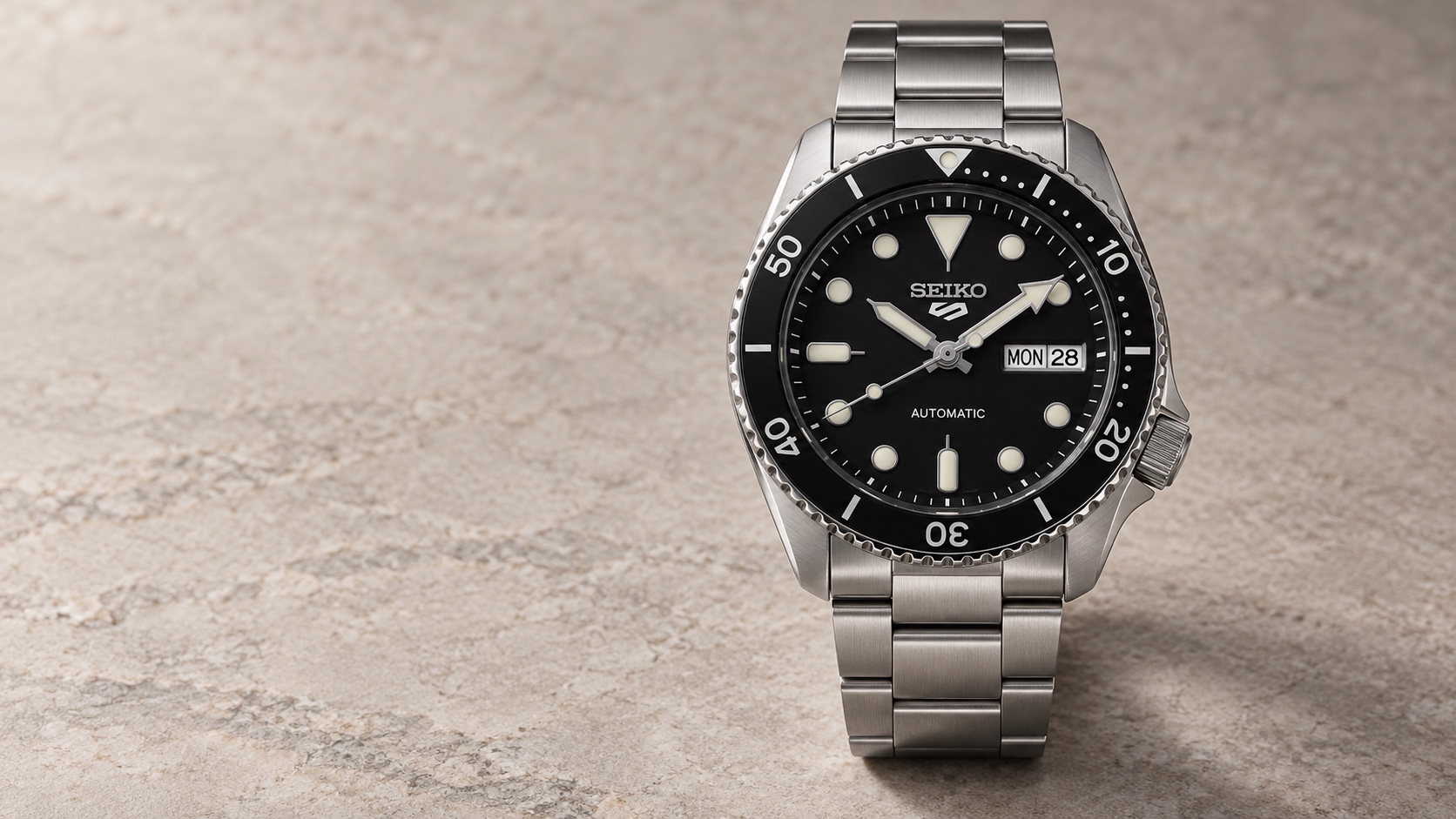
Perhaps you like a rotating bezel, broad hands and a steel bracelet, but every sports watch you try seems to occupy the whole top of your wrist. The Seiko SRPK29 addresses that specific problem. Its 38 mm case keeps the familiar Seiko 5 Sports look while reducing the overall package.
Smaller does not automatically mean better. It also changes the space available for the dial, the apparent width of the bracelet and how much presence the watch has against a jacket or jumper. The SRPK29 is worth considering because those proportions suit a different preference, not because 38 mm is a universally correct size.
Based on Seiko’s published information. Specifications checked on 8 September 2026.
The reference at a glance
| Movement | 4R36 automatic with manual winding and stop seconds |
|---|---|
| Reserve | Approximately 41 hours |
| Case | Stainless steel; 38.0 mm diameter; 12.1 mm thick |
| Lug-to-lug | 44.2 mm |
| Lug width | 20 mm |
| Crystal | Hardlex |
| Water resistance | 10 bar |
| Weight | 140 g |
| Display | Hours, minutes, seconds, day and date |
| UK listed price | £310, checked 8 September 2026 |
Specification source: Seiko UK SRPK29 specifications.
A sports-watch family that has already changed direction
Seiko’s design history traces the original Sportsmatic 5 to 1963 and Seiko 5 Sports to 1968, when a growing interest in sport helped shape the collection. The company renewed Seiko 5 Sports in 2019 with a stronger emphasis on contemporary casual style. Its own designers discuss that shift as a response to changing tastes, rather than a requirement to reproduce every old watch feature.
The SRPK29 belongs in that evolving story. Its compact case offers another way into the same recognisable sports-watch vocabulary, with the day-date display still serving an everyday purpose. That is a more useful historical connection than treating an old model nickname as a technical specification. Seiko’s designers explain the collection’s development and the thinking behind its modern role.
Look at the whole outline
The 44.2 mm lug-to-lug length deserves as much attention as the diameter. It tells you how far the case extends along the wrist, while the 12.1 mm height helps you judge clearance under a sleeve. Neither number includes an assessment of your wrist shape, so use them to choose what to try, rather than to predict an exact fit from circumference.
A bezel occupies some of the visible face. On a smaller watch that leaves a relatively concentrated dial, which can be appealing if you prefer a compact instrument-like layout. Someone who wants an expansive, open display might find the same design less satisfying. Check the day and date at your normal reading distance instead of examining them only up close.
Ask for the bracelet to be positioned close to your likely size. A loose display watch can slide away from the position where you would actually wear it. Check the clasp beneath the wrist and whether the bracelet articulates where you need it to. The 20 mm lug width is useful if you later consider a conventional replacement strap.
The ordinary complication that earns its place
A day-date display is especially useful when your routine has slipped out of the usual pattern: a holiday, shift work or a long weekend. It answers two small questions without using another hand or a separate screen. If you regularly lose track of the day, that can be more relevant than a more elaborate complication.
There is a little work attached. The calendar does not know which months end before the thirty-first, so it needs manual correction. Seiko’s 4R36 operating instructions also caution against quick-setting the calendar while the watch displays between 9 pm and 4 am. Learn the setting sequence when you buy it rather than discovering it after the first month change.
The movement can be wound by hand and its seconds hand can be stopped for setting. Those are useful controls, but the approximately 41-hour reserve still makes this a watch that benefits from regular wear. A full weekend in a drawer can leave it stopped before Monday.
Sporting appearance, specific limits
The unidirectional bezel gives the watch a practical elapsed-time marker. You can line it up with the minute hand to keep track of a short task without operating the movement. It does not provide an alarm, so you still need to remember to look. That distinction matters more for cooking or parking than any debate about whether a bezel looks sufficiently purposeful.
The published water resistance is 10 bar and the crystal is Hardlex. The SRPK29 sits in Seiko 5 Sports, while Seiko separately identifies its diving models and their specifications. Treat this as the compact everyday sports watch it is presented as. If scuba use is the reason for the purchase, start with an explicitly specified diver rather than assuming that a rotating bezel settles the issue.
What to compare, and who should buy it
The Seiko SSK001 GMT is a revealing comparison. It is 42.5 mm across and 46.0 mm lug-to-lug, with a second time zone in place of the SRPK29’s simpler emphasis. Comparing the two shows why diameter and overall reach must be considered together: the difference in width is larger than the difference in length. Their £430 and £310 UK listed prices were checked on 8 September 2026.
Choose the SRPK29 if a smaller case, a useful calendar and an uncomplicated sports-watch appearance are your priorities. It also suits someone who already owns a larger watch and wants a clear change in proportions. Pass if you want a broad dial, automatic time correction or an explicitly designated dive watch. The right reason to buy the SRPK29 is that its proportions and functions fit your routine, not that a smaller diameter wins a specification contest.
Image: AI-generated illustration. Fine details may differ from the watch.


