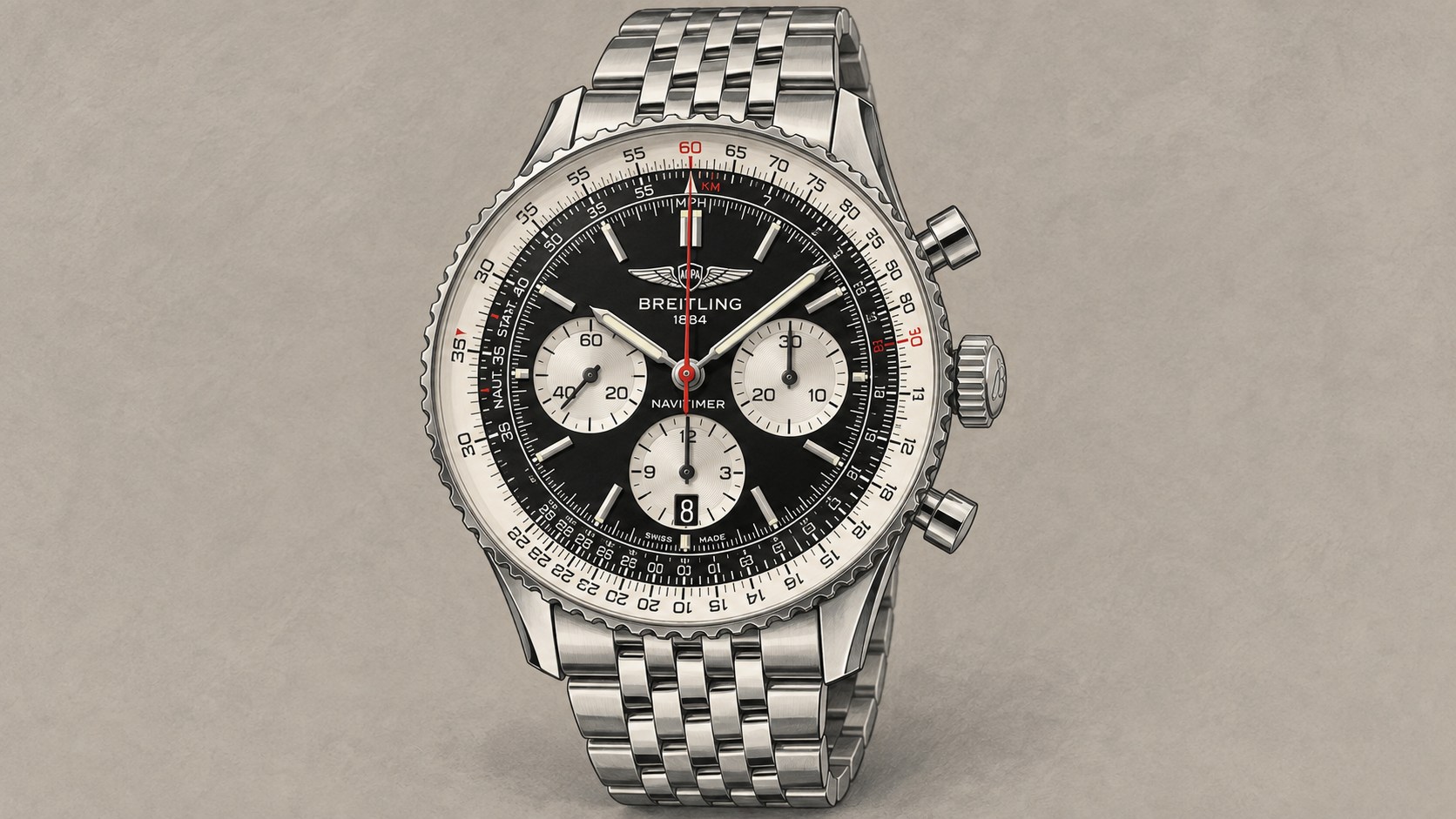
A Navitimer and Portugieser can both be forty-one-millimetre automatic chronographs without remotely resembling the same watch. Breitling surrounds three contrasting counters with a circular slide rule. IWC gives two vertically aligned registers a much broader, quieter silver background.
Choose the Navitimer if the dense calculator dial is a feature you want to explore and enjoy. Choose the Portugieser if the timing function appeals more when framed by open space, Arabic numerals and blue hands. The shared diameter is a useful control in this comparison: it makes the different uses of that space especially obvious.
The references compared
| Feature | Navitimer B01 41 | Portugieser Chronograph |
|---|---|---|
| Reference | AB0139211B1A1 | IW371605 |
| Diameter / thickness | 41mm / 13.6mm | 41mm / 13.0mm |
| Movement | Automatic Breitling 01 | Automatic IWC 69355 |
| Reserve | Approximately 70 hours | 46 hours |
| Timing counters | 30 minutes; 12 hours | 30 minutes |
| Dial | Black; three silver counters; date | Silver-plated; two vertical counters; no date |
| Outer scale | Circular slide rule | Fine minute scale |
| Water resistance | 3 bar | 3 bar |
| Attachment | Seven-row steel bracelet | Blue alligator strap |
Two histories behind the decision
Breitling dates the Navitimer to 1952, with its circular slide rule serving the aviation calculations central to the design. The Portugieser family began in 1939, but its chronograph story developed later, including the rattrapante of 1995 and the regular chronograph of 1998. Those histories should not be collapsed into a claim that the current IWC layout has existed since the family’s first year. The modern comparison reflects two different priorities within established watch families. Breitling retains a visibly specialised calculating instrument; IWC adapts the broad dial and numeral vocabulary of the Portugieser to a restrained chronograph arrangement. Their historical identities explain why similarly sized cases contain such different amounts of visible information.
The slide rule needs to be part of the attraction
The Navitimer’s concentric scales are not merely a decorative substitute for an ordinary bezel. They form a circular calculating system, adding a second set of interactions around the elapsed-time mechanism. Someone who enjoys that kind of analogue instrument has a clear reason to choose the Breitling.
Someone who wants a chronograph chiefly for its counters may find those scales visually unnecessary. The Portugieser leaves more space between its slim outer markings and the centre of the face. Neither preference requires a judgement about whether the owner is sufficiently technical. The question is whether a calculating bezel adds interest or clutter to the object you want to read.
The hour counter is a practical Breitling distinction
The Navitimer provides elapsed minutes and hours in addition to running seconds. The Portugieser’s vertical arrangement combines a thirty-minute chronograph register with small running seconds. It does not offer a separate elapsed-hour counter.
That makes the Breitling more immediately informative for longer timed events. The IWC compensates visually by giving its two registers more breathing room. If you never want to track elapsed hours, the omitted counter may be part of the cleaner design you prefer. If an hour total is one of your reasons for buying a mechanical chronograph, the difference should be settled before appearance alone chooses the winner.
A calendar and longer reserve, or an uninterrupted face?
Breitling’s B01 offers approximately seventy hours of reserve, compared with the IWC’s forty-six. The Navitimer also includes a date, while this Portugieser does not. These are useful, concrete benefits if a calendar and longer time off the wrist fit your expectations.
The IWC’s no-date composition remains a positive choice for someone who wants the broad silver dial kept free of another aperture. Its vertical counters and blue numerals create a particular symmetry which adding a date could change. A more extensive function list does not automatically create the more appealing face, especially when the visual arrangement is the main reason for considering the watch.
The bracelet changes the complete comparison
The selected Navitimer arrives on its characteristic seven-row steel bracelet. The IWC uses blue alligator, allowing the silver dial and polished case to stand apart from a darker attachment. Their equal diameters therefore conceal very different complete objects.
Choose the Navitimer when the calculating scales, contrasting counters, hour register and bracelet form the chronograph you want. Choose the Portugieser when the open silver face, blue numerals, vertical registers and leather strap feel more resolved. Both carry a three-bar rating in these references, so neither should be selected on an assumption that a sporting story guarantees a higher depth specification. The decisive differences are already visible in the designs and their timing layouts.
Specifications and sources checked on 8 September 2026. Navitimer exact specifications; Navitimer history; Portugieser exact specifications; Portugieser development.
Image: AI-generated editorial illustration of the Breitling AB0139211B1A1. Fine dial details and finishing may differ from the production watch.


