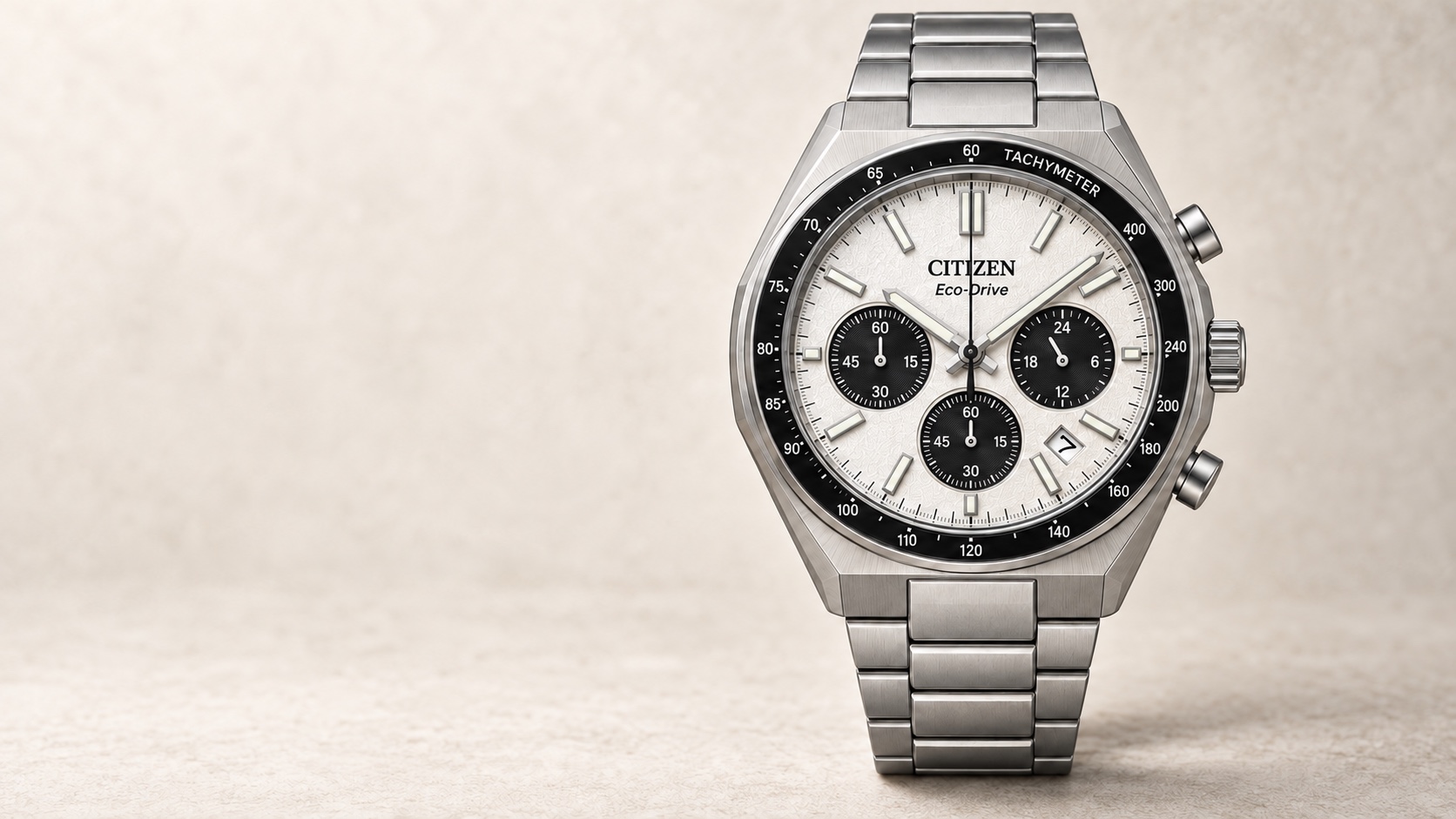
Three small dials do not necessarily mean three elapsed-time counters. A chronograph can devote one register to running seconds, another to a 24-hour indication and only one to accumulated minutes. Before choosing the face you like, find out which parts move when you press start.
The Breitling Navitimer B01 41, Citizen Zenshin CA4610-85A and Bulova Lunar Pilot 96K111 make that distinction useful. They offer different timing capacities and different ways of presenting fractions of a second, while their movements introduce separate ownership routines.
Start with the job of each indication
| Exact reference | Case diameter | Chronograph indication | Power | Important extra display |
|---|---|---|---|---|
| Breitling AB0139211B1A1 | 41mm | Quarter-second scale; 30-minute and 12-hour counters | B01 automatic; about 70h | Circular slide rule and date |
| Citizen CA4610-85A | 42.5mm, Europe; 42mm, UK | 1/5-second steps; up to 60 minutes | B620 Eco-Drive | 24-hour indication and date |
| Bulova 96K111 | 43.5mm | 1/20-second register; 60-minute counter | NP20 battery quartz | Running seconds; no date |
The Citizen size difference is a regional listing discrepancy, retained rather than silently resolved. More importantly for this comparison, its 24-hour hand follows the ordinary time; it does not make the Zenshin a separately adjustable second-time-zone watch.
The history explains why the faces are busy
Breitling developed the Navitimer in 1952 by combining a chronograph with a circular slide rule, giving the surrounding numbers a genuine calculating purpose. Bulova’s lunar connection centres on a chronograph worn during Apollo 15 in 1971, although the modern Lunar Pilot uses a different quartz mechanism. Citizen’s Zenshin arrived as a contemporary titanium collection in 2024. Its chronograph brings contrasting registers into a more current material-led design. Those backgrounds explain three different reasons to enjoy the face, without proving that any one layout will be easiest for your eyes.
Long intervals favour the Navitimer
The B01’s 30-minute and 12-hour counters let the Navitimer display intervals extending well beyond an hour. That matters if you want to time a longer journey or event without mentally counting repeated circuits of a minute register. The quarter-second scale is another part of the display, not a guarantee that your thumb can start and stop an event with quarter-second accuracy.
The circular slide rule remains separate from the chronograph’s job. It can perform calculations, but the extra scales also occupy visual space. If you only want to time short tasks, decide whether learning or looking at that calculator is a positive part of the purchase. It does not become useful merely because it is historically important.
The Citizen separates timing from a familiar daily display
The CA4610’s B620 chronograph measures up to 59 minutes and 59.8 seconds, then stops automatically after an hour of continuous operation. The 1/5-second chronograph hand, minute counter and ordinary running seconds have distinct roles. A full hour is a practical limit to understand before expecting the watch to record an entire afternoon.
The textured light dial and dark registers make the small indications visually prominent. That does not mean all of them concern the stopwatch. Learn the 24-hour display alongside the date and ordinary time, then practise reading an elapsed interval without confusing those functions.
Eco-Drive supplies energy from light. The titanium case and bracelet have a published European weight of 101g, offering another reason to choose the Citizen beyond its counter arrangement. Its official UK price was £499 on 8 September 2026.
The Bulova puts fractional seconds in a separate place
The Lunar Pilot’s 1/20-second register, 60-minute counter and running-seconds display divide the information differently. Its central large seconds hand serves the chronograph, while normal seconds continue in a smaller register. A stationary central hand can therefore be entirely normal when the stopwatch is not running.
The NP20’s 262kHz oscillator describes the quartz movement, while the 1/20-second indication describes what the chronograph displays. Those numbers should not be treated as the same measurement. For everyday intervals, clear elapsed minutes are often more useful than a smaller fraction you rarely need.
The exact 96K111 includes a steel bracelet and an additional black leather NATO-style strap. Bulova listed £599 in the UK at the check. Its 43.5mm diameter also makes fitting part of the decision, regardless of how appealing the dial looks enlarged on a screen.
Test the reading task you intend to use
Ask to start, stop and reset the watch, then read a short accumulated interval at a normal distance. Check which hand records ordinary seconds and where the elapsed minutes appear. A demonstration of those simple actions reveals more than memorising a list of subdial positions.
Choose the Navitimer for longer timing capacity and the calculator-rich design. Choose the Citizen for light-powered operation and its titanium package, accepting the one-hour limit. Choose the Bulova for its particular quartz chronograph display and lunar-associated design. The best layout is the one you understand without repeatedly reconstructing what each hand is doing.
Based on manufacturer information. Specifications checked on 8 September 2026.
Sources: Navitimer B01 41 specifications and origins; Citizen UK: CA4610-85A; Citizen Europe: CA4610-85A; Citizen: Zenshin 2024 introduction; Citizen: B620 instruction manual; Bulova UK Lunar Pilot 96K111; Bulova global 96K111 calibre and technical details; Bulova Apollo 15 anniversary account; Bulova Lunar Pilot simplified chronograph instructions.
Image: AI-generated illustration. Fine details may differ from the watch.


