Based on Bulova’s published information. Specifications checked on 8 September 2026.
The Lunar Pilot 96K111 makes most sense when you want a chronograph with a space story that can wait in a drawer without needing to be wound. Bulova pairs a historically recognisable design with a modern high-frequency quartz movement. That combination offers a different ownership experience from a mechanical Omega Moonwatch, even though photographs invite an immediate comparison.
At £599 on Bulova’s UK site when checked, the question is whether the watch itself appeals after the lunar association has caught your attention. Its black dial, broad case and unusual pushers need to work for you on an ordinary Tuesday. History is a reason to look; fit and the movement are reasons to keep it.
The event behind the name
Bulova’s lunar connection centres on Apollo 15 and 2 August 1971, when a Bulova chronograph was worn on the Moon. The brand’s anniversary account celebrates that mission rather than claiming this modern quartz movement travelled there. That distinction gives the current watch a more interesting identity: it translates a historical instrument into something easier to own today. The 96K111 belongs to Bulova’s Archive Series and its official listing dates this version to February 2023. Bulova describes the 43.5mm case as matching the original chronograph’s diameter. Earlier modern Lunar Pilots also remain in the range, so the collection name does not identify one size or dial layout. Check 96K111 on the offer if this is the version you intend to buy.
What the 96K111 includes
The UK product page establishes the price and configuration; Bulova’s global specification identifies the NP20 calibre and 20mm lug width.
| Specification | Lunar Pilot 96K111 |
|---|---|
| Case diameter | 43.5mm |
| Case and bracelet | Stainless steel |
| Movement | NP20 high precision quartz |
| Quartz frequency | 262kHz |
| Chronograph | 60 minutes; 1/20-second register |
| Crystal | Sapphire with anti-reflective treatment |
| Water resistance | 50 metres |
| Lug width | 20mm |
| Included alternative strap | Black leather NATO-style strap |
| Official UK price, 8 September 2026 | £599 |
Why quartz is part of the attraction
The NP20 runs from a battery, so timekeeping does not depend on wearing or winding the watch. If you alternate among several watches, that is a substantial convenience. Pick it up, check the time and put it on. There is no date on this reference to correct after a short month.
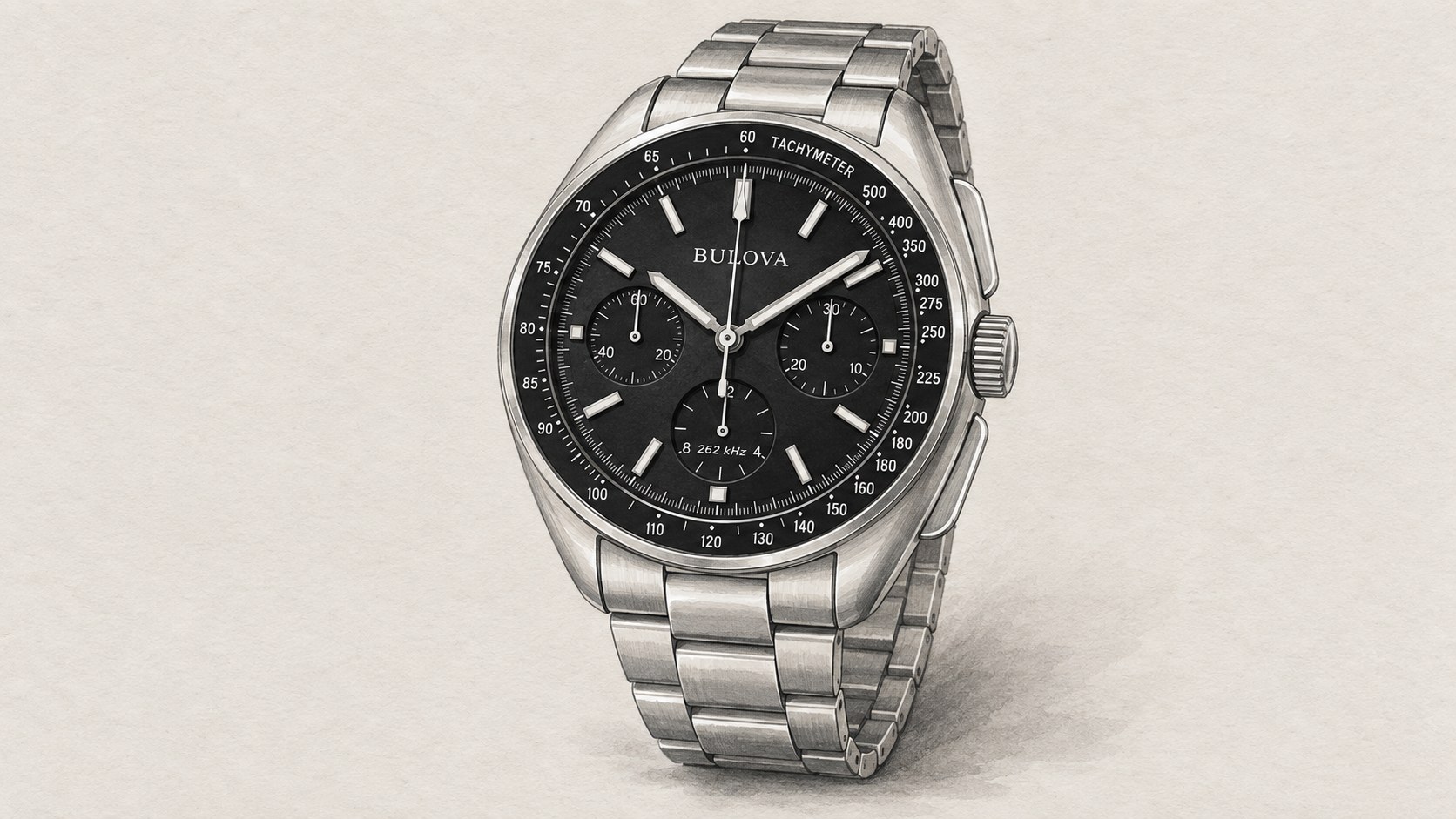
Bulova’s 262kHz figure describes the quartz oscillator, not how many divisions you can read on the dial. The chronograph offers a separate 1/20-second register, with elapsed minutes at nine o’clock and ordinary running seconds at six. The large central seconds hand serves the chronograph. Someone expecting that prominent hand to move constantly should understand the layout before assuming it has stopped working.
The brand’s chronograph guide explains the start, stop and reset sequence. In practice, a minute register suits timing a cooking stage, a journey segment or a meeting. Reading tiny fractional divisions and pressing a button at exactly the right instant are different tasks; the displayed resolution does not make a person’s timing equally precise.
The Moonwatch comparison needs an exact Omega
Take the Speedmaster Moonwatch Professional 310.32.42.50.04.001 as the mechanical comparison. Omega’s official manual specifies a 42mm steel watch on a rubber strap with manually wound calibre 3861, a 50-hour power reserve and 5-bar water resistance. The Lunar Pilot has the larger stated diameter, while the Omega introduces a regular winding routine. Neither figure alone decides how the complete watch will sit on a wrist.
If the purpose of buying is to enjoy a mechanical chronograph, the Bulova will not supply that experience merely because its dial occupies similar territory. Conversely, if you want a ready-to-wear chronograph with a legitimate historical connection, choosing quartz is entirely consistent with the brief. Compare the movements as objects you will live with, rather than treating one as a temporary substitute for the other.
The Bulova also deserves a fitting in both supplied configurations. A bracelet must be sized properly; a pass-through leather strap changes the way the watch rests above the wrist. Check the crown and pushers with your hand bent, and view the watch at normal conversational distance. A close-up photograph can make a large case seem less consequential than it is.
Ownership and the other useful comparison
A battery-powered chronograph still needs maintenance. Arrange battery replacement when required and have the seals assessed if you intend to use the watch around water. The included leather strap is best kept away from prolonged soaking. The sapphire crystal helps resist everyday scratching, but the bracelet and case will acquire wear of their own.
For an alternative centred on convenience, consider the Seiko Speedtimer SSC813, sold in the UK as SSC813P1. Its 39mm case and V192 solar chronograph change two major parts of the proposition: a smaller diameter and light-powered charging. That is a useful comparison if those practical differences matter more than the Bulova’s lunar association.
Choose the 96K111 if its wide black dial, supplied strap options and quartz readiness are what you want. Choose a mechanical Moonwatch because you want the Omega and its winding experience. The Lunar Pilot is easiest to appreciate when it is bought for its own combination of character and convenience.
Image: AI-generated editorial illustration of the Bulova 96K111. Design details are approximate; this is not a product photograph.


