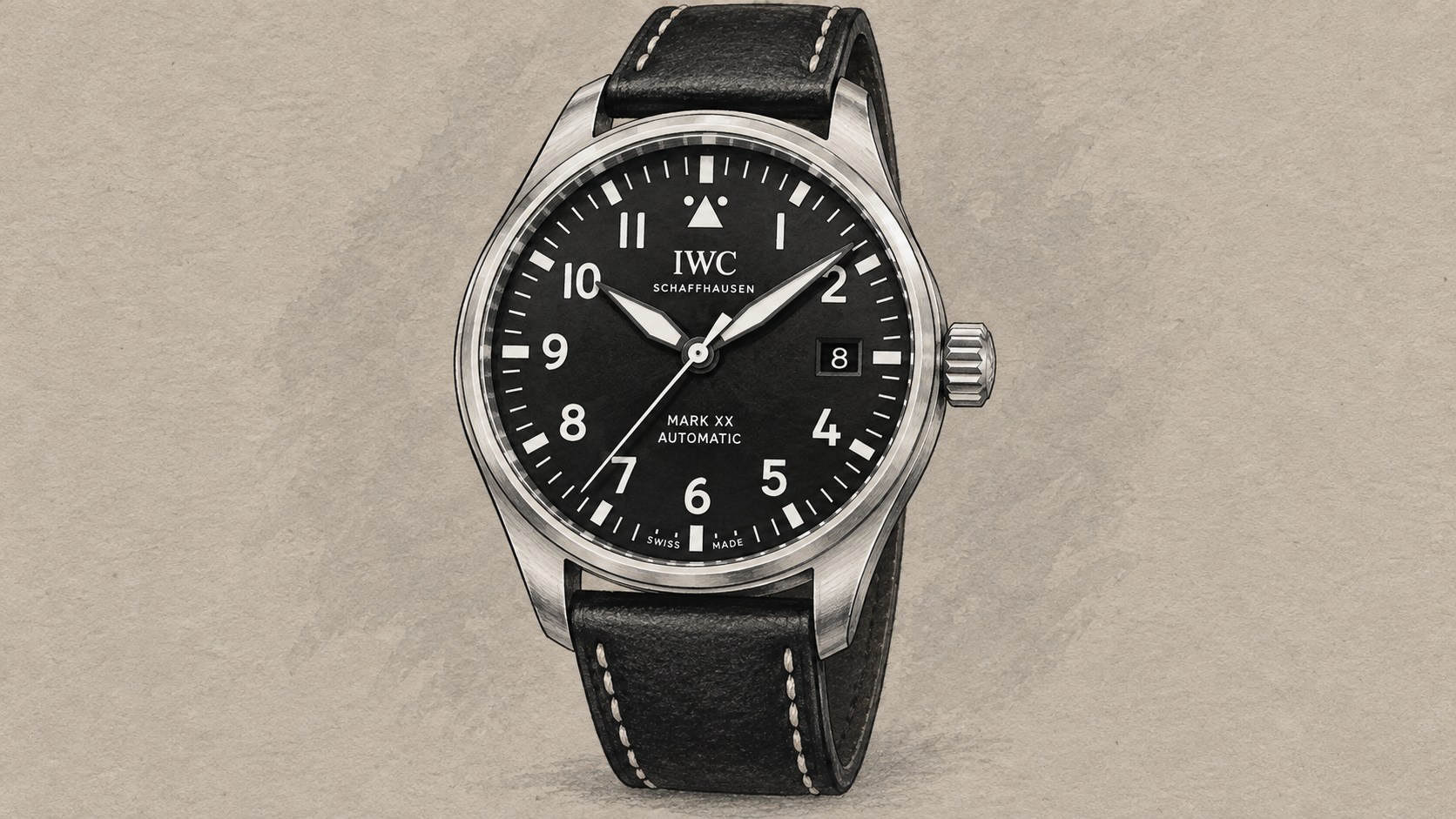
Put an IWC Mark XX beside a Breitling Navitimer and the term pilot watch starts to look less like a single design category. One gives the hands and numerals almost the whole dial. The other surrounds its chronograph with a small circular calculator. Both have an aviation lineage, but their faces solve different problems.
The history becomes clearer when we ask what a wearer needed to do: find the time quickly, orient the dial, measure an interval or calculate a relationship between speed, distance and time. Familiar features then become decisions about information rather than a collection of decorative aviation symbols.
Moving useful time onto the wrist
Hamilton’s museum account describes an early wristwatch from 1918 intended for pilots and soldiers, with simple wire lugs characteristic of the period. Its watches timed the first United States airmail service between New York, Philadelphia and Washington, DC. The change from pocket to wrist mattered because the display became accessible without first taking a watch out of clothing.
That is a more useful starting point than assuming every early aviator wore a watch resembling a modern black-dial automatic. Hamilton’s current H64615135 is a 42 mm steel watch with a day and date, sapphire crystal and an 80-hour H-40 movement. Those specifications belong to a contemporary product. The historical continuity is the interest in accessible information, not an unchanged case or movement.
Make the hands distinguishable before adding information
IWC’s Mark 11, introduced in 1948 for the British Royal Air Force, provides a different thread. In its historical account, IWC describes requirements including accuracy, robustness and ease of maintenance. A short, substantial hour hand and a more slender, pointed minute hand helped distinguish the two indications. The design did not depend solely on making every element equally large.
That distinction still matters on a modern dial. A watch with generous numerals can be harder to interpret if the hands disappear against them. Contrast, hand shape and hierarchy work together. A prominent minute hand helps when a user needs the exact minute; a distinctive hour hand prevents a quick glance from becoming a small decoding exercise.
IWC also dates the Mark 11’s triangle in place of the twelve numeral to deliveries from 1952 onwards. This is a reminder that even a supposedly archetypal pilot dial developed over time. The current Mark XX’s triangle provides a conspicuous orientation point, but it should not be projected backwards onto every early Mark 11.
The case also protected the information
A dial cannot be useful if the movement is disturbed or the watch stops functioning. The historical Mark 11 used a soft-iron cage to protect against magnetic fields. The modern IW328201 lists a sapphire crystal secured against displacement during a pressure drop, alongside a screw-in crown and 10-bar water resistance.
These are distinct technical responses. They should not be collapsed into a general claim that every contemporary pilot watch reproduces every protection of a military predecessor. The Mark XX also has a 120-hour reserve and the EasX-CHANGE strap system, improvements that serve present-day ownership even when the watch spends its life on the ground.
| Modern reference | Case diameter | Display | Movement / reserve | Water resistance |
|---|---|---|---|---|
| IWC Mark XX IW328201 | 40 mm | Time and date | 32111 automatic / 120 hours | 10 bar |
| Hamilton H64615135 | 42 mm | Time, day and date | H-40 automatic / 80 hours | 10 bar |
| Breitling Navitimer AB0139211B1A1 | 41 mm | Chronograph, date and slide rule | B01 automatic / about 70 hours | 30 m |
Sometimes more information was the point
Breitling’s Navitimer shows why a sparse dial cannot be the only definition of functional aviation design. The brand traces its development to an AOPA request in 1952. Willy Breitling adapted the slide rule used on the earlier Chronomat to aviation calculations. The resulting watch could combine elapsed-time measurement with operations such as multiplication, division and unit conversion.
The circular scales demanded space and close reading. Breitling describes the original 41 mm case as unusually large for its time, and the beaded bezel edge as an aid to manipulation. Here, complexity was the consequence of including a calculator. The outer scales and the chronograph did separate jobs, even though both contributed to the watch’s dense appearance.
Large controls also need a specific explanation. Oris, for example, says it created the Big Crown in 1938 for gloved airmen. That supports the practical reason for its oversized crown. It does not mean that every crown on every watch called a pilot model was designed around the same requirement. The Navitimer’s grippable bezel illustrates a related problem applied to a different control.
What remains when the cockpit changes
The modern Hamilton adds everyday calendar information; the IWC preserves a strong visual hierarchy; the Breitling retains a mechanical chronograph and an analogue calculation tool. Their present specifications also differ substantially. The Navitimer’s 30-metre water resistance, for example, is not equivalent to the 10-bar ratings of the other two.
Aviation history explains why these objects look the way they do without deciding which is best for every current pilot or watch buyer. A clear dial is useful in many settings, and a slide rule can remain intellectually satisfying after it ceases to be a daily necessity. The most revealing way to read a pilot watch is to trace each feature back to the task it was meant to make easier.
Based on manufacturer information. Specifications checked on 8 September 2026.
Sources: Mark XX exact specifications; Mark XX introduction and Mark 11 origins; IWC Mark design development; Hamilton Pilot Day Date specifications; Hamilton aviation history and 2024 collection; Navitimer B01 41 specifications and origins; Hamilton museum: early aviation watches; Breitling Navitimer origins and aviation calculations; Oris Big Crown origins in 1938.
Image: AI-generated editorial illustration of the IWC IW328201. Fine dial details and finishing may differ from the production watch.