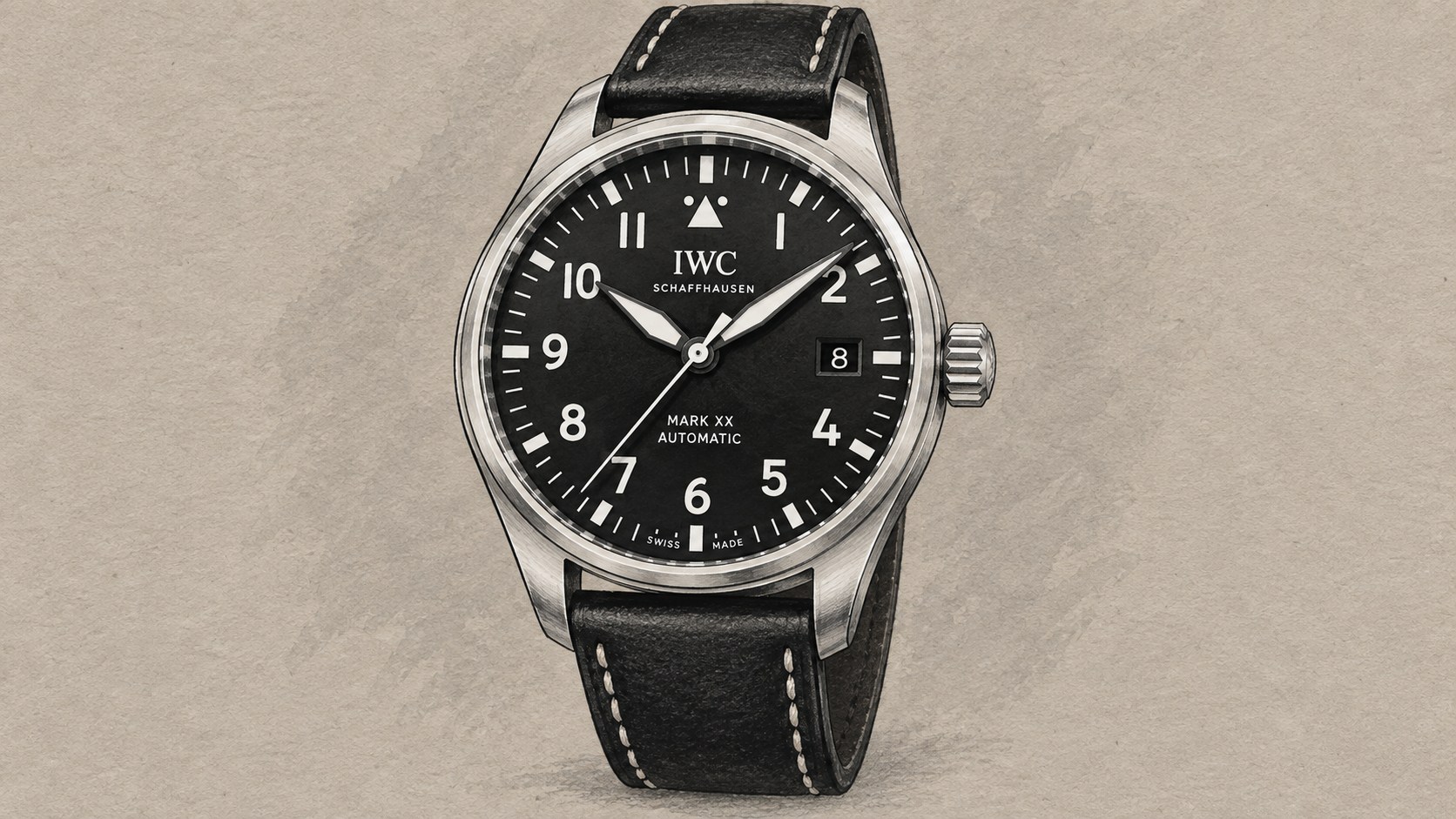
The Mark XX is an appealing watch for someone who thinks a clear black dial is already a complete idea. It does not add a chronograph, a rotating bezel or a second time zone to make that idea seem more expensive. Instead, the significant modernisation sits in the movement, case and strap arrangement.
The black-dial IW328201 combines the familiar pilot-watch numerals with a five-day power reserve and a relatively restrained profile. Its argument is strongest when those details improve a design you already want. If the plain face leaves you searching for something more spectacular, the longer reserve will not turn it into a different kind of IWC.
The history behind the choice
The Mark XX continues a line whose defining reference point is the Mark 11, developed for the British Royal Air Force in 1948. IWC records that earlier watch remaining in service into the 1980s. Its importance was a clear, functional time display, a quality that remains visible in the later civilian designs. Introduced in 2022, the Mark XX updates that language with calibre 32111, revised case geometry and a modern strap-changing system. It is therefore a continuation of a design purpose rather than a literal military reissue. The historical connection is most useful when it explains the uncluttered numerals and strong orientation marker. It does not require the current owner to invent an aviation role for an everyday automatic watch.
The exact reference
| Specification | Published detail |
|---|---|
| Reference | IW328201 |
| Case | Stainless steel; 40mm diameter; 10.8mm thick |
| Dial | Black; Arabic numerals; date |
| Movement | Automatic IWC-manufactured calibre 32111 |
| Reserve / frequency | 120 hours / 4Hz |
| Winding | Bidirectional pawl system |
| Seconds | Central; hacking |
| Water resistance | 10 bar; screw-in crown |
| Crystal | Convex sapphire; secured against pressure-drop displacement |
| Strap | Black calfskin; EasX-CHANGE |
| Lug width | 20mm |
The dial keeps its hierarchy
The large Arabic numerals provide the first layer of information, with the triangle at twelve establishing orientation. The date adds an everyday function without asking the dial to support several competing complications. On this reference, the black background gives the light markings a direct visual relationship.
This is the kind of simplicity worth distinguishing from an empty design. The proportions of the numerals, the space around them and the relative emphasis of the hands still determine whether the face is satisfying. Someone attracted to that order may find a chronograph less useful to look at, even if it offers more to operate. The Mark XX has to succeed through the information it presents repeatedly, not through occasional mechanical entertainment.
The reserve is the principal mechanical attraction
The 32111’s stated five-day reserve is a meaningful feature in a watch with such a restrained dial. IWC describes a bidirectional pawl winding system, so the automatic mechanism can replenish energy through rotor movement in both directions. The extended autonomy does not need an extra dial display to become part of the specification.
For someone who alternates watches, the benefit is a longer potential interval before restarting and resetting an adequately wound watch. More broadly, it shows that a familiar exterior need not imply a static technical brief. The Mark XX is an example of modernisation which preserves the visual reason people wanted the design in the first place.
Practical details without a dramatic case
The case combines a screw-in crown with a ten-bar rating. IWC also lists a sapphire crystal secured against displacement caused by a drop in air pressure. That is a specific construction feature, and a more useful description than turning the entire watch into a general claim of indestructibility.
The 10.8mm published height keeps the case relatively restrained for an automatic sports-oriented watch. Its visual language remains round and straightforward, with no large rotating bezel competing for attention. A fitting can concentrate on the revised lug shape and the complete profile. There is little decorative hardware to distract from whether the case itself has the balance you want.
EasX-CHANGE makes the strap a real option
The supplied black calfskin establishes a coherent monochrome configuration. The EasX-CHANGE attachment system is intended to make compatible strap changes straightforward, giving the simple watch head a practical way to change emphasis. That feature belongs to the ownership proposition, even if the black strap is the one you initially prefer.
It is still worth choosing the configuration you actually want at purchase. A bracelet-equipped Mark XX is a separate buying option, and the existence of interchangeable attachments does not make every possible combination equivalent. The black leather reference is particularly clear in its intent: it keeps the dial, case and strap relatively quiet, allowing the typography to remain the dominant characteristic.
The Ranger and Ingenieur clarify the decision
A Tudor Ranger offers another interpretation of a simple, legible watch, while the IWC Ingenieur uses the same named movement family inside a much more overtly designed case-and-bracelet composition. Those comparisons reveal what the Mark XX is selling beyond a reserve figure. It is the pilot-watch arrangement and comparatively understated enclosure.
Choose it when the familiar numerals, date and extended autonomy are enough to make a complete everyday watch. Choose the Ingenieur when the bracelet architecture and dial texture should carry more of the attraction, or another simple field design when its typography speaks more clearly to you. The Mark XX is strongest when restraint is a positive preference, supported by useful modern details beneath it.
Specifications and sources checked on 8 September 2026. Mark XX exact specifications; Mark XX introduction and Mark 11 origins; IWC Mark design development.
Image: AI-generated editorial illustration of the IWC IW328201. Fine dial details and finishing may differ from the production watch.


