A 36 mm watch can look purposeful and clear. A 42 mm watch can look well balanced. Either can also be wrong for the person considering it. Diameter helps narrow a search, but it cannot decide how a case, dial and bracelet will sit together on your wrist.
Start with what you want to see. Some buyers enjoy a watch occupying much of the wrist; others prefer visible space around it. Neither preference needs permission from a size chart. Measurements are most useful when they explain the physical differences between the watches you already like.
Diameter is one direction through the case
A quoted case diameter describes width, usually excluding the crown. It is a helpful first comparison between round watches, but the bezel and dial divide that space differently. A broad timing bezel can leave less visible dial than a thin polished ring on a smaller case.
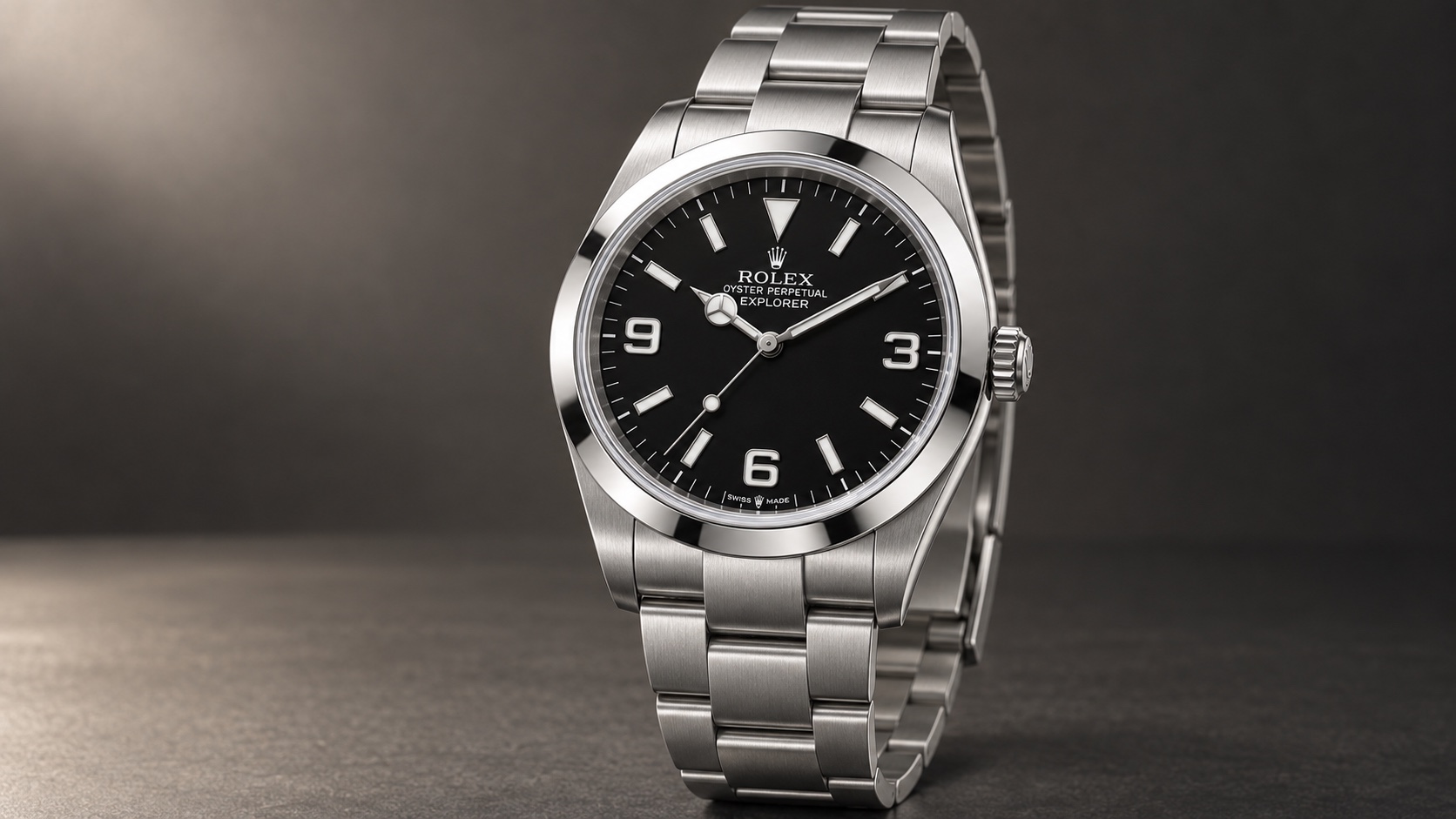
The Rolex Explorer 36 has a smooth bezel around a strong three, six and nine numeral layout. The Hamilton Pilot Day Date uses a larger case and a dial with minute markings and calendar information. The Hamilton’s extra width is not simply an enlarged copy of the Explorer’s display.
Compare the elements you need to read. Hour markers, hand contrast and calendar placement can matter more than the external number. A large diameter does not by itself guarantee that every piece of information will be easier to distinguish.
Three examples with different proportions
| Reference | Case diameter | Additional context |
|---|---|---|
| Rolex Explorer 124270-0001 | 36 mm | No date; smooth bezel; Oyster bracelet |
| Omega Aqua Terra 220.10.38.20.03.001 | 38 mm | 12.24 mm thick; 45 mm lug-to-lug; 19 mm attachment width |
| Hamilton Pilot Day Date H64615135 | 42 mm | 11.85 mm thick; 20 mm strap attachment; day and date |
The two published thickness figures make the point neatly: the smaller-diameter Omega is thicker than the selected Hamilton. A rule that treats smaller as thinner would miss that difference. The measurement you care about under a shirt cuff is not necessarily the measurement highlighted in the product name.
Lug-to-lug measures the watch along the wrist
The lugs are the parts of the case that hold the strap or bracelet. Lug-to-lug length describes the span from one end of the case to the other. The Aqua Terra’s published 45 mm length supplies information that its 38 mm diameter cannot.
Also examine what happens immediately beyond the lugs. A bracelet’s first links may extend the shape before it begins to curve down. A flexible strap can follow a different line. This is why changing the attachment can alter the impression of fit without changing the case diameter at all.
When comparing product photographs, look for side views and images showing the attachment. A straight-on dial image is excellent for studying markers but weak evidence about how the ends of the watch approach the wrist.
Size has changed without one answer replacing another
Rolex introduced the Explorer after the successful Everest ascent of 1953, drawing on its earlier expedition associations. The later collection moved to 39 mm in 2010, returned to 36 mm in 2021 and added a 40 mm option in 2023. Those changes show a design being offered through different proportions over time.
The current 36 mm Explorer is therefore an intentional choice within the collection. Its size is part of the design’s present identity, as well as its historical appeal. Equally, the existence of a larger version recognises that buyers can prefer the same basic watch language with more visible case and dial.
A useful fitting takes more than a photograph
Have the watch held or adjusted to a realistic bracelet length. An oversized bracelet hanging beneath the wrist can distract from how the case should sit. Place the watch where you normally wear one, then turn your hand and check the crown’s relationship with the back of it.
View it from a normal distance as well as close up. A phone photograph taken very near the wrist can dominate your judgement with a view you rarely experience in daily life. A mirror or another person’s ordinary viewing distance offers a useful second perspective.
If sleeves matter, bring the kind you actually wear. Check the case height and whether the cuff passes over it comfortably. That direct observation answers a practical question more clearly than debating whether a particular diameter belongs in a formal or casual category.
Use a familiar watch as your baseline
If you already own a watch that fits well, record its diameter, length, thickness and attachment type. Use those as comparison points for a shortlist. The aim is to understand what changes, rather than to turn the familiar watch into a permanent maximum or minimum.
Choose the proportions that make the design work for you. A compact Explorer, a 38 mm Aqua Terra and a larger Hamilton can each be convincing choices, but for different combinations of display, shape and personal preference. The numbers should help explain your decision, not make it on your behalf.
Based on manufacturer information. Specifications and sources checked on 8 September 2026.
Sources: Rolex Explorer 36 specifications; Rolex Explorer origins; Rolex Explorer size evolution; Hamilton Pilot Day Date specifications; Hamilton aviation history and 2024 collection; Hamilton aviation timeline; Omega Aqua Terra specifications; Omega Seamaster and Aqua Terra history; Omega on nautical dial details.
Image: AI-generated editorial illustration of the Rolex Explorer 36 reference 124270-0001. Fine dial details and finishing may differ from the production watch.