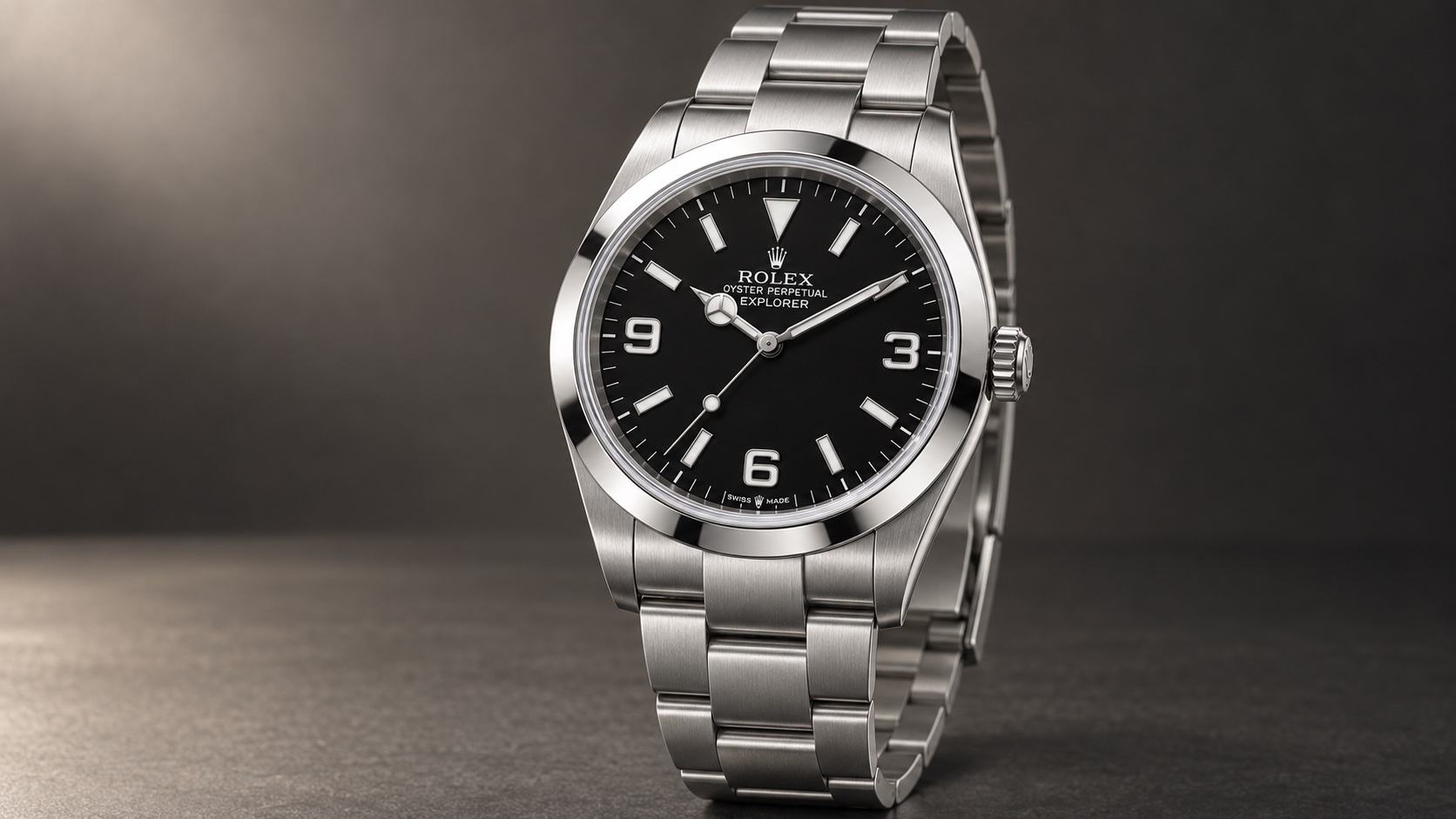
The Explorer 36 asks a question that wrist-size charts cannot settle: do you want the watch to occupy most of the available space, or do you like seeing room around it? A compact case can look deliberate on a broad wrist. It can also feel underwhelming to someone who enjoys a larger object.
Reference 124270 is worth considering when the absence of fuss is the attraction. It gives you time, a black dial and a familiar numeral pattern. If you expect the Rolex name to deliver a dramatic visual event every morning, this may be the wrong kind of reward.
The history behind the choice
Rolex’s connection with Himalayan expeditions predates the Explorer. The brand supplied Oyster watches to expeditions during the 1930s, then introduced the Explorer after the successful Everest ascent in 1953. That sequence matters: the modern collection celebrates the expedition history, rather than making today’s reference the watch carried on the first ascent. Size has changed during the model’s later life. Rolex records a move to 39mm in 2010, a return to 36mm in 2021, and the addition of a 40mm version in 2023. The current smaller case is consequently an intentional branch of the collection. It is neither an accidental leftover nor a universal instruction about how everyone should wear a sports watch.
The exact reference
| Specification | Published detail |
|---|---|
| Reference | 124270-0001 |
| Case | 36mm Oystersteel |
| Dial | Black; 3, 6 and 9 numerals |
| Bezel | Smooth Oystersteel |
| Movement | Automatic calibre 3230 |
| Stated reserve | Approximately 70 hours |
| Maker precision | −2/+2 seconds per day after casing |
| Water resistance | 100m |
| Crystal | Sapphire |
| Bracelet / clasp | Oyster / Oysterlock with 5mm Easylink |
A small case with a strong numeral pattern
The Explorer’s three, six and nine give a compact dial an emphatic structure. Luminous filling in those numerals connects them with the other markers and hands, so the principal design is not dependent on tiny decorative details. The smooth steel bezel keeps a second printed scale from competing with it.
That is why 36mm can remain a deliberate choice alongside the larger Explorer. The design already supplies clear landmarks rather than relying on a broad diameter to create presence. The question is whether you enjoy the proportion of dial, bezel and surrounding wrist, not whether the Explorer clears a minimum acceptable size. Its compactness works with the layout; it does not need to be defended solely through a historical argument.
The empty space is part of the design
The dial avoids a date window, leaving the numeral layout uninterrupted. That simplicity has a practical cost if you habitually glance at your wrist for the date. Spend a few days noticing how often you do that before treating a time-only display as an automatic improvement.
The smooth bezel also has no timing scale. Someone accustomed to setting a diver’s bezel for cooking or parking may miss that small habit. Another owner may welcome having less to adjust. The Explorer’s restraint works best when it removes features you do not use, rather than features you enjoy but have been persuaded are aesthetically impure.
An Oyster bracelet without extra decoration
The three-piece solid-link Oyster bracelet matches the Explorer’s direct exterior. It avoids the finer pattern of a Jubilee, leaving the black dial as the visual centre. An Oysterlock safety clasp and 5mm Easylink extension make the fastening more functional than the watch’s spare face might suggest.
During a fitting, compare the bracelet’s line and clasp position with the larger Explorer. That is the useful physical check. Beyond fit, the bracelet is an important part of the watch’s restraint: it repeats broad steel forms instead of introducing another intricate motif. Someone who enjoys a Datejust’s combination of fluting and small links may find this deliberately quiet. Someone seeking a consistent, unfussy object may regard precisely the same difference as its advantage.
The 3230 is more than a reserve figure
The automatic 3230 has a stop-seconds function for precise setting, a blue Parachrom hairspring and Paraflex shock absorbers. Rolex publishes approximately seventy hours of reserve and an after-casing precision standard of minus two to plus two seconds per day. These are specific modern features beneath a face which makes little visual fuss about them.
The time-only arrangement is particularly coherent here. There is no calendar to interrupt the numeral pattern or to correct after a period stopped. Against that, the movement offers no extra display to reward someone who primarily enjoys complications. The Explorer’s mechanical interest is in the execution of a straightforward brief. It makes more sense as an intentionally simple Rolex than as an entry point to be replaced as soon as another function becomes available.
Compare the larger Explorer and the Air-King
The larger Explorer is the natural comparison when you like the layout but want more visual presence. Keep the decision focused on proportion. Choosing the smaller version does not make you more historically informed, and choosing the larger version does not mean you have misunderstood the design.
The Air-King offers another route, with its prominent minute numerals and coloured details. It is worth seeing when the Explorer feels too restrained, though those extra elements change the character considerably. Choose the 36mm Explorer when you enjoy its quiet scale and can happily forgo the date and timing bezel. Choose something else when you keep trying to explain away a lack of excitement. Restraint is valuable only when it is the quality you want to live with.
Specifications and sources checked on 8 September 2026. Rolex Explorer 36 specifications; Rolex Explorer origins; Rolex Explorer size evolution; Air-King alternative.
Image: AI-generated editorial illustration of the Rolex Explorer 36 reference 124270-0001. Fine dial details and finishing may differ from the production watch.


