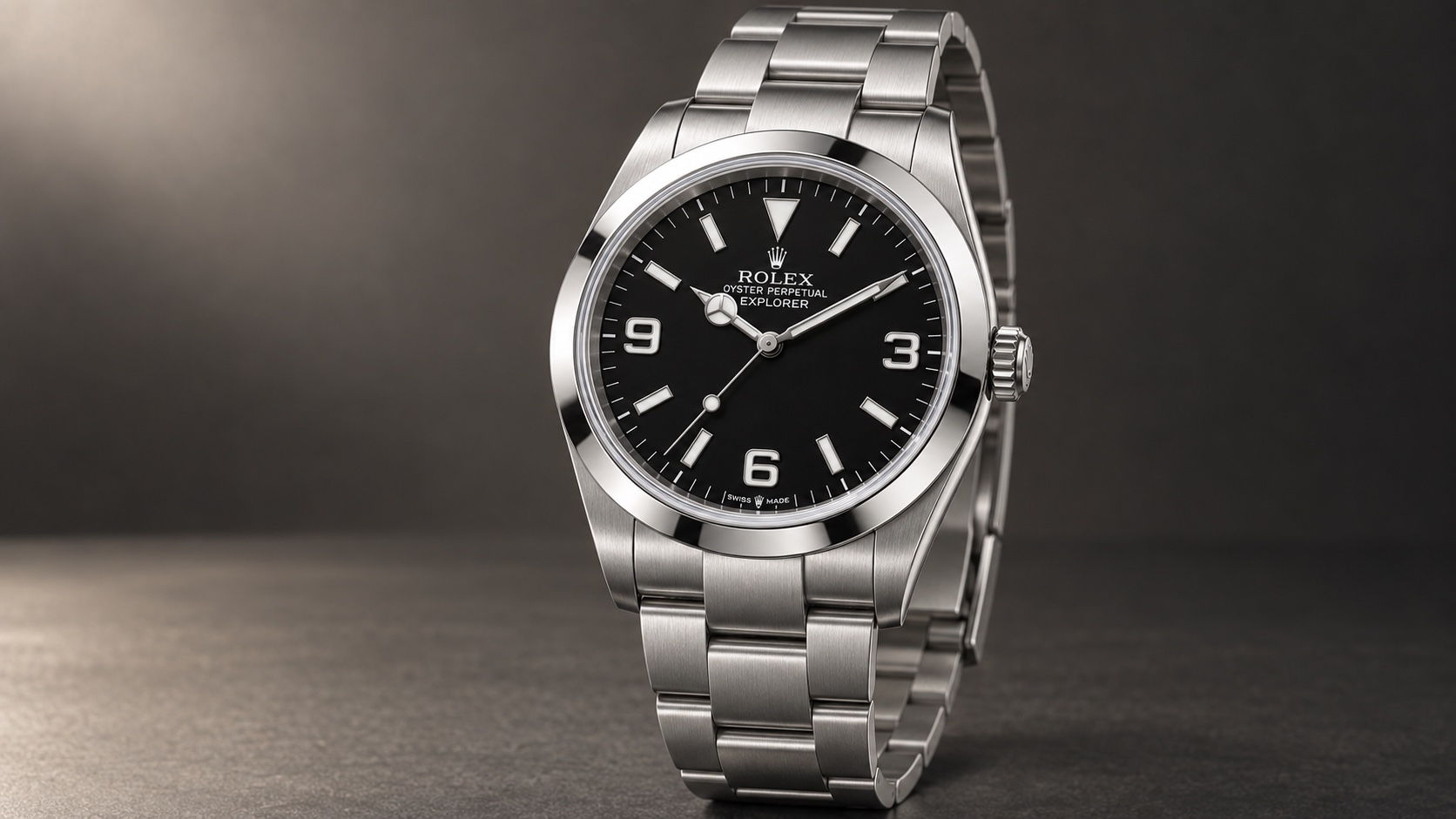
Three watches can all measure 36 mm and still look as though they belong to different wardrobes. A smooth bezel, a fluted bezel, a date magnifier and a precious-metal bracelet each change the balance of the same nominal diameter. The number is a useful starting point, but it is not the finished appearance.
The Rolex Explorer, Datejust and Day-Date make that especially clear. Keeping the diameter fixed lets you compare design and function without allowing a size preference to decide the result first. It also shows why 36 mm should be considered a versatile option rather than a category reserved for one gender or occasion.
Explorer: the simplest face of the three
The black 124270-0001 has a smooth Oystersteel bezel, three large numerals and no date. Its automatic 3230 provides approximately 70 hours of reserve. The Oyster bracelet’s broad three-piece links support the direct appearance, while the Oysterlock clasp and Easylink extension address practical wearing needs.
The Explorer dates to 1953, with later size changes including a move to 39 mm in 2010 and a return to 36 mm in 2021. The smaller modern reference is therefore an intentional choice within an evolving line. Consider it when you want the dial to remain clear and would prefer to check the calendar elsewhere.
Datejust: more texture without more diameter
Mint-green 126234-0051 adds a date at three, a Cyclops magnifier and a fluted white-gold bezel. The Jubilee bracelet is steel, creating a finer repeated pattern than the Explorer’s Oyster. Its automatic 3235 has the same approximately 70-hour headline reserve, although the additional calendar changes the setting routine.
The Datejust and Jubilee arrived together in 1945. That shared history explains why the pairing looks so established, but it does not make it the only valid Datejust configuration. An Oyster-bracelet version changes the visual emphasis while keeping the 36 mm case and calendar idea. Choose the combination itself, rather than a general belief that every Datejust looks equally formal.
Day-Date: material changes the whole impression
The yellow-gold 128238-0045 pairs a champagne dial with a fluted bezel and President bracelet. Calibre 3255 drives both the date and the full weekday display, with approximately 70 hours of reserve. Even at the same diameter as the Explorer, the gold case and bracelet make a different visual and financial commitment.
Rolex introduced the Day-Date in 1956, creating the President bracelet for its launch. The bracelet’s rounded three-piece links and concealed Crownclasp form part of the identity. The appeal should be the material, proportions and calendar you want to live with, rather than the idea that a Day-Date represents an obligatory final step in watch collecting.
| 36 mm reference | Material and display | Bracelet and movement |
|---|---|---|
| Explorer 124270-0001 | Oystersteel; black; no date | Oyster; automatic 3230 |
| Datejust 126234-0051 | Steel and white-gold bezel; mint; date | Jubilee; automatic 3235 |
| Day-Date 128238-0045 | Yellow gold; champagne; day and date | President; automatic 3255 |
Why equal diameter does not guarantee equal fit
The visible dial opening and bezel shape affect how large the face appears. Bracelet construction changes the visual transition from case to wrist. Weight, clasp position and available adjustment influence the physical result. None of those questions is answered by the shared diameter alone.
Try the watch at normal viewing distance, then in a mirror if available. A wrist-level close-up exaggerates the case relative to the rest of your arm. If you have been judging 36 mm watches only through close photographs, a normal-distance fitting can be more informative than another size chart.
Choose what you want the watch to contribute
The Explorer contributes a clear sporting face, the Datejust adds a useful date and more decorative texture, and the Day-Date makes precious metal and a full calendar central to the design. There is no reason that one wrist must prefer the same answer for all three.
Start with the model whose function and material appeal, then decide whether 36 mm produces the balance you want. A smaller case can be an affirmative design choice. It does not need to be justified by an arbitrary wrist-circumference rule, and it should not be bought solely because a particular size is fashionable.
Based on manufacturer information. Specifications and sources checked on 8 September 2026.
Sources: Rolex Explorer 36 specifications; Rolex Explorer origins; Rolex Explorer size evolution; Rolex Jubilee configuration; Rolex Oyster configuration; Rolex Datejust history; Rolex yellow-gold Day-Date 36; Rolex Day-Date origins.
Image: AI-generated editorial illustration of the Rolex Explorer 36 reference 124270-0001. Fine dial details and finishing may differ from the production watch.


