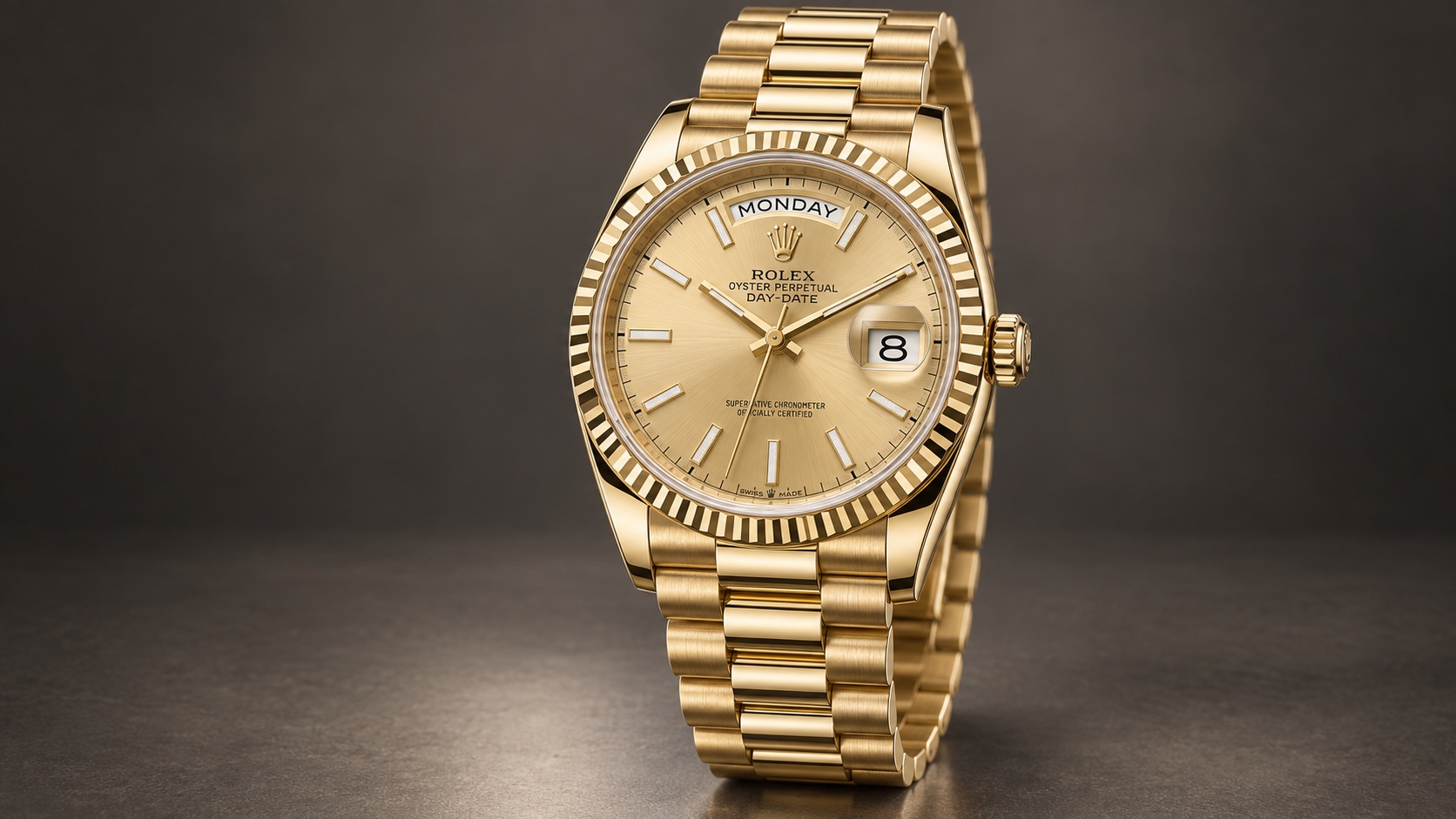
Yellow gold makes the Day-Date’s presence immediately obvious. Platinum offers a different kind of presence: a pale metal and, in the configuration considered here, an ice-blue dial. Choosing between them is less about improving the watch’s calendar function than deciding which complete object you want to wear repeatedly.
The 36mm size keeps this comparison focused. Reference 128238-0045 pairs yellow gold with champagne, while 128236-0018 combines platinum and ice blue. Neither needs to be reserved for a suit. What matters is whether its colour, weight and bracelet fit feel right with the clothes and routines you already have.
The history behind the choice
The Day-Date entered Rolex’s collection in 1956 with two calendar displays: the date and the day written out in full. The President bracelet was created for the same launch, giving the model a closely connected case-and-bracelet identity. That history explains why the bracelet name is so often used when people discuss the watch, but “President” is not a substitute for an exact Day-Date reference. Today’s 36mm models retain the calendar concept while using a contemporary automatic movement. The metal and dial combinations create different expressions of that shared design. A buyer can appreciate the collection’s established visual language without needing to imitate the public figures or formal settings with which the watch is often associated.
The exact reference
| Specification | Published detail |
|---|---|
| Main reference | 128238-0045; yellow gold, champagne dial |
| Compared reference | 128236-0018; platinum, ice-blue dial |
| Diameter | 36mm |
| Materials | 18ct yellow gold / 950 platinum |
| Bezel | Fluted; matching precious metal |
| Movement | Automatic calibre 3255 |
| Functions | Day and date; rapid setting; stop-seconds |
| Stated reserve | Approximately 70 hours |
| Water resistance | 100m |
| Bracelet / clasp | President / concealed Crownclasp |
The colour decision comes before the metal debate
The champagne dial and yellow-gold case form a deliberately warm combination. If that is the Day-Date you picture when you hear the name, do not talk yourself out of it solely because a paler metal seems easier to justify. You are buying an object partly for its appearance, and a strong preference is useful information.
The platinum version brings an ice-blue dial and a different contrast with skin, sleeves and jewellery. Rolex identifies this dial colour with its platinum watches. That does not mean every observer will recognise the metal, or that you should choose it in expectation of being unnoticed. Compare the actual watches under normal lighting and decide which you want to see on your own wrist.
Shared function, different object
Both references use calibre 3255 and the same basic day-and-date brief. The platinum choice does not buy a more elaborate calendar in this comparison. If you are looking for additional information or a different setting routine, changing metal is not the route to it.
The day display is useful when you enjoy reading the calendar at a glance, but it also occupies a prominent part of the dial. Think about whether that arrangement is central to the appeal. A Datejust provides a different calendar layout and should be considered separately if the Day-Date feels visually busy. Do not let the prestige of a metal override a preference for another watch’s display.
The President bracelet belongs to the identity
Both selected watches use the President bracelet and a concealed Crownclasp. The bracelet’s rounded link pattern is a major part of the Day-Date’s character. It gives the case a closely related setting rather than treating precious metal as a material confined to the watch head.
The concealed fastening also supports a continuous-looking bracelet. This is a different visual proposition from an overt sports clasp, even though both watches retain a 100-metre water-resistance specification. Compare the full adjusted watches once, especially their sense of mass and the bracelet’s position. After that, the enduring choice is between two complete precious-metal compositions. Looking only at a dial close-up misses much of the object that makes a Day-Date distinctive.
The day aperture changes the dial hierarchy
The spelled-out day occupies a broad arc at twelve, while the date receives its own magnifier at three. Those two calendar elements give the Day-Date a different structure from the Datejust before either bezel or bracelet enters the comparison. The display is part of the attraction, not simply a reason to call the watch more complicated.
Yellow gold and champagne make the selected calendar watch tonally warm and relatively unified. Platinum with ice blue introduces a cooler, more separated dial-and-case relationship. In this comparison the movement remains calibre 3255, so the metal choice does not alter the information delivered. Choose the palette which makes that familiar calendar layout most appealing. If the layout itself is what troubles you, changing precious metal is an expensive way to leave the original objection unresolved.
The purchase comparison should be specific
Obtain quotations for the exact configurations and establish what each includes. Do not use the spot price of the metal as a shortcut to valuing the finished watch. Nor should a general claim about rarity substitute for a clear description of the example, its condition and the seller’s terms.
Choose yellow gold when its warmth and visual identity are the qualities you want to enjoy. Choose platinum when the pale metal and ice-blue combination appeal more strongly and the complete watch suits your wrist. If either choice depends mainly on what someone else will infer about your success, pause and compare them again without that imagined audience. The useful luxury is owning a watch whose presence you like yourself, including on an entirely ordinary day.
Specifications and sources checked on 8 September 2026. Rolex yellow-gold Day-Date 36; Rolex platinum Day-Date 36; Rolex Day-Date origins.
Image: AI-generated editorial illustration of the Rolex Day-Date 36 reference 128238-0045. Fine dial details and finishing may differ from the production watch.


