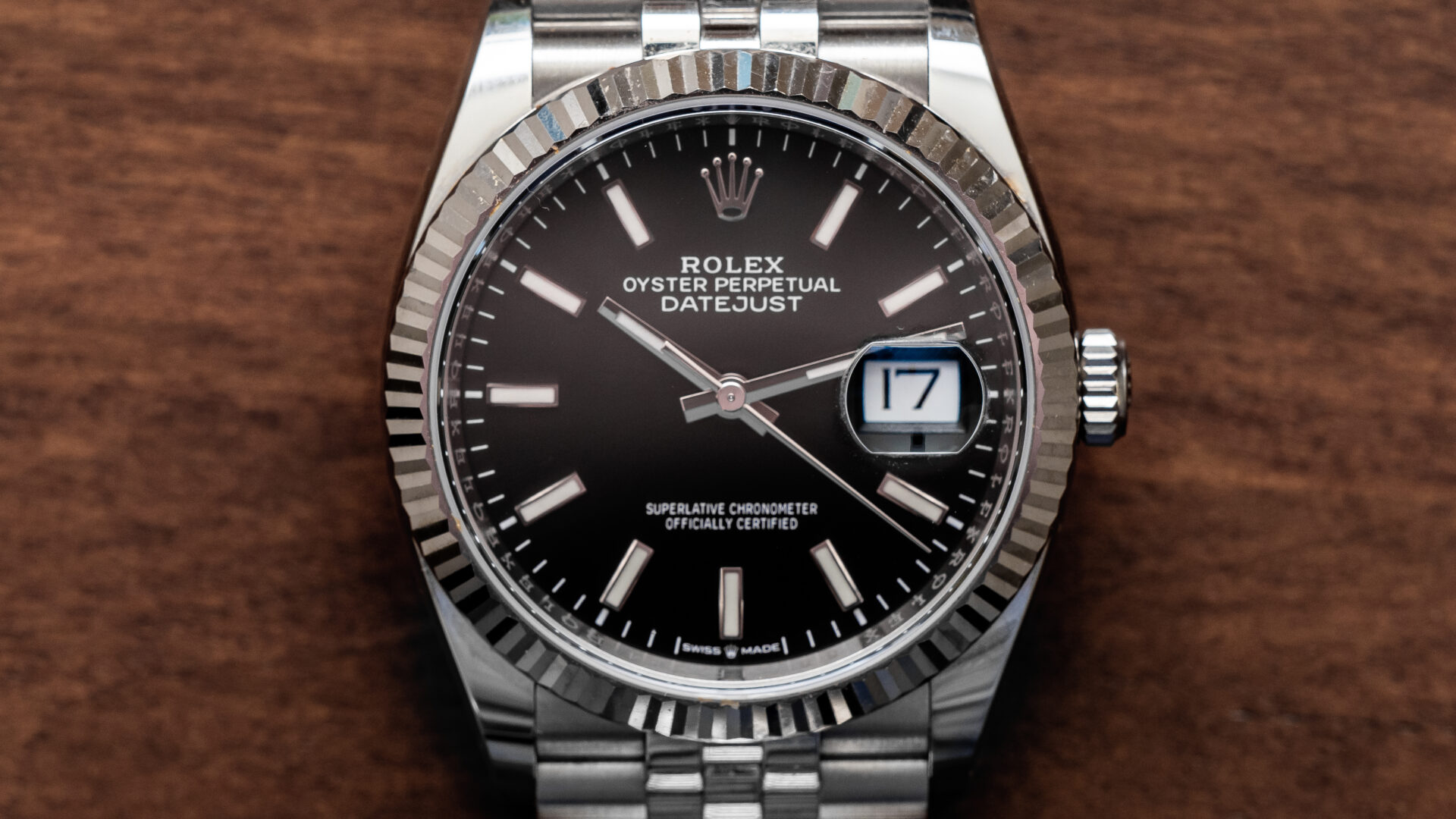
A Datejust can look surprisingly different without changing its dial or bezel. Put the mint-green 126234 on a Jubilee beside the equivalent Oyster configuration and the decision becomes clearer: one bracelet adds a finer pattern, while the other supplies broader, simpler lines. Neither is reserved for a particular dress code.
For an office watch, the useful question is how the whole combination looks and fits during your normal day. This comparison keeps the 36mm case, green dial and fluted white-gold bezel constant. That prevents a preference for a completely different watch from being mistaken for a preference about bracelets.
The history behind the choice
The Jubilee is part of the Datejust’s original story. Rolex introduced the Datejust in 1945 for the company’s fortieth anniversary, with a date aperture at three o’clock and a bracelet created for the launch. The original watch was offered in gold. That history helps explain why the Jubilee and fluted bezel look so naturally related, but it does not make the combination compulsory. A collection that has evolved over decades can support more than one reading of its design. Today’s steel-and-white-gold reference combines that recognisable vocabulary with a modern movement and clasp. Choosing an Oyster bracelet therefore changes the emphasis, rather than removing the watch’s identity or making it an incorrect interpretation of the Datejust.
The exact reference
| Specification | Published detail |
|---|---|
| Main reference | 126234-0051; Jubilee |
| Compared reference | 126234-0052; Oyster |
| Case | 36mm; Oystersteel and white gold |
| Dial / bezel | Mint green / fluted white gold |
| Movement | Automatic calibre 3235 |
| Stated reserve | Approximately 70 hours |
| Water resistance | 100m |
| Crystal | Sapphire with Cyclops |
| Jubilee | Five-piece links; Oystersteel |
| Both clasps | Oysterclasp with 5mm Easylink |
A comparison with fewer moving parts
The main watch here is configuration 126234-0051, with a Jubilee. Configuration 126234-0052 supplies the Oyster alternative. Both use the same mint-green dial and fluted bezel. Check those full suffixes when looking at listings, because the shorter reference alone does not settle the bracelet and dial arrangement.
This is also a white Rolesor watch. Its white-gold bezel does not mean the bracelet contains alternating white-gold links. Rolex specifies Oystersteel for the bracelets on these configurations. Understanding that distinction helps you assess what you are choosing: a particular combination of metals and shapes, rather than a general assumption that every pale polished surface is gold.
How much visual activity do you want?
The Jubilee repeats its small-link pattern around the wrist. With a fluted bezel, the result is deliberately detailed. If that is the Datejust image you have always liked, a plainer bracelet may feel like a compromise every time you look down. It is reasonable to buy the combination that first drew you to the watch.
The Oyster creates a broader visual rhythm. It can make the bezel stand out more clearly because fewer small elements compete with it. That does not transform this green, fluted watch into a discreet field watch. Evaluate the entire object with your sleeves, rings and other accessories. Trying to solve a dislike of the bezel by changing the bracelet is unlikely to address the real problem.
The shared clasp matters
Both selected configurations have an Oysterclasp and the Easylink extension. This is an important constant in a comparison often framed as though bracelet appearance determined every aspect of operation. The extension changes length by approximately 5mm; changing from Jubilee to Oyster does not remove that feature.
The two link patterns still distribute the visible steel differently. Jubilee breaks the bracelet into a finer sequence, while Oyster gives broader individual surfaces more prominence. Have both adjusted and compare the clasp position once. After that, the useful question is which pattern best completes the green dial and fluted white-gold bezel, rather than inventing a universal comfort ranking from the number of links.
The same Datejust beneath both bracelets
Calibre 3235, the date window and the Cyclops lens remain the same whichever of these bracelets you choose. The approximately seventy-hour reserve and 100-metre water-resistance specification are also shared. There is no movement upgrade hidden behind the more intricate Jubilee pattern.
The mint-green dial and white-gold fluting make this a deliberately detailed Datejust even on Oyster. Choosing the broader bracelet can reduce the number of small reflective elements, but it will not produce the spare face of an Explorer. That is useful to recognise before buying: if you like the Datejust’s calendar, green surface and patterned bezel, either bracelet can complete it. If those are the details you want to remove, another Rolex collection is the more honest comparison.
Buy the complete configuration you want
Do not base the purchase on an assumption that switching bracelets later will be simple or inexpensive. Establish compatibility, availability and the full quoted cost with the retailer first. That is especially relevant when a watch on the wrong bracelet is available immediately and the one you prefer is not.
Choose Jubilee when its fine pattern and close relationship with the fluted bezel are the attraction. Choose Oyster when you prefer the larger visual blocks and a less intricate bracelet. If both appeal equally, let the adjusted fit decide. Neither choice requires you to predict what colleagues or future buyers will prefer. The point of an everyday Datejust is that the configuration remains appealing long after the first occasion for which you bought it.
Specifications and sources checked on 8 September 2026. Rolex Jubilee configuration; Rolex Oyster configuration; Rolex Datejust history.
Image: Rolex Datejust 36 reference 126234 on Jubilee, shown with a black dial to illustrate bracelet and bezel design; the main article compares mint-green configurations. Photograph by Ajay Suresh (ajay_suresh), CC BY 2.0. Rolex Datejust 36 reference 126234 on Jubilee, shown with a black dial to illustrate bracelet and bezel design; the main article compares mint-green configurations. Photograph by Ajay Suresh (ajay_suresh), CC BY 2.0. Source. Original downloaded unchanged. Resized for web display.



