Think about the last time you looked at your wrist to check the date. If the answer is this morning, a calendar has an obvious job. If you always reach for a phone or computer, the window may contribute more to the appearance of a watch than to its usefulness. Either answer is reasonable. The mistake is treating a date as an automatic upgrade, or treating its absence as proof of better design.
The Rolex Datejust 126234-0051, Explorer 124270-0001 and Jaeger-LeCoultre Master Control Date Q4018421 make the choice tangible. They also demonstrate how much else changes when you move between otherwise straightforward everyday watches.
Why the window became part of the design
Rolex introduced the Datejust in 1945, alongside the Jubilee bracelet, for its fortieth anniversary. The calendar was central to the model’s identity rather than an afterthought added to an existing dial. Today’s Explorer follows a different line: a black face with prominent 3, 6 and 9 numerals and no date. Jaeger-LeCoultre introduced Master Control in 1992 with its 1,000-hour testing programme. The modern Master Control Date retains the idea of a restrained everyday watch while using the updated calibre 899. This context matters because deleting or adding a calendar does not create an equivalent version of each design. The Datejust’s magnifier, Explorer’s numerals and Master Control’s broader dial are all part of their respective characters.
| Exact reference | Diameter | Movement / reserve | Calendar | Water resistance |
|---|---|---|---|---|
| Rolex Datejust 126234-0051 | 36 mm | 3235 automatic / about 70 hours | Date with Cyclops magnifier | 100 m |
| Rolex Explorer 124270-0001 | 36 mm | 3230 automatic / about 70 hours | None | 100 m |
| JLC Master Control Date Q4018421 | 40 mm | 899 automatic / 70 hours | Date | 5 bar |
Two 36 mm Rolexes, two quite different faces
The selected Datejust combines Oystersteel with a white-gold fluted bezel, a mint-green dial and a five-piece-link Jubilee bracelet. Its Cyclops lens makes the date a prominent visual feature. If that magnified window is what you notice first in every picture, decide whether you enjoy it before spending time on movement comparisons. It will remain there every time you check the hour.
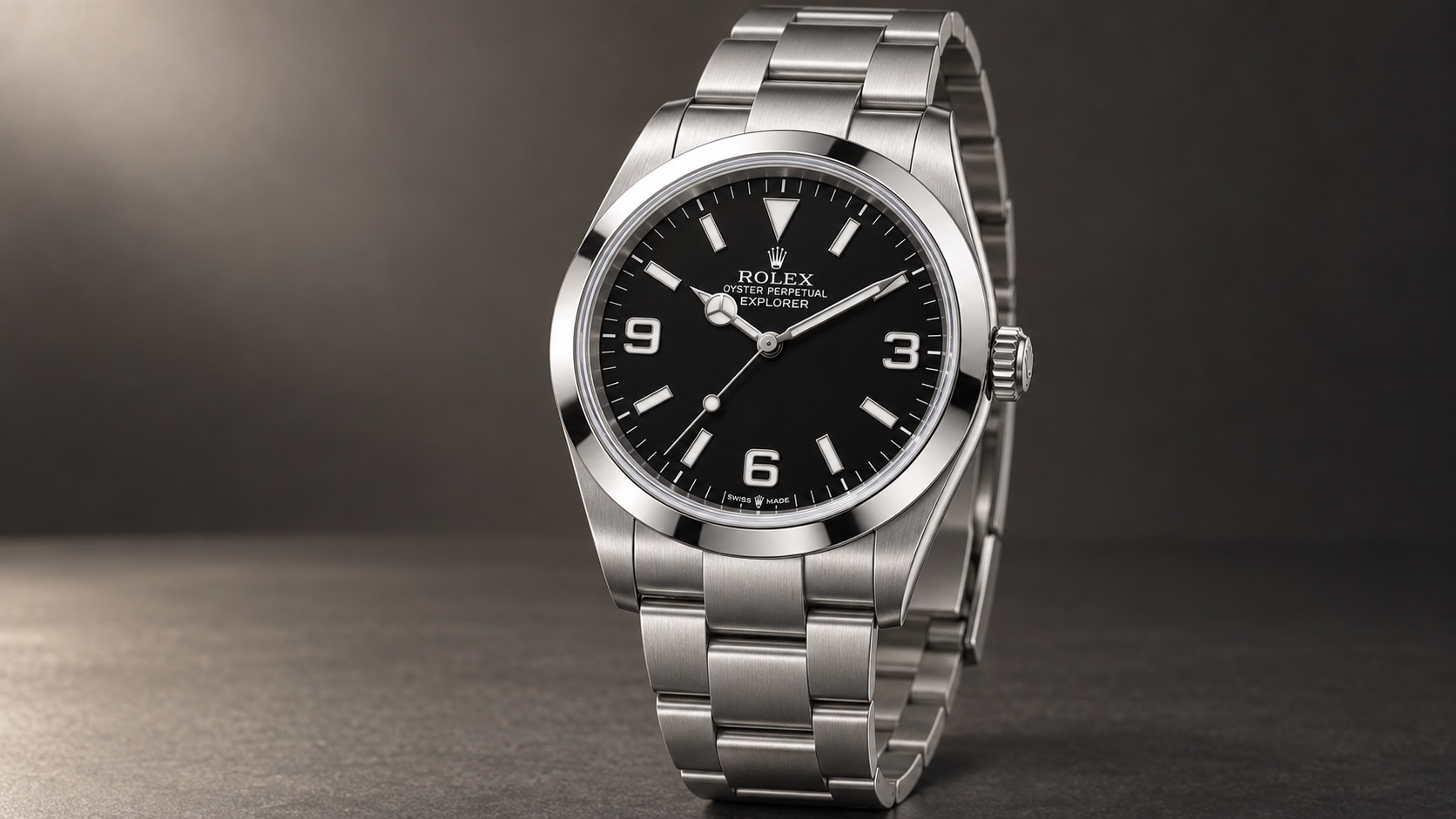
The Explorer has a smooth steel bezel and a black dial without a magnifier. Large hour numerals take the space a calendar might otherwise interrupt. The steel Oyster bracelet also produces a different visual rhythm from the Jubilee. These watches share a nominal diameter and 100-metre water resistance, but choosing the Explorer does not simply mean purchasing a Datejust with one feature removed.
Both selected bracelets have a 5 mm Easylink extension. The clasp arrangements differ: the Datejust uses an Oysterclasp and the Explorer an Oysterlock safety clasp. Try the exact combination you intend to buy. A photograph of another dial, bezel or bracelet can be enough to change which one you prefer.
A date without the magnifying lens
The Master Control Date offers a third approach. Its 40 mm steel case is 8.78 mm thick, with a silver-grey sunray dial and a date window at three. It puts a calendar in a comparatively open dial, without the Datejust’s Cyclops lens. That does not establish a legibility winner: the size of the printed date, viewing angle and your eyesight still matter.
The exact Q4018421 listing supplies a light-brown Novonappa calfskin strap and an additional black alligator strap. Its quick-change system is useful if those two appearances fit different parts of your week. This is also a different ownership proposition from the two steel-bracelet Rolexes. Leather and a 5-bar case rating deserve more consideration around water than the phrase everyday watch might suggest.
How often will you have to correct it?
Each of these movements has roughly 70 hours of reserve when fully wound. That can help a watch stay running across an ordinary two-day break, but a partly wound watch starts with less. If a dated watch stops for several days, you must restore both the time and the calendar. An Explorer removes that calendar-setting task.
A conventional date display also needs correction after a month shorter than 31 days. It is not an annual or perpetual calendar. Follow the manufacturer’s setting procedure, including any restrictions on when to adjust the date. There is little advantage in buying a feature you find useful only when somebody else keeps it correctly set.
During a fitting, read the time and date from the distance you normally use, without bringing the watch up towards your face. Then check whether the hands obscure the window at a particular time. For the Explorer, look at how easily you locate the hour and minute hands among the large numerals. This gives a more personal answer than arguing about perfect dial symmetry.
Choose the Datejust if the date is part of your daily routine and you enjoy its magnified display and fluted bezel. Choose the Explorer if a simpler setting routine and its particular black-dial layout appeal. Choose the Master Control Date if you want the calendar in a slim, larger-dial watch on interchangeable leather straps. Start with usefulness, then buy the complete design that makes you want to wear it.
Based on manufacturer information. Specifications checked on 8 September 2026.
Sources: Rolex Jubilee configuration; Rolex Datejust history; Rolex Explorer 36 specifications; Rolex Explorer origins; Current Master Control Date reference; Master Control origins and testing programme.
Image: AI-generated editorial illustration of the Rolex Explorer 36 reference 124270-0001. Fine dial details and finishing may differ from the production watch.


