The seconds hand is the invitation. On a Spring Drive watch it travels around the dial in a continuous glide, making an ordinary minute surprisingly interesting to watch. The engineering behind that movement took considerably longer to settle: more than two decades separated the original idea from a watch customers could buy.
Spring Drive history is compelling because the goal was awkward. Keep a mainspring and the character of a traditional watch, but use an electronic reference to regulate the time. That demanded more than putting two familiar technologies in the same case. It required them to share a very small energy budget.
1977: an idea that did not fit a simple category
Grand Seiko traces the project to Yoshikazu Akahane at Suwa Seikosha in 1977. His aim was a spring-powered watch with the accuracy associated with electronic timekeeping. The distinction between power source and regulator is central. One provides the energy to keep a watch moving; the other determines the rate at which that energy is released.
This also explains why calling Spring Drive merely “a quartz watch with a sweeping hand” misses its central idea. The hand is the visible outcome of a different regulating arrangement. Equally, describing it as purely mechanical leaves out the quartz oscillator and circuitry that make the arrangement work.
The long obstacle was energy, not the shape of the hand
The company’s development account describes repeated difficulty in generating sufficient electrical power while reducing what the circuit consumed. Osamu Takahashi joined the project in 1993, and circuit specialist Kunio Koike became involved in 1997. Work on generation, circuitry and the movement had to progress together. An elegant concept was not enough if it exhausted its mainspring too quickly.
The 1997 prototype demonstrated the idea without a battery or step motor. That is a particularly useful milestone: the project was finding a way to regulate spring-driven motion electronically, rather than using an electric motor to advance the hands. The final result would depend as much on efficiency as on miniaturisation.
In that light, the long development period makes sense. A demonstration that runs briefly and a practical wristwatch are different achievements. The later demand for automatic winding and a useful reserve added another hurdle before the system could become a regular Grand Seiko proposition.
1999 brought Seiko production; 2004 brought Grand Seiko 9R
The official movement chronology records Seiko’s limited-edition, manually wound 7R68 in 1999. Grand Seiko’s automatic 9R65 followed in 2004. Those are separate milestones: the technology’s commercial debut came before its arrival in the Grand Seiko collection.
The same chronology shows how development continued. Grand Seiko added its 9R86 chronograph in 2007, introduced the eight-day 9R01 in 2016 and launched the five-day 9RA5 in 2020. The 9RB2 Spring Drive U.F.A. arrived in 2025. Spring Drive therefore names a family of movements and an operating principle, not one fixed specification shared by every watch carrying it.
How the glide is regulated
In Grand Seiko’s technical explanation, the unwinding mainspring drives the gear train and a glide wheel. That wheel generates the small electrical supply needed by a quartz oscillator and integrated circuit. The circuit compares the wheel’s speed with the oscillator’s reference and applies an electromagnetic brake when necessary.
The regulator controls continuous rotation instead of repeatedly locking and releasing an escapement. This produces the recognisable motion of the seconds hand. It is a useful technical distinction, but the attraction is also visual: a moving indication can change the character of an otherwise conventional dial.
Two current watches that make the history visible
| Exact model | Case dimensions | Material | Movement | Reserve and stated accuracy | Displays |
|---|---|---|---|---|---|
| Grand Seiko SBGA211 Snowflake | 41 × 12.5mm; 49mm lug-to-lug | High-intensity titanium | 9R65 automatic Spring Drive | 72 hours; ±15 seconds per month | Time, date, power-reserve display |
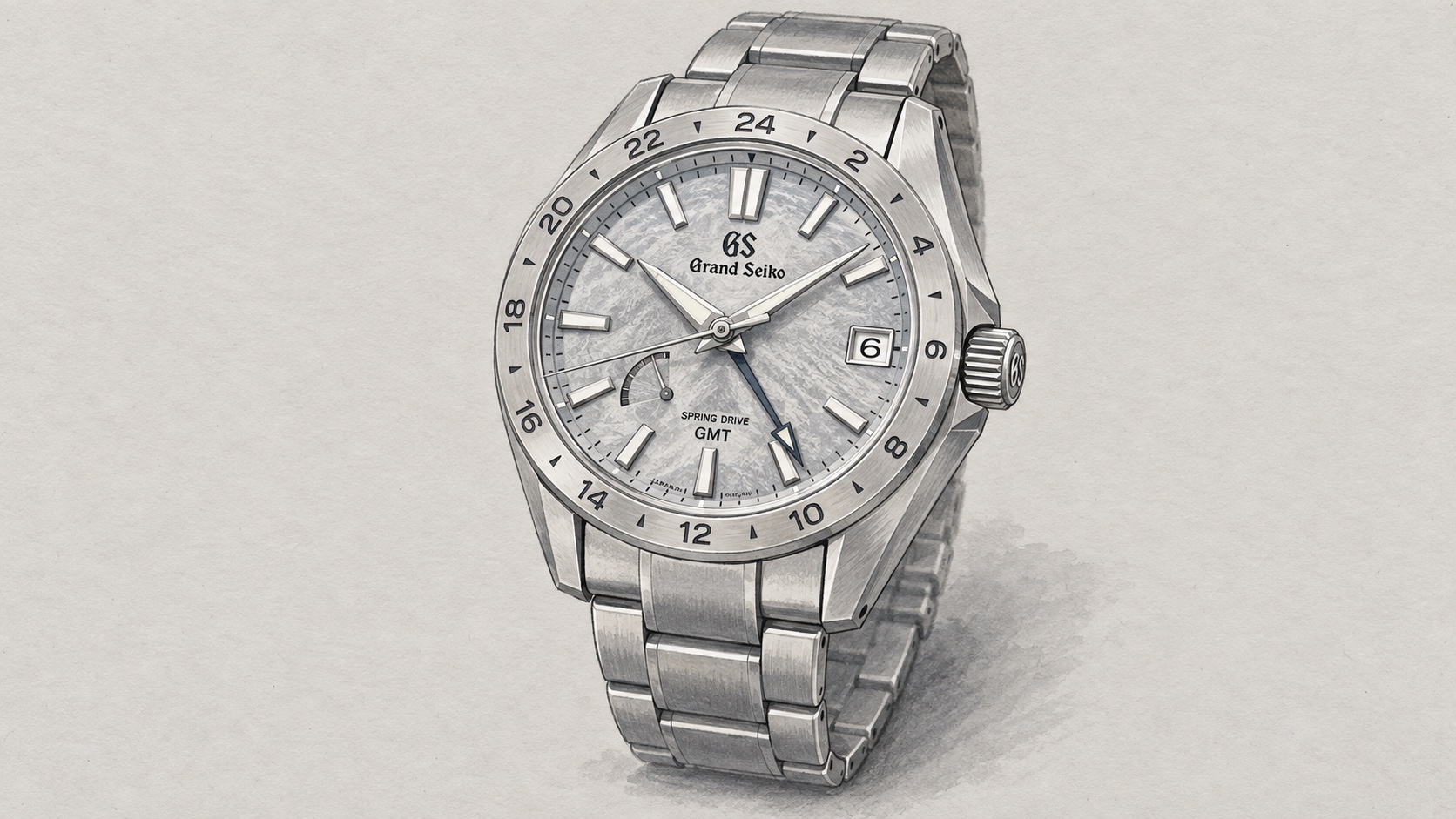
| Grand Seiko SBGE285 | 41 × 13.9mm; 48.3mm lug-to-lug | High-intensity titanium | 9R66 automatic Spring Drive | 72 hours; ±15 seconds per month | Time, date, GMT, power-reserve display |
The SBGA211 Snowflake uses the 9R65, the same calibre designation that marked Grand Seiko’s 2004 introduction. Its white textured dial, blue seconds hand and power-reserve indicator make the motion easy to notice. The reference has a 100m water-resistance rating and a titanium bracelet, so its appeal extends beyond a movement demonstration.
The SBGE285 adds a GMT display through the 9R66. It retains a three-day reserve and the same stated monthly accuracy as the Snowflake, but adds information and a different case profile. Both measure 41mm across; the table shows why that shared diameter does not make their proportions identical.
Choose the implementation as well as the invention
If the uninterrupted seconds hand is the main attraction, the Snowflake offers a comparatively direct expression of it. If a second time zone is useful, the SBGE285 makes that same underlying technology do more work. Neither requires a fascination with every development milestone to be enjoyable.
The history does explain the choice you are making. Spring Drive preserves spring power while accepting electronic regulation, and different generations develop that compromise in different ways. Decide which combination of dial, functions and case suits you, then judge the exact movement’s specifications. The innovation is shared; the watches are not interchangeable.
Based on the manufacturers’ published information. Sources and specifications checked on 8 September 2026.
Image: AI-generated editorial illustration of the Grand Seiko SBGE285. Design details are approximate; this is not a product photograph.