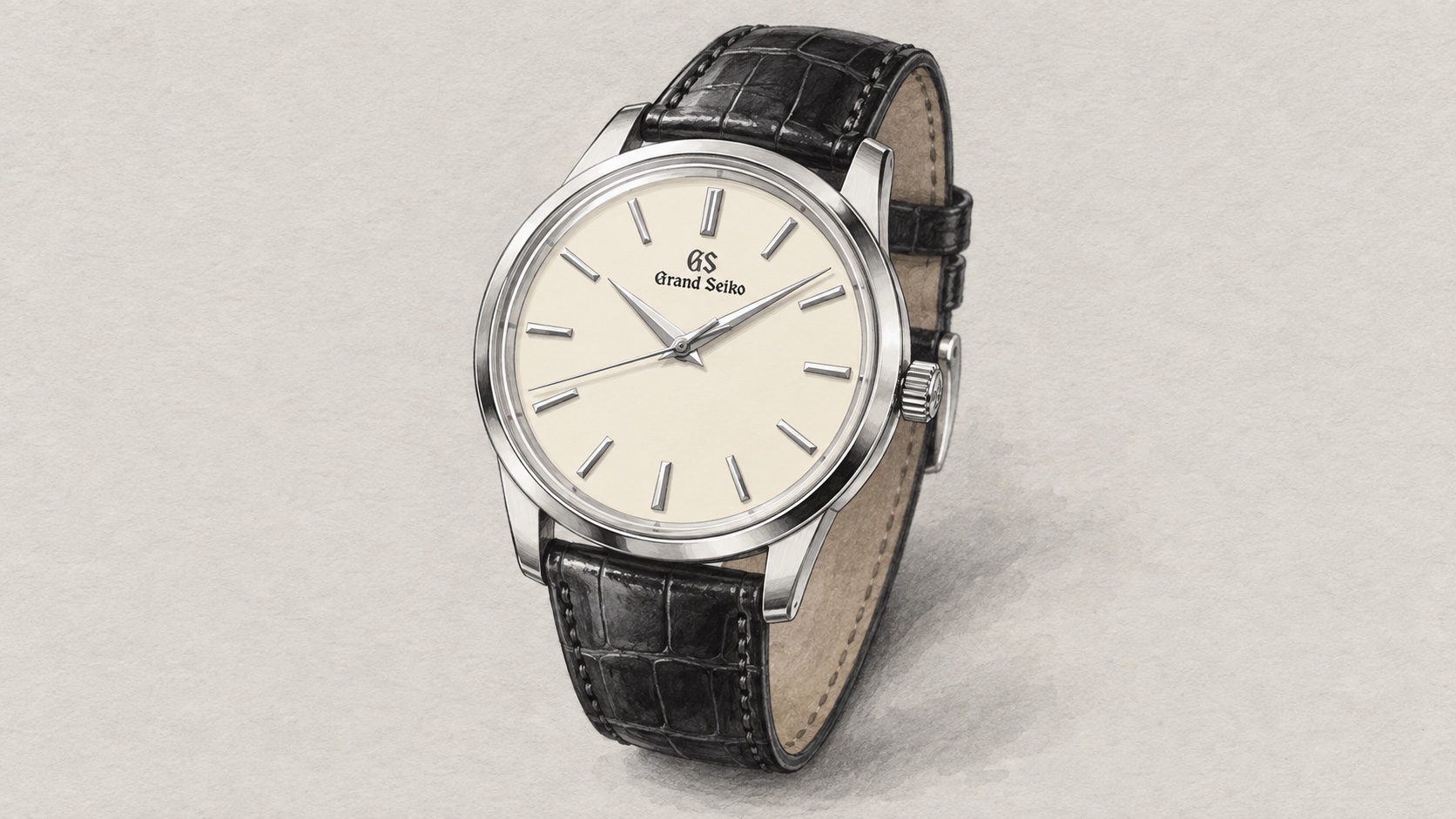
The Snowflake and SBGW231 make the choice between two Grand Seikos unusually clear. One turns snow-inspired texture, a blue gliding seconds hand and titanium into a distinctive everyday watch. The other removes the calendar and automatic rotor, leaving a cream dial and a smaller manually wound watch on leather.
Their shared three-day reserve conceals how differently they work and look. Begin with the SBGA211 if Spring Drive and the textured face are central to the attraction. Begin with the SBGW231 if the uninterrupted time display and deliberate act of winding are what you want. Neither needs to be described as the more serious Grand Seiko to make its case.
The references compared
| Feature | Snowflake SBGA211 | SBGW231 |
|---|---|---|
| Case | 41mm titanium | 37.3mm steel |
| Thickness | 12.5mm | 11.6mm |
| Movement | Spring Drive 9R65; automatic | Mechanical 9S64; manual |
| Reserve | Approximately 72 hours | Approximately 72 hours |
| Dial | White textured; date; reserve indicator | Cream; time only |
| Attachment | Titanium bracelet | Crocodile leather |
| Water resistance | 10 bar | Splash resistant |
| Crystal | Dual-curved sapphire | Box-shaped sapphire |
Two histories behind the decision
Grand Seiko’s first Spring Drive calibre, 9R65, established the movement family used in the Snowflake. Its winding mainspring and electronic regulation belong to a different development path from the conventional mechanical 9S64. Seiko introduced that manual calibre in 2011, connecting a modern three-day reserve with the hand-wound format of the first Grand Seiko in 1960. The relevant history is therefore technological as well as visual. Both watches reflect the brand’s longstanding attention to a clear time display, but they reach it through different mechanisms. The Snowflake makes its distinctive movement visible in the seconds hand and reserve display; the SBGW231 puts more of its identity into restraint and the interaction with its crown.
A gliding hand or a conventional mechanical rhythm
The Spring Drive movement uses a mainspring for energy, with a quartz reference and electromagnetic regulation governing its release. That produces the continuous glide which is one of the Snowflake’s most recognisable features. It is not a battery-powered quartz watch, and it is not a conventional lever-escapement automatic either.
The SBGW231 is a mechanically regulated, manually wound watch. Choosing it makes sense when that particular mechanism and the absence of an automatic rotor are positive preferences. Choosing the Snowflake makes sense when the gliding hand and its different regulation are part of what fascinates you. The movements offer a more interesting distinction than a simple contest over which one contains more traditional watchmaking.
The calendar and reserve display divide opinion for a reason
The Snowflake’s textured background is interrupted by a date window and a reserve indicator. Those functions make the face more informative, but they also give the texture a less symmetrical setting. The blue seconds hand moves across a dial which is doing several things at once.
The SBGW231’s cream face leaves more space around the hands and applied markers. It does not ask the owner to like a nature-inspired surface or a reserve scale. If you admire the Snowflake in close-up but keep imagining it without the indicators, the SBGW231 offers a genuinely different composition. If the cream dial seems too quiet, that is an equally good reason to choose the more visually specific Snowflake.
Smaller steel does not simply replace larger titanium
The Snowflake’s case and bracelet are titanium, and the maker lists the complete watch at 100g. Its larger diameter therefore should not be treated as proof that it is the heavier proposition in every comparison. The SBGW231 uses steel and a leather strap, producing a different balance and outline.
Compare the complete forms rather than the diameters alone. The Snowflake’s bracelet carries its metal surfaces around the wrist, while the SBGW231’s dark strap isolates the cream dial. Their published water-resistance descriptions also differ substantially. The Snowflake’s ten-bar specification fits its broader everyday brief; the SBGW231’s splash-resistant description reinforces that the leather-strapped watch is proposing another kind of object.
Which one deserves the place in your collection?
Choose the SBGA211 when Spring Drive, the titanium bracelet and the particular snow texture are the reasons you want a Grand Seiko. The calendar is then an additional benefit rather than an unwanted interruption, and automatic winding supports its everyday role.
Choose the SBGW231 when the smaller case, clean cream dial and manual winding form a coherent attraction of their own. It is less persuasive as a substitute bought while still wanting the Snowflake’s moving blue hand. Conversely, the Snowflake is not an upgrade for someone whose ideal watch deliberately has no calendar. Decide which display and mechanism you want to revisit daily; the shared reserve means that headline number does little to settle this particular choice.
Specifications and sources checked on 8 September 2026. Snowflake specifications; Spring Drive explained; SBGW231 specifications; 9S64 movement history.
Image: AI-generated editorial illustration of the Grand Seiko SBGW231. Design details are approximate; this is not a product photograph.


