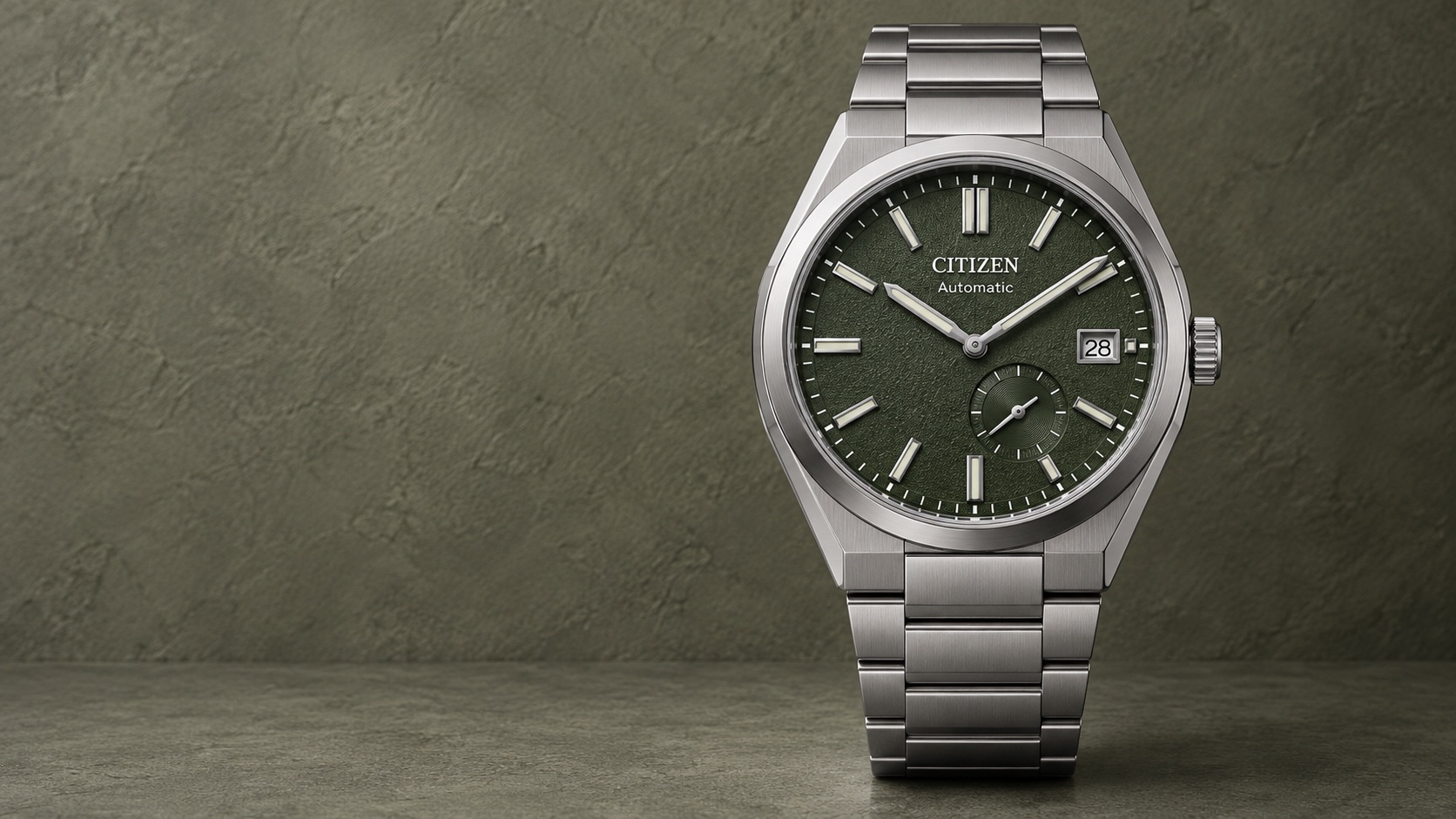
If the weight of a steel bracelet watch bothers you by mid-afternoon, titanium is a sensible place to look. It is less sensible to choose a titanium watch solely because its specification promises a particular material. The Citizen Zenshin NJ0180-80X, Tudor Pelagos 39 and Grand Seiko Snowflake SBGA211 have different dials, adjustments and movements. Those differences remain after the first impression of lightness.
There is a revealing number in this comparison: Citizen publishes 99 g for the Zenshin and Grand Seiko 100 g for the Snowflake. Those figures do not prove identical comfort, but they do show why a far more expensive movement should not be confused with a dramatically lighter watch.
Titanium carries three different design ideas
Citizen’s 2024 Zenshin programme connects its shaped case and bracelet to 1980s design, while the textured dial evokes raw titanium. Small seconds also recalls Citizen’s 1924 pocket watch in its centenary year. Tudor’s Pelagos 39 instead applies a compact format to its diving-watch tradition; its distinctive Snowflake hands belong to a design language introduced in 1969. Grand Seiko’s Snowflake uses a white textured dial and blued seconds hand to make the movement’s continuous glide visible. Its Spring Drive system combines mechanical energy with quartz-controlled regulation. These are useful differences to recognise before grouping all three together as alternatives on a material checklist.
| Exact reference | Diameter / thickness | Titanium construction | Movement / reserve | Published weight |
|---|---|---|---|---|
| Citizen NJ0180-80X | 40.5 / 11 mm | Super Titanium with Duratect TiC | 8213 automatic / 42 hours, Europe | 99 g |
| Tudor M25407N-0001 | 39 / 11.8 mm | Grade 2 titanium case and bracelet | MT5400 automatic / about 70 hours | Not specified here |
| Grand Seiko SBGA211 | 41 / 12.5 mm | High-Intensity Titanium case and bracelet | 9R65 Spring Drive / 72 hours | 100 g |
Weight is only one part of fit
The Zenshin is 40.5 mm across and 11 mm thick, with an angular case and a bracelet that visually continues its shape. The Pelagos is narrower at 39 mm but 11.8 mm thick. The Snowflake measures 41 mm across, 12.5 mm thick and 49 mm from lug to lug. On a smaller wrist, that last measurement can be more revealing than the near-identical published weight of the Citizen.
Published weights are reference figures, not a promise about the weight of a bracelet after you remove links. Tudor’s selected product information does not provide a comparable weight here, so there is no honest three-way numerical ranking. During a fitting, pay attention to whether the watch head sits securely and where the clasp lands beneath your wrist. A low overall weight cannot solve a poor bracelet fit.
Look at the surfaces, then the clasp
Citizen specifies Super Titanium with Duratect TiC surface treatment. Tudor uses grade 2 titanium, and Grand Seiko describes its material as High-Intensity Titanium. These names are not interchangeable hardness specifications. A treatment or alloy name alone is insufficient evidence for a claim that one finished watch will resist every kind of mark better than the others.
The Pelagos makes a specific practical case through its bracelet. T-fit gives adjustment at the clasp, and Tudor also supplies a complementary rubber strap. Its black dial has no date, its unidirectional bezel has a ceramic insert, and the case is rated to 200 metres. The Citizen and Grand Seiko each have a 10-bar rating and a date display, but neither becomes a Pelagos equivalent simply by sharing titanium construction.
Choose the dial before worrying about abstract metal rankings. The green Zenshin places small seconds away from the central hands. The Pelagos uses a comparatively direct diver layout. The Snowflake combines its pale texture with a power-reserve indicator and a central seconds hand. Each asks you to enjoy a different arrangement of information.
Three ways to keep it running
The Citizen’s calibre 8213 is a conventional automatic movement. The European specification gives 42 hours of reserve; Citizen Singapore describes approximately 40 hours for the same reference. Treat that as a regional specification difference, rather than assuming two hours of extra running time is guaranteed for every example.
Tudor specifies approximately 70 hours for its COSC-certified MT5400. Grand Seiko specifies 72 hours for the 9R65, with accuracy of ±15 seconds per month, equivalent to ±1 second per day in its published description. Spring Drive obtains energy from a mainspring, wound automatically or by hand, while its regulating system uses a quartz reference. It is not a battery-powered quartz watch, and its specification should not be described as if it were an ordinary mechanical escapement.
Choose the Zenshin when its green texture, small seconds and titanium bracelet answer the brief. Choose the Pelagos when clasp adjustment, a spare rubber strap and the diver’s layout are useful enough to justify it. Choose the Snowflake when the white dial and Spring Drive are the reason you want the watch. Titanium makes each of these possible in its own way; it does not make them substitutes for one another.
Based on manufacturer information. Specifications checked on 8 September 2026.
Sources: Citizen Europe: NJ0180-80X; Citizen Singapore: NJ0180-80X; Citizen: Zenshin 2024 introduction; Pelagos 39 specifications; Pelagos 39 design and movement; Tudor Pelagos 39 history and press dossier; Grand Seiko UK SBGA211; Grand Seiko Spring Drive explanation.
Image: AI-generated illustration. Fine details may differ from the watch.


