Three small circles on a chronograph dial look reassuringly familiar. They can make two watches seem closely related even when their hands are doing different jobs. On one, the central stopwatch hand takes a minute to complete a lap. On another, it races around in ten seconds.
Chronograph layout history is therefore more than a story about attractive “panda” dials. It is the history of deciding which measurement deserves the largest hand, where to put the accumulated time and how much extra information can fit around it. Familiar looks can conceal quite different priorities.
1952: the Navitimer surrounds timing with calculation
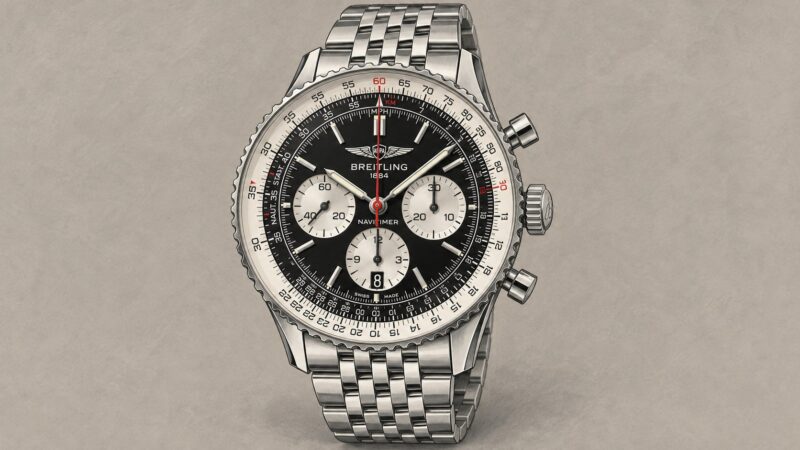
Breitling dates the Navitimer’s development to 1952, when Willy Breitling combined a wrist chronograph with a circular slide rule. The Aircraft Owners and Pilots Association adopted it as its official timepiece two years later. This gave the watch a distinct visual problem: a chronograph already needed several indications, and the calculator added two more interacting scales.
The result was intentionally information-rich. The outer part of the dial was not empty space waiting to be decorated. It held a separate tool. That history makes the Navitimer’s density easier to understand, even if the modern buyer is attracted chiefly to its appearance.
It also explains why judging all chronographs by the same ideal of minimalism is unhelpful. A calculator-equipped watch has a different brief from one designed to make an elapsed-time reading as prominent as possible. Removing those outer scales would simplify the face while changing the identity of the watch.
1957: the Speedmaster moves a useful scale outward
Omega’s account of the original 1957 Broad Arrow Speedmaster emphasises its bezel-mounted tachymeter and the connection with motor racing. Moving that scale outside the main dial made the case border an active part of the timing display. The bezel and central chronograph hand could work together while the smaller counters occupied the dial.
That arrangement gives the Speedmaster a different visual hierarchy from the Navitimer. The timing scale has a strong dark frame, and the subdials read as separate areas within it. It is a design you can appreciate before needing the calculation the outer scale allows.
The history is not a guarantee that every later Speedmaster has the same movement, size or calendar layout. Omega’s current collection includes several interpretations. The exact reference matters particularly when an apparently familiar model has recently changed.
1969 to 2021: Zenith gives the central hand a faster job
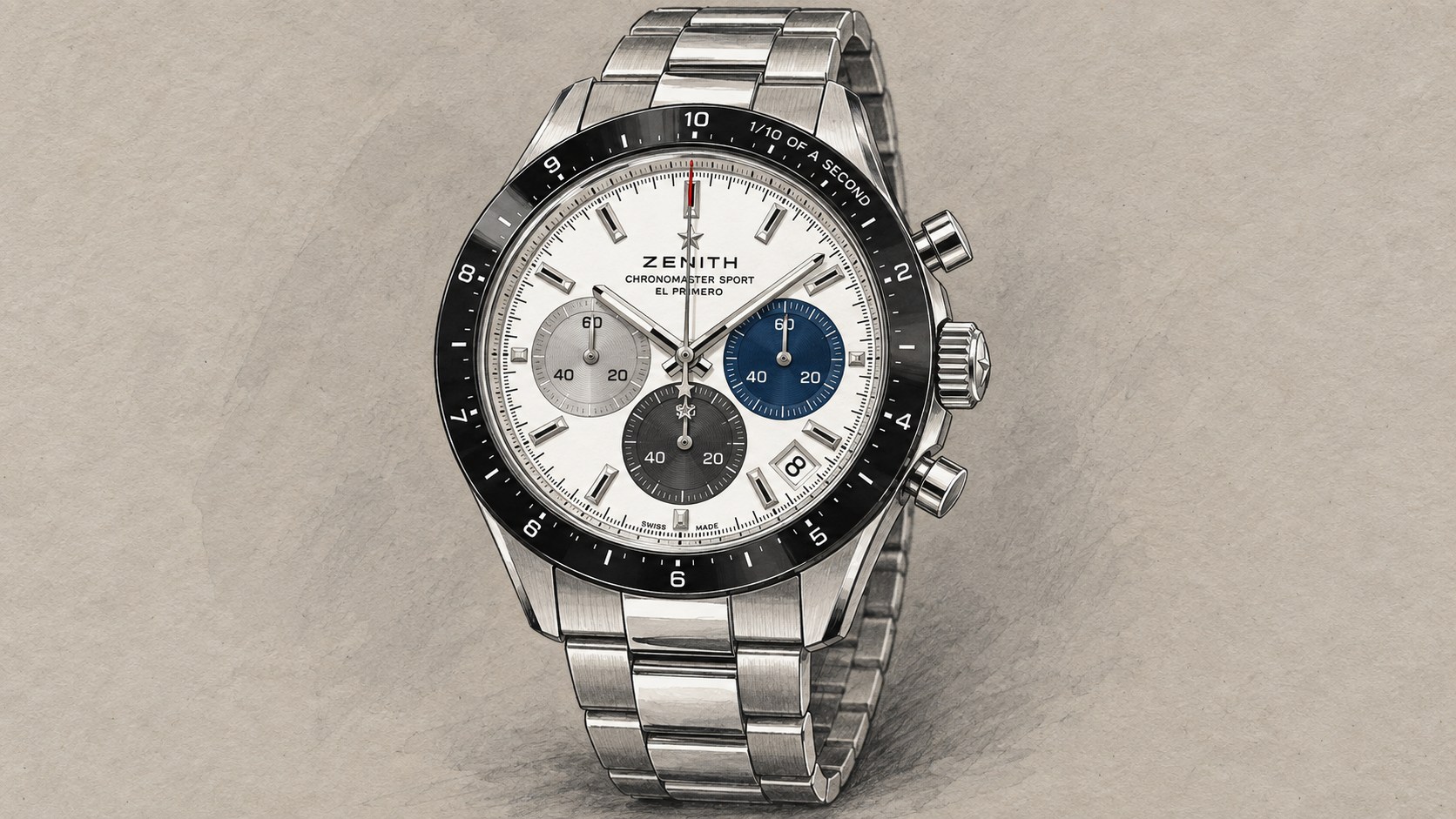
Zenith’s El Primero lineage reaches back to 1969. Its 2021 Chronomaster Sport introduction developed the high-frequency chronograph around a conspicuous one-tenth-second display. The central chronograph hand completes a revolution in ten seconds, with a matching scale on the bezel.
That changes how the display must distribute information. In the Chronomaster Sport’s documented layout, the counter at three records 60 seconds, the counter at six records 60 minutes and running seconds sit at nine. Three counters remain, but their functions cannot simply be inferred from a familiar arrangement of circles.
The three colours add another layer of identity. They help distinguish the counter areas visually, while the mechanism defines what those areas actually measure. This is where styling and engineering meet most clearly: a colour scheme can guide the eye, but it cannot substitute for understanding the scale.
Three modern chronographs with different priorities
| Exact reference | Case diameter × thickness | Movement and reserve | Display emphasis | Water resistance |
|---|---|---|---|---|
| Omega Speedmaster 38 324.30.38.50.01.002 | 38 × 14.75mm | 3332 automatic; 52 hours | Round counters; no date; tachymeter bezel | 100m |
| Breitling Navitimer B01 41 AB0139211B1A1 | 41 × 13.6mm | Breitling 01 automatic; about 70 hours | 30-minute and 12-hour counters; date; circular slide rule | 30m |
| Zenith Chronomaster Sport 03.3100.3600/69.M3100 | 41mm diameter | El Primero 3600 automatic; about 60 hours | Central 10-second revolution; 60-second and 60-minute counters; date | 100m |
The black Speedmaster 38 reference 324.30.38.50.01.002 belongs to Omega’s 2026 collection extension. It has round subdials, no date and the automatic calibre 3332. Those details distinguish it from earlier Speedmaster 38 references with oval counter treatments and a date. A shared collection name is not enough to transfer an older specification.
The modern Navitimer retains its circular slide rule alongside the date and chronograph counters. The Chronomaster Sport makes the fast central hand and one-tenth-second bezel scale central to its appeal. All three are automatic, yet the interaction between bezel, hands and counters remains materially different.
Read the scales before choosing the dial
A useful comparison starts by identifying the running seconds. Then find the hand that starts with the chronograph, the counter that accumulates minutes and, if present, the hour recorder. This short exercise prevents an attractive arrangement from obscuring a function you actually wanted.
Next, decide what you enjoy about the watch. The Navitimer rewards an appetite for layered information. The Speedmaster offers a clearer division between a timing bezel and the main dial. The Zenith makes its movement’s fast measurement visible in a more theatrical way. None of those priorities automatically makes the others obsolete.
The lasting lesson is that chronograph design has developed through different answers to different jobs. Choose the layout you can understand and enjoy, then check the exact reference. Three subdials may be the beginning of the comparison, but they are never the whole specification.
Based on the manufacturers’ published information. Sources and specifications checked on 8 September 2026.
Image: AI-generated editorial illustration of the Zenith 03.3100.3600/69.M3100. Fine dial details and finishing may differ from the production watch.