Cartier makes a persuasive case for choosing a watch from its outline inward. The square frame of a Santos and the long sides of a Tank communicate their identity before you examine a calibre or even read the time. Their shapes are not simply containers for movements. They are the main event.
That approach helps explain why changing a few millimetres, rounding an edge or removing a familiar dial detail can produce a markedly different Cartier. The history is a sequence of experiments with proportion, rather than a straight march from an old round watch to a better rectangular one.
1904: the Santos puts a practical problem into a square case
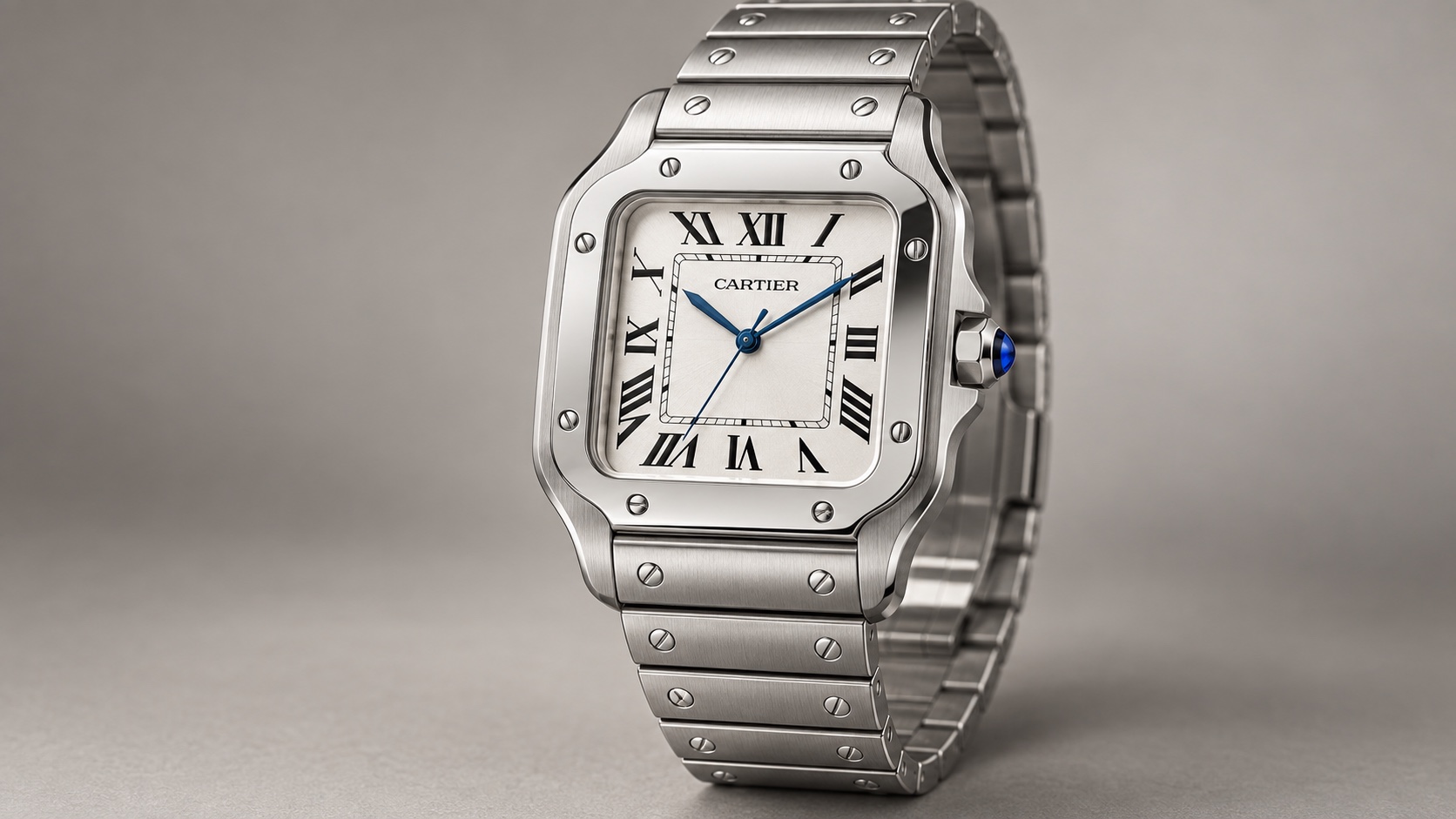
In Cartier’s account of its design history, Louis Cartier created a watch for Alberto Santos-Dumont in 1904 so the aviator could consult the time without retrieving a pocket watch. Its square form and visible bezel screws became central to the Santos identity. The practical setting matters, but so does the decision to make those construction details part of the appearance.
Today, that combination gives the Santos an unusual position. It has jewellery-like attention to surfaces and a conspicuous mechanical-looking border. The exposed screws interrupt the polish and give the square case a rhythm that a plain round bezel cannot reproduce.
The modern Medium WSSA0029 develops that vocabulary with a steel bracelet, an automatic 1847 MC movement and 100m water resistance. Cartier supplies a second calfskin strap, with QuickSwitch interchangeability and SmartLink bracelet adjustment. The familiar shape now belongs to a notably adaptable watch, rather than a fixed recreation of the original aviation object.
1917: the Tank makes the sides part of the design
Cartier dates the Tank’s creation to 1917. Its two parallel side sections, commonly called brancards, are fundamental: they frame the dial and connect the watch visually to its attachment. That relationship explains why the shape remains recognisable even when the dial colour or movement changes.
Compared with the Santos, a conventional Tank puts less emphasis on a broad border surrounding the dial equally on every side. The vertical elements lead the eye along the wrist. This gives a relatively small watch a clear direction, so the width alone can be a misleading description of its presence.
The difference is useful when trying watches on. A round diameter compresses a case into one familiar number. A shaped Cartier asks you to consider length and width together, then notice how the strap meets the case. A longer watch can extend along the wrist without needing to become much wider.
1922 and beyond: Tank is a family of forms
Cartier’s 2025 presentation dates the Tank Louis Cartier to 1922, describing it as a successor to the original Tank. The same presentation revisits the Tank à Guichets, first introduced in 1928, with aperture-based time displays. That contrast demonstrates how far the Tank idea can stretch without abandoning its basic case identity.
It also makes collection names worth reading carefully. The 2025 presentation includes a new large automatic Tank Louis, while the medium WGTA0211 considered here is hand-wound. The family history cannot tell you the mechanism in an individual reference. Size names and movement types need to be checked together.
The WGTA0211 uses yellow gold, a golden sunray-effect dial and golden-finished sword-shaped hands. It takes the Tank Louis towards a much quieter display than the familiar Roman-numeral composition. The rectangular outline carries more of the identity when the dial is reduced this far.
Three current references, three different propositions
| Exact reference | Material and length × width × thickness | Movement | Dial | Attachment and rating |
|---|---|---|---|---|
| Santos de Cartier Medium WSSA0029 | Steel; 41.9 × 35.1 × 8.8mm | 1847 MC automatic | Silvered opaline; blued sword hands | Steel bracelet plus calfskin strap; 100m |
| Tank Louis Cartier Medium WGTA0211 | Yellow gold; 33.7 × 25.5 × 6.6mm | 1917 MC manual; 37 hours | Golden sunray-effect dial; golden-finished hands | Black alligator strap; 30m |
| Tank Must Large WSTA0136 | Steel; 33.7 × 25.5 × 6.6mm | High Autonomy quartz | Silvered dial; blued sword hands | Black grained calfskin strap; 30m |
The Tank Must Large WSTA0136 gives the familiar Tank arrangement a steel case and quartz movement. Its silvered dial and blued hands create a more graphic contrast than the golden Tank Louis. Both references share published dimensions of 33.7 by 25.5 by 6.6mm, despite one being called Large and the other Medium within their respective ranges.
That is a particularly clear example of why collection labels cannot replace measurements. The two Tanks occupy the same stated case envelope, but the material, dial treatment and daily interaction differ. Winding the Louis and leaving the quartz Must ready to wear are distinct ownership preferences, not simply different levels of the same product.
Choose the shape before the historical argument
The Santos suits a buyer who wants the bracelet and case to make a strong, continuous statement, with the option to soften it on leather. A Tank makes more sense if you are drawn to a narrower composition and the way its parallel sides frame the wrist. Trying both shapes tells you more than debating whether square or rectangular watches are theoretically more versatile.
Within the Tank family, the Must and Louis show how much can change without changing dimensions. Choose quartz steel for a practical expression of the recognisable layout, or consider the gold hand-wound reference because its material and restrained dial are specifically what you want.
Cartier’s history rewards attention to those small decisions. The enduring achievement is a set of shapes strong enough to survive considerable variation. The most satisfying choice is the version whose proportions still hold your attention after the famous name and story have done their work.
Based on the manufacturers’ published information. Sources and specifications checked on 8 September 2026.
Image: AI-generated editorial illustration of the Cartier Santos de Cartier Medium WSSA0029. Fine dial typography and finishing may differ from the production watch.