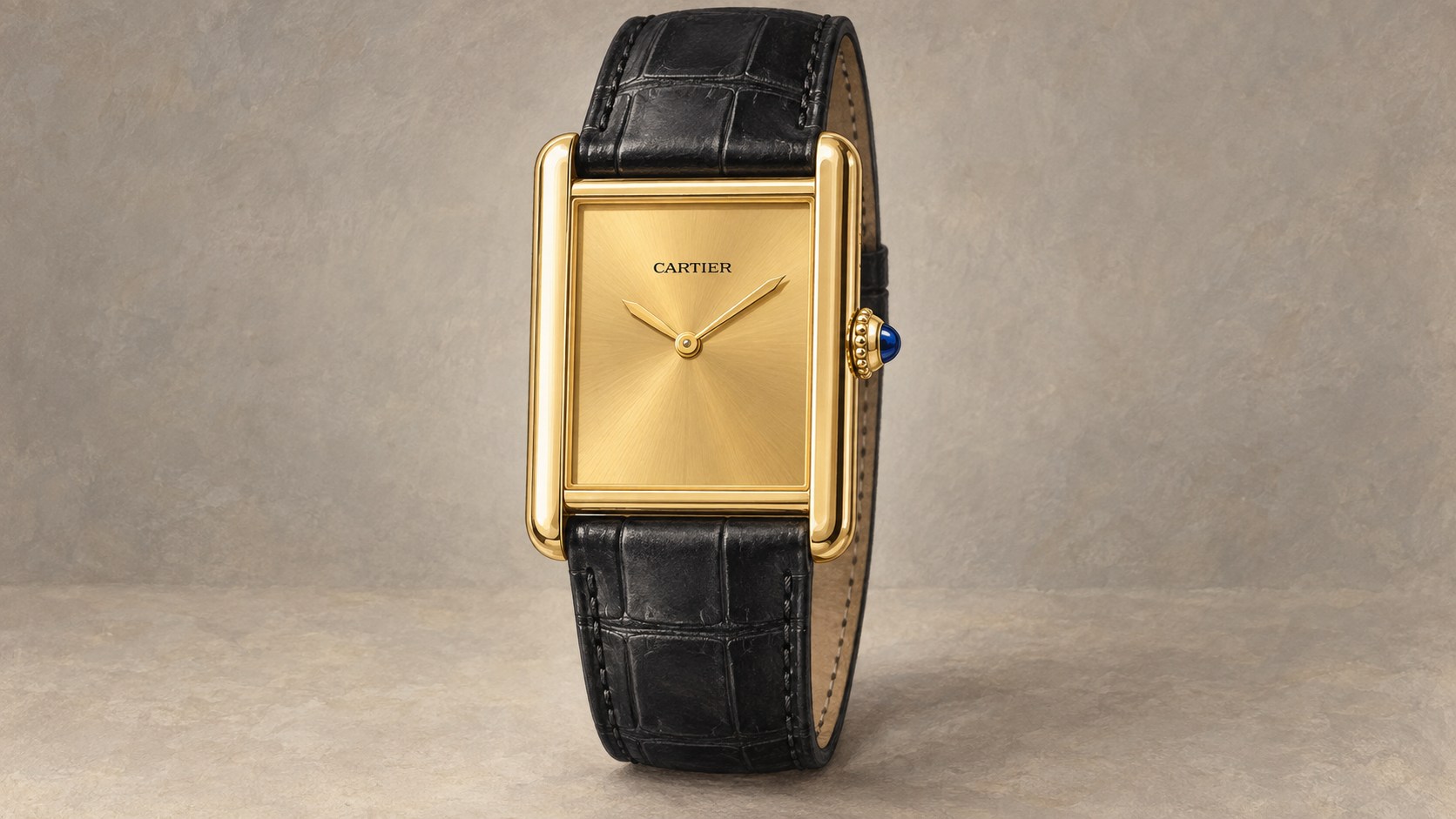
A simple gold Tank asks you to value the object rather than its list of functions. On WGTA0211, the golden sunray dial, yellow-gold case and gold-coloured hands concentrate attention on material and proportion. There is no date or seconds display to supply another reason to glance down.
That makes the hand-wound medium model a particularly deliberate purchase. Its 1917 MC movement adds a small daily relationship with the mechanism, while the exterior remains quiet. It is worth choosing when those limited ingredients are exactly what you want, rather than when you are hoping the Tank name will compensate for a desire for more visible technical activity.
The history behind the choice
The original Tank design dates to 1917, and Cartier identifies the Tank Louis Cartier as a development introduced in 1922. Its connection to the parent shape is visible in the long side elements which frame the dial and continue towards the strap. The family has continued to evolve rather than preserving one movement and size indefinitely. In 2025 Cartier introduced a new large Tank Louis with the automatic 1899 MC calibre. That update is relevant precisely because the medium WGTA0211 examined here remains manually wound, using the 1917 MC. A current buyer therefore has to choose a particular Tank Louis, not just the family name. The continuity lies in the design language, while size, dial treatment and winding method can change the experience substantially.
The exact reference
| Specification | Published detail |
|---|---|
| Reference | WGTA0211 |
| Case | 18K yellow gold; medium model |
| Dimensions | 33.7mm long by 25.5mm wide; 6.6mm thick |
| Dial | Golden; sunray effect |
| Hands | Golden-finished steel; sword-shaped |
| Movement | Manual-winding manufacture calibre 1917 MC |
| Stated reserve | 37 hours |
| Functions | Hours and minutes |
| Crown | 18K yellow gold; sapphire cabochon |
| Water resistance | 30m |
| Strap | Semi-matt black alligator leather |
Gold across the case and the face
This reference repeats a warm colour through the case, dial and hands. The sunray effect supplies movement in the surface as light changes, while the black alligator strap creates a clear boundary around the gold object. It is a more concentrated palette than the familiar silver-dial, blued-hand Tank combination.
That concentration is its attraction and its compromise. The hands are not selected to create the same strong colour break as blue against silver. Someone who wants the most immediately contrasted Tank display should compare another exact dial treatment. Someone attracted to the warm, nearly continuous gold composition should acknowledge that the design places atmosphere and material near the centre of the choice.
The side elements do the architectural work
The long gold sides are not simply a bezel around a small rectangle. They define the Tank’s silhouette and carry the eye from strap to case. The relatively small dial opening is part of that balance: adding more visible face is not automatically an improvement when the surrounding gold is one of the reasons to choose the watch.
The medium case measures 33.7 by 25.5mm and is 6.6mm thick. Those are shaped-watch dimensions, not equivalents to a round diameter. In person, assess the complete length and how the black strap leaves the case. The useful question is whether the gold frame and dial have the balance you wanted, rather than whether Medium sounds substantial enough for the purchase.
Manual winding is part of the brief
The 1917 MC is a manually wound manufacture movement with a published thirty-seven-hour reserve. Its task is limited to hours and minutes. The owner supplies energy through the crown rather than relying on an automatic rotor during wear, which makes the act of winding a more visible part of ownership than the mechanism is on the dial.
That routine can be part of the pleasure. It can also be an unnecessary demand for someone who wants to select the watch only occasionally and find it ready. The right comparison is not between mechanical prestige and an inferior alternative. It is between a particular mechanical ritual and the convenience of an appropriate quartz Tank. Choose the routine which adds something you actually value.
Do not confuse it with the automatic large model
Cartier’s 2025 large Tank Louis uses a different calibre, the automatic 1899 MC. That means a general description of the current collection can easily become misleading if applied to this medium reference. The names describe related designs with different movement choices.
The newer automatic does not make manual winding obsolete as a preference. It simply gives another way to own the family shape. If your ideal Tank includes a deliberate winding ritual and these specific medium proportions, WGTA0211 remains the relevant watch. If your priority is automatic operation, identify the appropriate large reference and compare its complete dimensions and dial rather than assuming only the winding method changes.
Where the extra expense earns its place
A steel quartz Tank Must can provide the broad rectangular vocabulary with a different material and movement brief. The gold Tank Louis must therefore justify itself through the particular warmth, case execution and mechanical relationship you want. Those qualities are not reducible to the amount of information displayed.
Choose this reference when its golden dial and frame are the point, and the manually wound movement makes that simple object more engaging. Choose another Tank when contrast, quartz readiness or automatic winding matters more. A watch with two hands can offer a great deal of visual interest, but only to someone who wants to spend time with the details those hands leave room to notice.
Specifications and sources checked on 8 September 2026. Tank Louis Cartier WGTA0211 specifications; Cartier Tank Louis history and 2025 development; Cartier Tank design principles; Quartz Tank Must comparison.
Image: AI-generated editorial illustration of the Cartier WGTA0211. Fine dial details and finishing may differ from the production watch.


