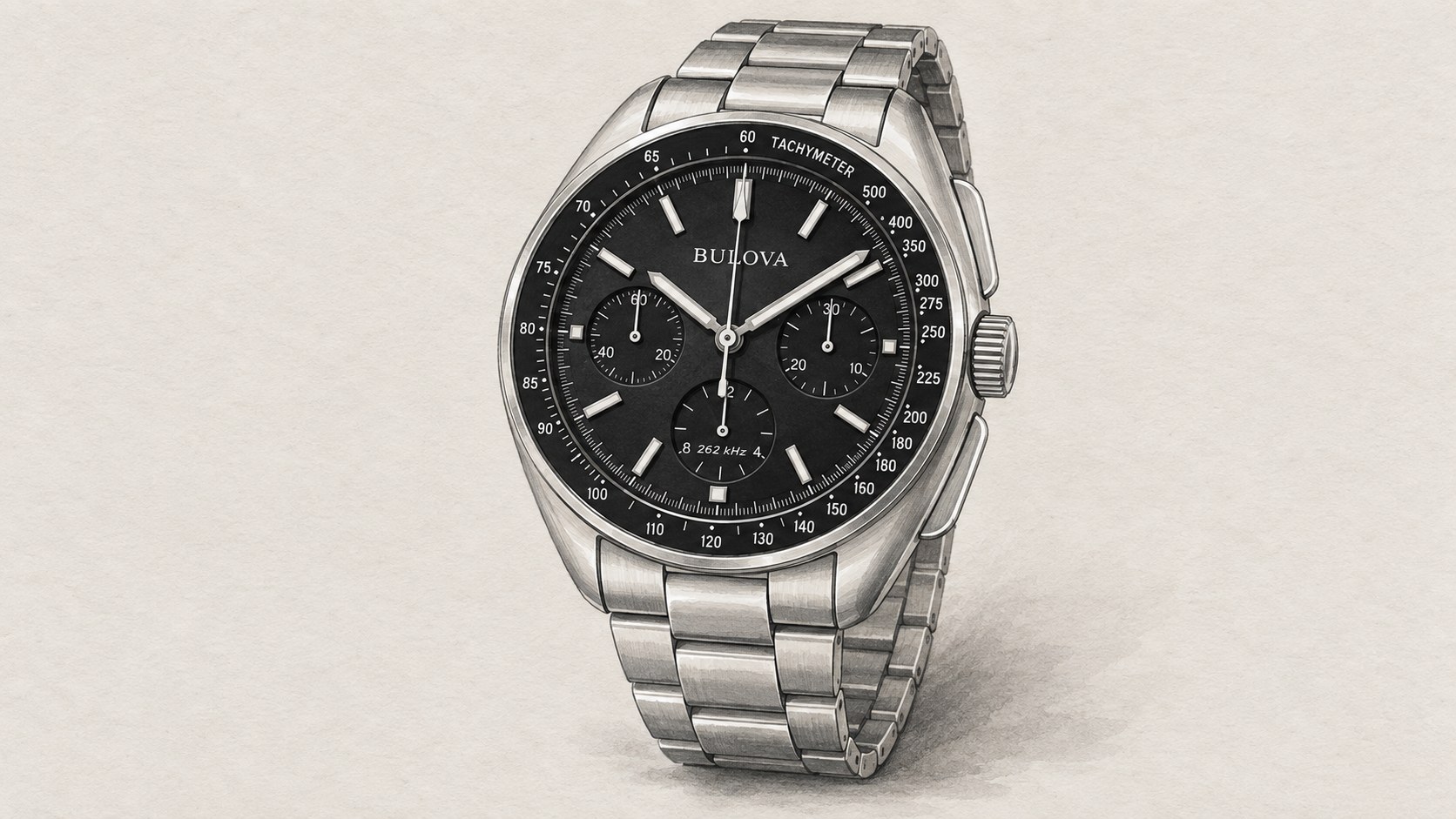
A connection to the Moon can lead to two very different ownership routines. The Bulova Lunar Pilot keeps its quartz movement running between outings. The Omega Speedmaster Moonwatch asks you to wind a mechanical movement and gives you a view of it through sapphire.
The choice is therefore more personal than deciding which space story is stronger. This comparison uses Bulova’s 43.5 mm black-dial 96K111 and Omega’s 42 mm sapphire Moonwatch on steel. Both are modern chronographs with historical connections, but neither is the original watch carried on a mission.
The references compared
| Feature | Bulova 96K111 | Omega 310.30.42.50.01.002 |
|---|---|---|
| Diameter | 43.5 mm | 42 mm |
| Thickness | Not stated in source used | 13.18 mm |
| Lug width | 20 mm | 20 mm |
| Movement | NP20 high precision quartz | 3861 manual winding |
| Reserve / frequency | 262 kHz quartz oscillator | 50-hour mechanical reserve |
| Crystal | Anti-reflective sapphire | Domed sapphire; inner coating |
| Water resistance | 50 m | 50 m |
| Attachments | Steel; extra black leather NATO-style | Steel bracelet |
| Caseback | Closed commemorative design | Sapphire display |
Specifications: Bulova UK Lunar Pilot 96K111; Omega exact sapphire Moonwatch 310.30.42.50.01.002.
Two lunar connections, two modern mechanisms
Omega’s account of Apollo 11 connects the Speedmaster with NASA qualification in 1965 and the 1969 lunar landing. That institutional role is central to the Moonwatch identity, even as the movement and modern sapphire construction have evolved.
Bulova’s lunar connection comes from Apollo 15, when a specially adapted chronograph was worn on the Moon on 2 August 1971. The current Lunar Pilot translates that association into a high-frequency quartz watch, rather than reproducing the original mechanism. The stories explain why these particular chronographs exist. They do not make their present movements equivalent, and the purchase becomes more satisfying when the historical interest supports a watch you also want to use.
Quartz readiness or a winding ritual?
The Bulova’s NP20 operates with a 262 kHz quartz oscillator. That makes the watch a practical candidate for someone who enjoys the history but wants to pick up the chronograph without first restoring its mechanical reserve.
The Omega’s manually wound calibre 3861 offers 50 hours of reserve. There is no automatic rotor to replenish it during the day. Winding is a repeated part of owning this version, and should be an attraction rather than an inconvenience you hope to overlook.
The sapphire back gives that routine a visible counterpart. You can look at the movement you have just wound. Bulova’s closed back instead keeps the commemorative exterior central. One offers mechanical observation, the other a simpler relationship with daily readiness.
The Bulova is the larger starting point
At 43.5 mm, the Lunar Pilot is wider than the 42 mm Moonwatch. That difference is worth addressing early if you already find broad chronographs difficult to place on your wrist. The Bulova’s historical association does not shrink its present dimensions.
Omega documents a 47.5 mm lug-to-lug measurement and 13.18 mm thickness for the selected sapphire reference. Those extra measurements help you judge its footprint more usefully than diameter alone. The source set used here does not supply an equivalent complete set for the Bulova.
Try the watches with their bracelets adjusted, paying attention to where the first links turn down. A case can look manageable from directly above yet extend beyond the usable top of the wrist once the attachment is included.
Two chronographs, two different pleasures
Both present central chronograph timing alongside smaller counters, with a tachymeter scale contributing to the instrument-like appearance. The attraction may be occasional practical timing, an interest in the mechanism or simply the way a chronograph organises its face.
For the Omega buyer, the manual calibre and Master Chronometer specification are part of the product itself. For the Bulova buyer, the high-frequency quartz mechanism offers its own technical identity. Describing the latter merely as an imitation misses a major reason to choose it.
Operate the start, stop and reset controls during a demonstration and read the relevant counters at an ordinary viewing distance. The layout you find satisfying matters more than an abstract ranking based only on movement category.
The included attachments change the package
Bulova includes a steel bracelet and an additional black leather NATO-style strap. That gives you two quite different visual treatments from the outset. The strap can make the watch’s historic instrument character more prominent, while the bracelet creates a continuous steel outline.
The selected Omega is the steel-bracelet sapphire reference. Its clasp includes a comfort setting, and the display back is a defining reason to choose it over another Moonwatch configuration. Decide whether those details are the ones you actually want before comparing prices across superficially similar listings.
Which story belongs on your wrist?
Choose the Lunar Pilot when the Apollo 15 connection, quartz readiness and included strap alternative make a watch you would use often. Its larger diameter is the main fitting question to resolve.
Choose the Moonwatch when winding calibre 3861, seeing its movement and owning this particular continuation of the Speedmaster appeal together. Neither choice needs borrowed experiences from an astronaut to work. The strongest purchase combines a history you care about with a routine and shape you enjoy.
Based on manufacturer information. Specifications checked on 8 September 2026.
Image: AI-generated editorial illustration of the Bulova 96K111. Design details are approximate; this is not a product photograph.


