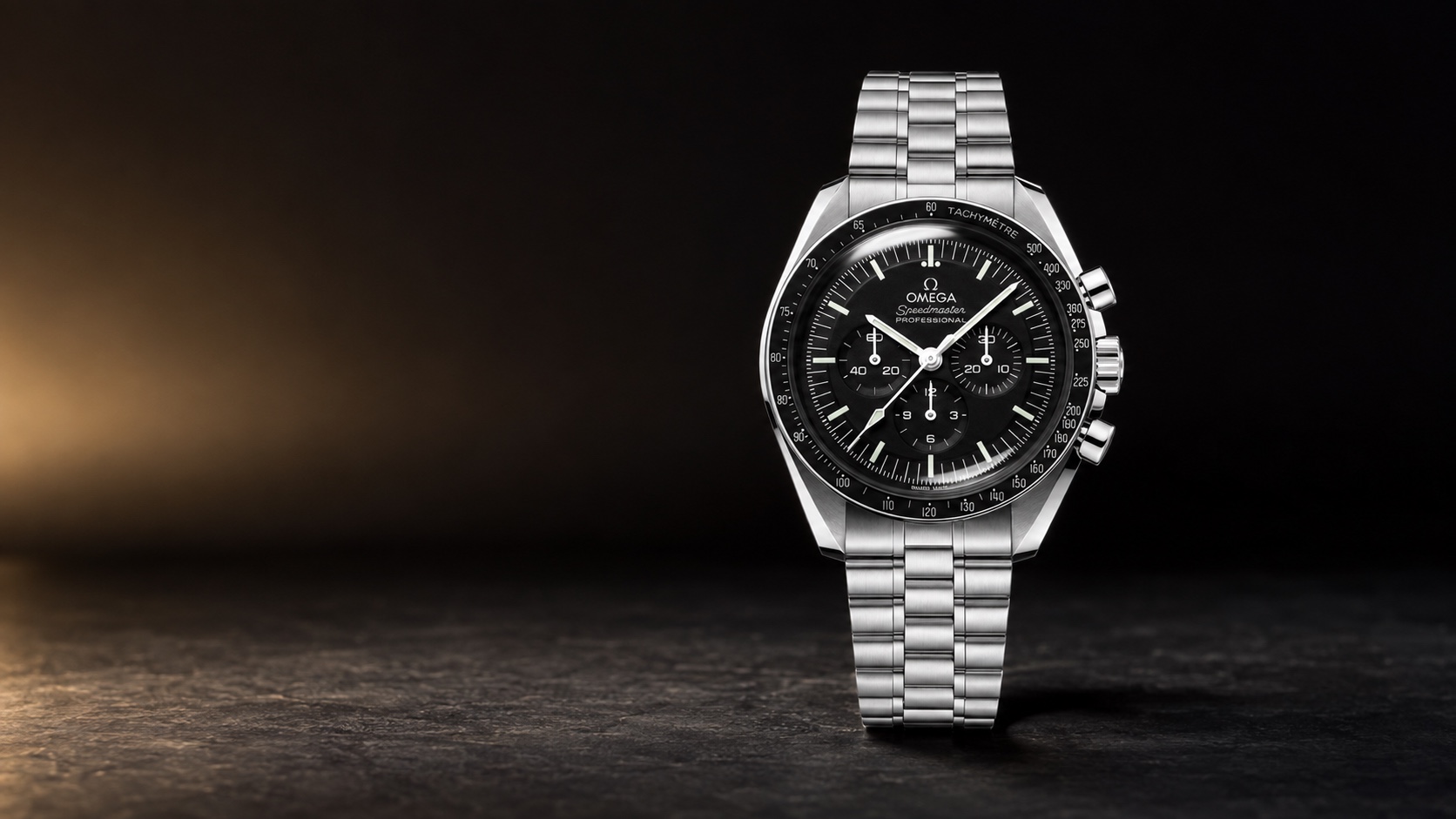
Research-based guide by The Wrist Guide Editorial, using manufacturer specifications and guidance checked on 7 September 2026. This is not a hands-on test. The featured image is an AI composition based on the manufacturer’s product photograph, not a photograph taken during hands-on testing.
The sapphire Speedmaster Moonwatch asks a simple question: will you enjoy operating a mechanical chronograph often enough to make it part of your routine? The design may be the initial attraction, but winding, reading its counters and living with its size are what determine whether it becomes a regular companion.
This guide covers 310.30.42.50.01.002, the black-dial Moonwatch Professional with sapphire crystal and a steel bracelet. Use the complete reference when comparing listings: photographs and abbreviated model names can make nearby configurations look interchangeable.
The exact configuration
| Case | Steel; 42 mm diameter; 13.18 mm thick; 47.5 mm lug to lug |
|---|---|
| Movement | 3861 manual-winding Co-Axial chronograph |
| Certification | Master Chronometer |
| Power reserve | 50 hours |
| Crystal | Domed sapphire with internal anti-reflective treatment |
| Caseback | Transparent |
| Water resistance | 5 bar |
| Bracelet | Steel; foldover clasp with comfort setting; 20 mm lug spacing |
These are Omega’s specifications for the exact reference. They are not measurements taken by The Wrist Guide.
Hand winding is the first buying decision
Wearing this watch does not automatically replenish its reserve. That makes the winding routine a more useful pre-purchase test than reading another account of its reputation. Ask the retailer to show you the crown operation and let you try it. Decide whether it feels like something you will gladly do at a regular time, or a chore you will repeatedly forget.
Fifty hours gives some flexibility between windings, but it is not a generous three-day allowance. If you alternate watches over several days, expect to reset it when it has stopped. That is neither a defect nor a reason everyone should reject it; it is an ownership habit that needs to suit you.
Omega provides reference-specific instructions through its product pages and the QR code on its international warranty card. Keep the correct instructions to hand rather than following setting advice for a different Speedmaster. Find the official user manual.
Read the stopwatch as well as the time
The large central chronograph hand measures elapsed time; ordinary running seconds are shown on a smaller dial. The movement also drives 30-minute and 12-hour recorders. This division is worth understanding before deciding the display is intuitive.
During a demonstration, start timing something, stop it and read the result before resetting. Try a longer interval if the shop visit allows. The dial needs to communicate both normal time and accumulated minutes clearly enough for your eyesight. A chronograph that you only admire in photographs can turn out to be a function you rarely use.
If you do enjoy timing everyday tasks, the separate counters offer a reason to interact with the watch. If you mainly want a quick glance at the time, compare that experience with a simpler display before committing. Additional functions are valuable when they match what you actually do.
Sapphire, a visible movement and real-world fit
The sapphire front and transparent back are the defining reasons to choose this configuration. Spend time looking through both. Reflections, dial visibility at an angle and your interest in the movement are personal observations that a specification sheet cannot settle. This guide does not claim to have compared crystal glare or scratch resistance in testing.
The 42 mm diameter is only one part of the fit. Its stated 47.5 mm case length gives a different perspective, while the thickness still matters under a cuff. Neither dimension tells you exactly how the bracelet will drape on your wrist. Have it sized as realistically as possible before deciding.
Omega lists a comfort setting in the clasp. Ask the retailer to demonstrate the arrangement supplied on the watch you are buying, especially when comparing an older example. Make sure there is a comfortable fit both with your hand relaxed and with your wrist bent at a desk.
What the certification adds
Omega’s Master Chronometer programme includes eight examinations, and owners can access the results for their individual watch. That is more useful evidence than an unsourced claim that every example runs identically. Ask how to retrieve those results when collecting it. Omega’s certification and test-results information.
Budget for care, not just purchase
Omega recommends an annual water-resistance check and a complete service every five to eight years, with service needs affected by use and environment. Its guidance also notes that seals age and impacts can affect water resistance. Treat the 5 bar rating as a specification that depends on the watch remaining in suitable condition. Omega’s care recommendations.
Request a current UK purchase quotation and service estimate for this chronograph. A historical price from an older review is a poor basis for the ownership budget, and neither future servicing costs nor resale value can be guaranteed here.
Verdict
Choose the sapphire Moonwatch if you want to see the movement, enjoy the chronograph layout and welcome regular hand winding. Settle the bracelet fit and counter readability in person first. If winding already sounds irritating, address that before buying on appearance alone. The official product link above provides direct, non-affiliate purchase and boutique enquiries.


