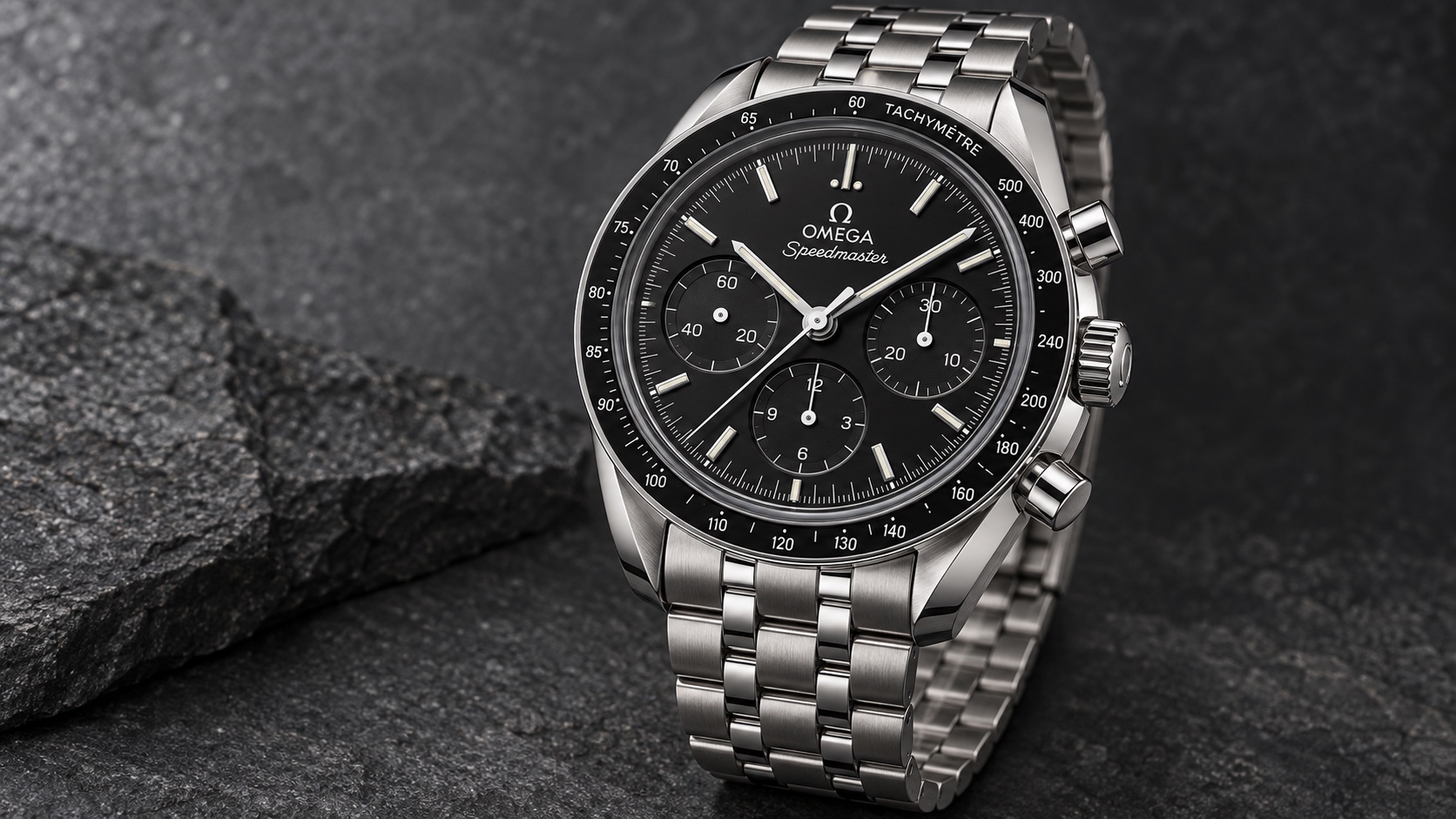
The latest black Speedmaster 38 changes a familiar comparison. The 324.30.38.50.01.002 announced inAugust 2026 has round subdials and no date, bringing its face closer to the Moonwatch than older descriptions of the 38 suggest. It remains a different watch mechanically and physically.
Choose it when automatic winding and the shorter case footprint are important. Choose the sapphire Moonwatch when its manual movement, broader dial and lower profile are the combination you want. The smaller-diameter watch is actually thicker in the published figures, so the decision deserves more attention than a simple choice between big and small.
The references compared
| Feature | 2026 Speedmaster 38 | Sapphire Moonwatch |
|---|---|---|
| Reference | 324.30.38.50.01.002 | 310.30.42.50.01.002 |
| Diameter / thickness | 38mm /14.75mm | 42mm /13.18mm |
| Lug-to-lug | 44.96mm | 47.50mm |
| Movement | Automatic 3332 | Manual 3861 |
| Reserve | 52 hours | 50 hours |
| Certification | Certified chronometer | Master Chronometer |
| Calendar | No date | No date |
| Water resistance | 100m | 50m |
| Bracelet | Steel; comfort release | Steel; comfort setting |
Two histories behind the decision
The Speedmaster family began in 1957, with its later NASA qualification and lunar role giving the Moonwatch a distinct place in that history. The 38mm collection is another branch, and Omega’s 25August 2026 update explicitly moved its appearance closer to the Moonwatch. Round counters replaced oval ones, while this black no-date reference received calibre 3332. Other newly announced 38mm versions retained a date and a different calibre. The historical point is therefore one of development within the family, rather than a competition over which modern reference was on the Moon. The current sapphire 3861 Moonwatch continues an established design line; the new 38 offers another way to approach some of that appearance with automatic winding.
The dial gap has narrowed
The black 38 now has a no-date face and round chronograph counters. Those changes matter if the older oval displays or calendar window were what previously discouraged you. It should be judged as this new reference rather than through pictures of the outgoing configuration.
The Moonwatch still has its own dial proportions and relationship to the surrounding tachymeter. A similar set of indications does not make two faces identical once the available space changes. If your interest is mainly the classic appearance, compare the spacing and scale of the complete displays. The new 38 can be the preferred composition without needing to be described as a miniature copy.
Winding is a clearer difference than reserve
The automatic 3332 and manual 3861 have stated reserves of fifty-two and fifty hours respectively. That small numerical gap is unlikely to be the main reason to choose one. How energy enters the movement is the more meaningful distinction.
The automatic can replenish itself during suitable wear; the Moonwatch requires deliberate winding through the crown. Some buyers want that interaction because it contributes to the mechanical relationship. Others want to enjoy a chronograph without making winding part of its daily appeal. Neither preference needs to be justified through a claim that only one winding method belongs in a Speedmaster.
Smaller across, thicker from the side
The 38’s 44.96mm lug-to-lug length is shorter than the Moonwatch’s 47.50mm. Its 14.75mm height, however, exceeds the larger watch’s 13.18mm. Those measurements describe different shapes rather than one watch being uniformly reduced.
A fitting should compare the case edges and the way the bracelets leave the lugs. The shorter automatic may suit the footprint you want while the thinner manual may suit your preferred profile. Looking only at dial diameter would hide that trade-off. The better choice is the complete form you prefer, including the dimension least visible in a straight-on product photograph.
Certification and rating complete the picture
The selected Moonwatch carries Master Chronometer certification; the new 38 is described as a certified chronometer. Those names should not be treated as interchangeable. The 38 also has the higher stated water-resistance rating in this comparison, giving it a different practical specification alongside its automatic winding.
Choose the new black 38 if its shorter footprint, automatic operation and revised no-date face answer your priorities. Choose the sapphire Moonwatch if the manual 3861, lower case profile and established dial arrangement are the reasons you want a Speedmaster. The 2026 update makes the choice more interesting by removing an old calendar difference, but it leaves enough mechanical and dimensional distinctions for either watch to have a clear purpose.
Specifications and sources checked on 8 September 2026. 2026 Speedmaster 38 specifications; Sapphire Moonwatch technical sheet; August 2026 Speedmaster 38 changes; Moonwatch NASA and lunar history.
Image: AI-generated editorial illustration of the Omega Speedmaster 38 reference 324.30.38.50.01.002 current 2026 no-date version. Fine dial details, bezel contours and finishing may differ from the production watch.


