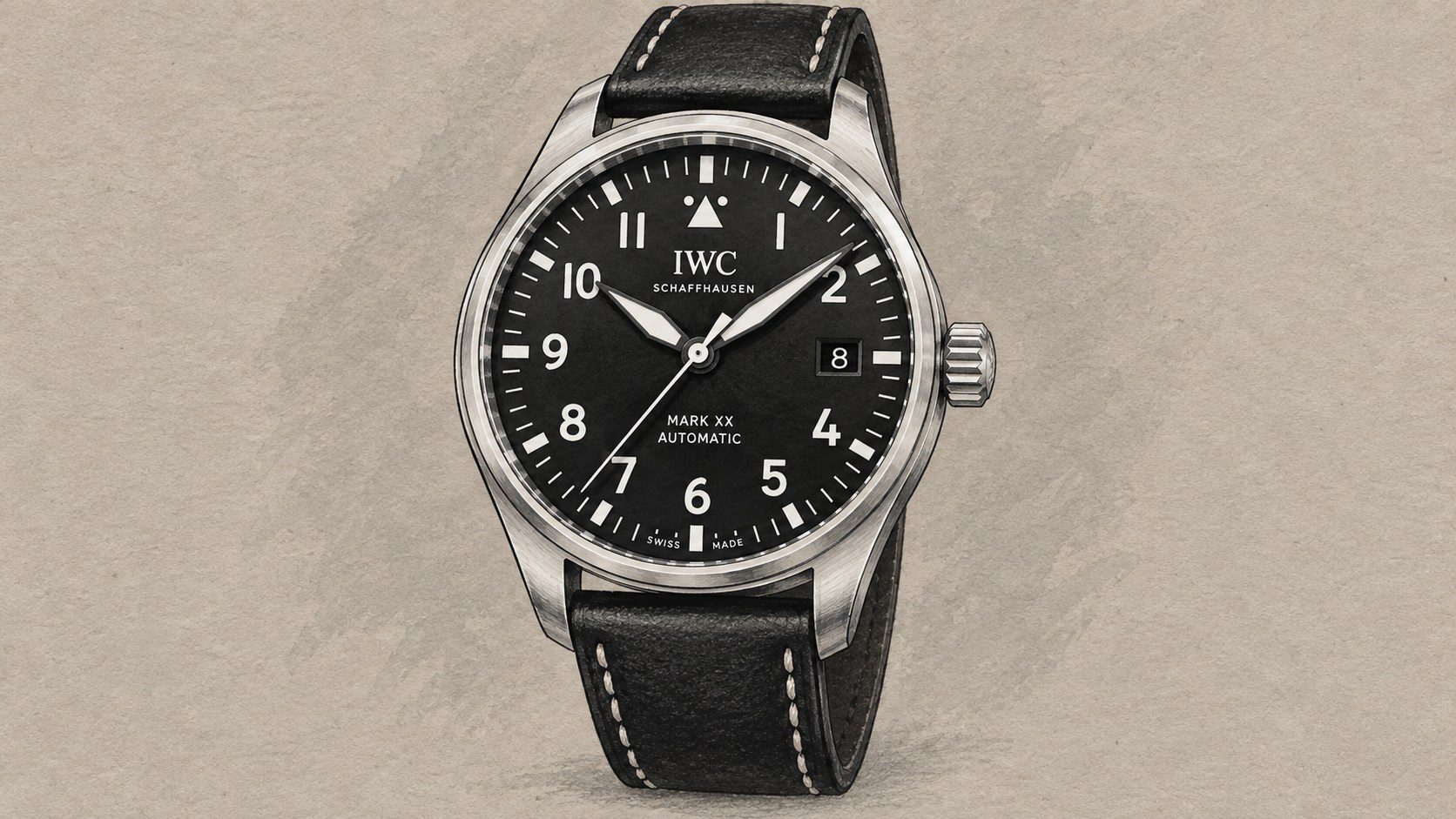
A Mark XX and a 556 I RS can both satisfy the wish for a restrained black-dial automatic. They do it with different visual languages. The IWC uses full Arabic numerals and the familiar pilot triangle; the Sinn removes most of that printed information and uses a red seconds hand as its principal accent.
The movement comparison also has a clear centre: IWC’s published five-day reserve. The Sinn instead offers a smaller case diameter, a display back and a higher stated pressure rating. Decide which of those differences you will actually appreciate before treating one maker’s reputation as an answer to every part of the comparison.
The references compared
| Feature | IWC Mark XX | Sinn 556 I RS |
|---|---|---|
| Reference | IW328201 | 556 I RS |
| Case diameter / thickness | 40mm / 10.8mm | 38.5mm / 11mm |
| Movement | Automatic IWC 32111 | Automatic Sellita SW200-1 |
| Reserve | 120 hours | Not stated on current Sinn sheet |
| Dial | Black; Arabic numerals; date | Glossy black; batons; red seconds; date |
| Water resistance | 10 bar | 20 bar |
| Back | Closed | Sapphire display back |
| Attachment | Black calfskin; EasX-CHANGE | Leather, silicone or steel options |
Two histories behind the decision
The Mark XX belongs to a line whose important historical reference is IWC’s Mark 11 of 1948. Its present numerals and orientation marker keep that instrument vocabulary visible while the modern movement changes the ownership proposition. Sinn began in 1961 under pilot Helmut Sinn, with cockpit clocks and navigation instruments helping shape its approach to watches. The current 556 sheet explicitly connects its sparse display with that background. The two histories therefore overlap in a concern for readable instruments without producing the same dial. IWC retains more of the recognisable pilot-watch notation, while the 556 I RS reduces the face to markers, hands and a calendar, then gives the seconds a deliberate flash of red.
The dials make different promises
The Mark XX’s numerals give each hour an immediately named position. The triangle at twelve provides a strong orientation point, while the date occupies the right side of the dial. This is the more literal pilot-watch face of the pair.
The Sinn’s batons are less descriptive, but that sparseness is also the attraction. A glossy black background and red seconds hand stop it being merely an exercise in removing decoration. If you enjoy the IWC’s numerals, the Sinn may look too anonymous. If you find a full set of numerals visually busy, the 556 can offer the cleaner arrangement. Neither judgement requires pretending that one design is unreadable.
Five days is the clearest IWC convenience
IWC specifies a hundred and twenty hours for calibre 32111. That creates a useful buffer when the watch is set aside while another is worn. The current Sinn sheet identifies the SW200-1 but does not state a reserve, so assigning it an unsourced exact duration would make the table look more complete without making it more trustworthy.
The IWC’s reserve is particularly persuasive if resetting a date watch irritates you. If winding and setting are occasional, untroublesome interactions, the Sinn’s exterior can remain the deciding factor. A long reserve is a practical attraction, but it is not a measure of how much pleasure either face or movement will give its owner.
Different cases, different details to inspect
The Sinn is smaller in diameter but slightly thicker on the published numbers. It also exposes the movement through a sapphire back, whereas the selected Mark XX uses a closed back. Someone who enjoys seeing the automatic mechanism has a clear Sinn feature to put on the list.
The 556’s twenty-bar rating exceeds the Mark XX’s ten-bar specification. Neither needs a rotating bezel to offer its stated pressure resistance. Conversely, no technology fitted elsewhere in Sinn’s catalogue should be assumed present here: the 556’s exact current sheet is the relevant specification. The same restraint applies to historical IWC construction details which are not listed for the Mark XX.
Choose the configuration as well as the face
This Mark XX reference arrives on black calfskin and includes IWC’s EasX-CHANGE attachment system. Sinn offers several attachment choices, so compare the actual leather or bracelet package being quoted. A watch head weight is not the weight of a complete steel-bracelet configuration.
Choose the Mark XX when its numeral layout, IWC identity and five-day reserve create the watch you want. Choose the 556 I RS when the smaller case, glossy sparse face, red seconds and display back make a more convincing whole. The useful decision is between those tangible qualities. If only the brand name changes your verdict, spend a little longer comparing the details that will remain in view after the purchase conversation has ended.
Specifications and sources checked on 8 September 2026. Mark XX specifications; IWC Mark history; Sinn current 556 sheet; Sinn history.
Image: AI-generated editorial illustration of the IWC IW328201. Fine dial details and finishing may differ from the production watch.


