Based on Sinn’s published information. Specifications checked on 8 September 2026.
The Sinn 556 I RS is an appealing everyday choice when your wish list is short: a clear analogue dial, a manageable case, an automatic movement and enough water resistance for ordinary active use. The challenge is deciding whether those are your priorities, rather than accepting the idea that one watch can be the best everyday tool for everyone.
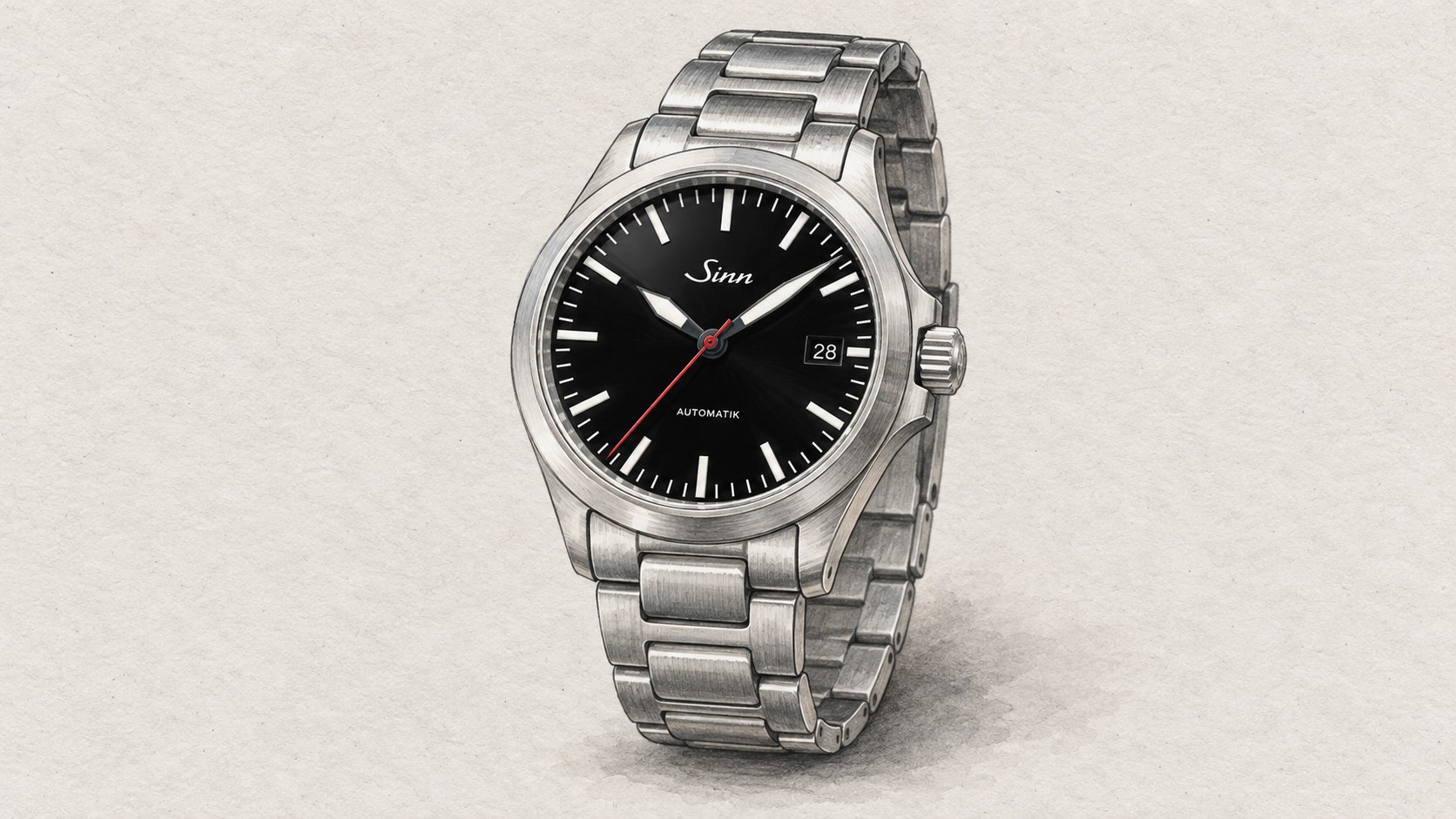
This is the glossy black, baton-marker version with a red seconds hand. That small colour accent gives it a distinct identity within the 556 family. It is worth selecting the exact dial deliberately, because a watch this simple places much of its character in details you will look at repeatedly.
The instrument background, in an everyday form
Sinn’s origins help explain the 556’s visual restraint. Pilot and blind-flying instructor Helmut Sinn founded the company in 1961; engineer Lothar Schmidt took it over in 1994 and expanded its development of technical materials and protective systems. The manufacturer’s account of that history connects the watches to practical instrument making. Sinn explicitly relates the 556’s sparse display to its pilot and navigation cockpit clocks. The 556 I RS carries that influence into a comparatively simple wristwatch: hours, minutes, seconds and a date, with the red seconds hand providing a visible distinction. This background explains the design direction without implying that every technical feature offered elsewhere in Sinn’s catalogue is fitted to the 556.
The exact 556 I RS specification
Sinn’s current model sheet specifies the following. Its weight excludes the strap or bracelet, an important distinction when comparing it with a complete watch.
| Specification | 556 I RS |
|---|---|
| Case diameter and thickness | 38.5 × 11mm |
| Weight without strap | 65g |
| Lug width | 20mm |
| Case | Satinised stainless steel |
| Movement | SW200-1 automatic, 26 jewels |
| Frequency | 28,800 vibrations per hour |
| Functions | Time, date and stop seconds |
| Front crystal | Sapphire, anti-reflective on both sides |
| Back and crown | Sapphire display back; screw-down crown |
| Water resistance | 20 bar |
Where the simple dial earns its place
The case diameter is useful if you want a watch with some visual presence that does not depend on a very wide bezel or elaborate dial. The baton markers and contrasting hands keep the display focused. The red seconds hand offers a way to check that the movement is running without adding another scale or register.
At the same time, the I RS uses a glossy dial. Consider that finish alongside the anti-reflective crystal rather than expecting every black instrument-style watch to have the same appearance. Look at it near a window and under ordinary indoor lighting. Published specifications can identify the materials; they cannot decide which reflections or level of shine you find attractive.
A fitting should include the configuration you plan to buy. The 20mm lug width gives you a familiar size for alternative straps, but a bracelet, leather strap and silicone strap distribute the weight differently. The quoted 65g is not a promise that a bracelet-equipped watch will weigh that little. Include the actual strap and clasp in your comparison and in the price you request.
Mechanical ownership is the real choice
The SW200-1 winds automatically as it is worn and allows the seconds to be stopped for setting. Those are useful, conventional mechanical features. They suit a person who enjoys a watch with a movement to maintain and occasionally reset, rather than someone whose only priority is leaving a perfectly ready time display on a shelf for weeks.
Do not pay for the 556’s mechanical appeal while resenting every part of that routine. If it stops during a rotation, it needs to be restarted and the time and date checked. Sinn’s current sheet also notes that dealer stock can differ after technical changes, so confirm the movement in the specific watch if buying an older example. The sheet does not provide a model-specific reserve figure, and this guide does not substitute one from a generic movement listing.
Its sapphire back lets the owner see the movement. That is part of the enjoyment, but it also distinguishes the watch from models that use a closed back and additional internal protection. Choose the architecture that fits your interests rather than assuming a visible movement is always an upgrade.
What would make you choose something else?
The Sinn 856 adds TEGIMENT surface hardening, magnetic-field protection and Ar-Dehumidifying Technology in a 40mm case. Those are concrete reasons to move up if you want those protections. They are not hidden features of the 556. The 856 also changes the dial and case finish, so it deserves its own fitting.
If everyday readiness matters more than a mechanical movement, the Casio Edifice EFV-100D-1AV provides a straightforward steel quartz alternative with 100-metre water resistance. That comparison is useful because it tests the underlying reason for buying. A more expensive mechanical watch does not become necessary merely because both watches are called practical.
Sinn’s ownership guidance recommends regular water-resistance checks because seals age, and protection from unnecessary shocks. Apply that sensible routine even to a watch with a substantial pressure rating. Choose the 556 I RS when its restrained appearance, dimensions and automatic movement meet your everyday brief. Its strength is how closely those parts can match a clear set of preferences, rather than a universal claim to be the best.
Image: AI-generated editorial illustration of the Sinn 556 I RS. Design details are approximate; this is not a product photograph.


