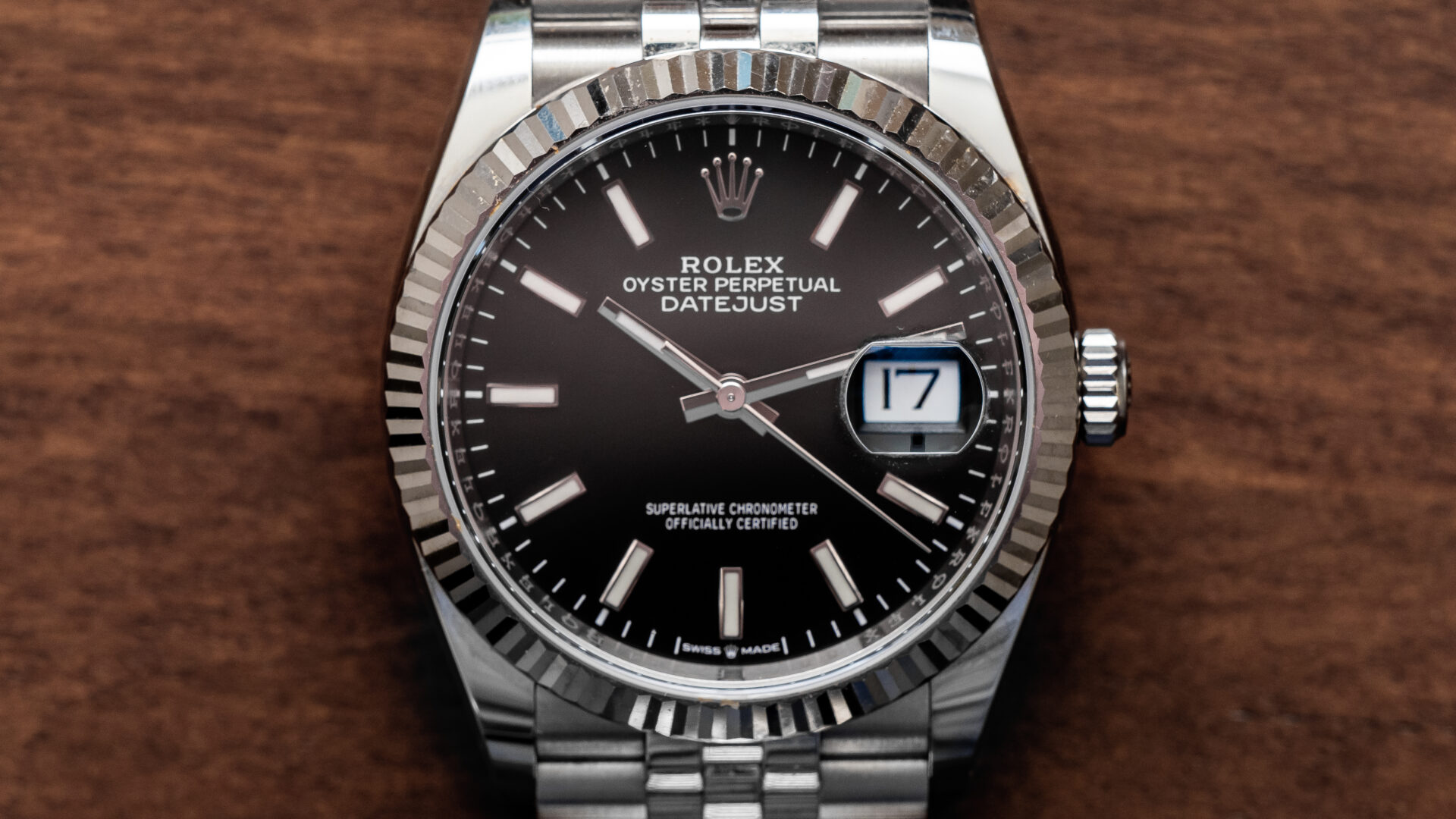
The Datejust 36 and Explorer 36 are a useful comparison because size does not settle it. Both selected references are thirty-six-millimetre automatics with the same stated reserve and water-resistance rating. The meaningful differences are concentrated in the face, bezel and bracelet.
Choose the mint-green Datejust on Jubilee if you want a calendar and an object with more surface detail. Choose the black Explorer if you prefer strong orientation numerals and a smoother surrounding frame. Neither becomes the universal daily-watch answer merely because its diameter is restrained. They turn the same basic scale into two quite different things to look at.
The references compared
| Feature | Datejust 36 | Explorer 36 |
|---|---|---|
| Reference | 126234-0051 | 124270-0001 |
| Case | 36mm; steel and white gold | 36mm; Oystersteel |
| Dial | Mint green; date | Black; 3-6-9; no date |
| Bezel | Fluted white gold | Smooth steel |
| Movement | Automatic 3235 | Automatic 3230 |
| Reserve | Approximately 70 hours | Approximately 70 hours |
| Water resistance | 100m | 100m |
| Bracelet / clasp | Jubilee; Oysterclasp; Easylink | Oyster; Oysterlock; Easylink |
Two histories behind the decision
Rolex introduced the Datejust in 1945, with the Jubilee bracelet forming part of its original presentation. That connection helps explain why the fluted bezel and five-link bracelet feel like a coherent decorative combination today. The Explorer arrived in 1953 after a longer association between Rolex Oyster watches and Himalayan expeditions. Its present identity draws on that functional time-display story. These histories explain different design priorities rather than assigning the owner a social role. A Datejust need not spend its life at formal occasions, and an Explorer does not require a mountain. What remains relevant is the choice between a calendar watch with decorative framing and a no-date watch whose legible numerals carry more of the identity.
The calendar changes more than the function
The Datejust adds a window at three and a Cyclops magnifier over it. That gives the wrist an immediate source of calendar information and creates an obvious visual interruption on the right side of the face. If you frequently check the date, the function can outweigh the interruption very easily.
The Explorer uses that part of the dial for its large three numeral. Along with six and nine, it establishes a different hierarchy from the Datejust’s markers. Someone who likes a complete no-date composition may find that arrangement more satisfying every time the hour is read. The decision is therefore not just whether an extra function is useful. It is whether you prefer the face created by adding it.
Jubilee and Oyster are different parts of the design
The selected Datejust’s five-piece Jubilee links provide repeated small surfaces, complementing the white-gold fluting around the crystal. The Explorer’s three-piece Oyster bracelet and smooth bezel organise the exterior into broader, plainer elements. The surrounding steel matters almost as much as the dials.
Rolex also offers a corresponding mint-green Datejust on Oyster, so the comparison need not force every Datejust buyer into Jubilee. The two Datejust configurations use Oysterclasp with Easylink, while this Explorer has Oysterlock and Easylink. Those clasp names should remain distinct. If you like the Datejust calendar but want a less intricate bracelet, changing configuration may answer the preference more directly than changing model families.
Similar mechanics leave room for taste
Both watches offer approximately seventy hours of reserve and a hundred-metre rating. Their different calibre numbers reflect different display briefs, including the Datejust’s calendar. Those shared headline figures make it difficult to justify either watch as a sweeping practical improvement over the other for every owner.
That is a helpful outcome. It leaves the purchase centred on the details which actually distinguish the objects. The Explorer is not automatically a better daily watch because its styling is more functional, and the Datejust is not automatically more useful because it displays more information. The reserve and rating establish a broadly capable foundation; the preferred face and bracelet decide which foundation you will enjoy looking at.
The more revealing side-by-side check
Compare the two complete bracelets and the amount of attention each bezel attracts. A single dial photograph hides much of what separates them. At the same diameter, the Datejust’s colour, fluting and small bracelet links can create a more decorative presence, while the Explorer’s black face concentrates attention on its numerals and hands.
The Datejust is the stronger choice when the calendar and that decorative detail are positive attractions. The Explorer is the stronger choice when a no-date face and smoother hardware make the watch feel resolved. If you keep wishing the Explorer had a date, start with the Datejust. If you keep imagining the Datejust without its window or fluting, the Explorer is already offering a coherent answer.
Specifications and sources checked on 8 September 2026. Datejust 36 specifications; Explorer 36 specifications; Datejust history; Explorer history.
Image: Rolex Datejust 36 reference 126234 on Jubilee, shown with a black dial to illustrate bracelet and bezel design; the main article compares mint-green configurations. Photograph by Ajay Suresh (ajay_suresh), CC BY 2.0. Rolex Datejust 36 reference 126234 on Jubilee, shown with a black dial to illustrate bracelet and bezel design; the main article compares mint-green configurations. Photograph by Ajay Suresh (ajay_suresh), CC BY 2.0. Source. Original downloaded unchanged. Resized for web display.



