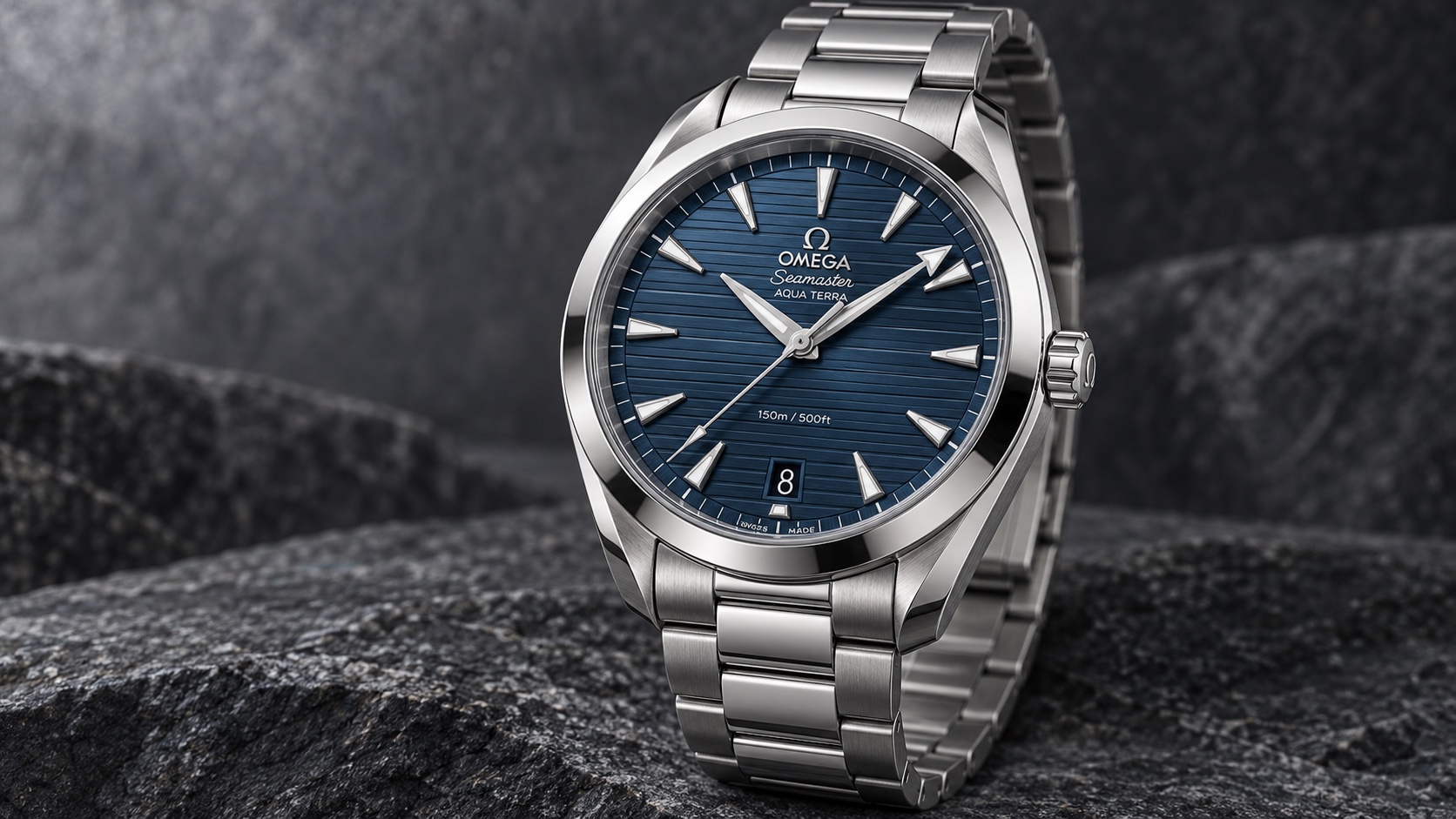
The Aqua Terra and Datejust are often recommended as watches that can cover many occasions. That general usefulness does not make their designs interchangeable. In these references, Omega combines a blue horizontal-texture dial with a smooth frame and date at six. Rolex puts mint green inside white-gold fluting, with a Jubilee bracelet and magnified date at three.
The more revealing decision is which arrangement you want to look at. Choose the Aqua Terra if the teak pattern and central alignment of the calendar appeal. Choose this Datejust if the fluted bezel, Jubilee links and Cyclops are positive attractions, rather than details you hope will become less noticeable with time.
The references compared
| Feature | Aqua Terra 38 | Datejust 36 |
|---|---|---|
| Reference | 220.10.38.20.03.001 | 126234-0051 |
| Case | 38mm steel | 36mm steel and white gold |
| Dial | Blue horizontal teak | Mint green |
| Date | At six; no magnifier | At three; Cyclops magnifier |
| Movement | Automatic 8800; Master Chronometer | Automatic 3235 |
| Reserve | 55 hours | Approximately 70 hours |
| Water resistance | 150m | 100m |
| Bracelet | Steel; butterfly clasp | Jubilee; Oysterclasp and Easylink |
Two histories behind the decision
Rolex introduced the Datejust in 1945, with the Jubilee bracelet accompanying its original presentation. That established a lasting connection between the calendar watch and a bracelet with repeated small links. Omega’s Aqua Terra arrived in 2002 within the older Seamaster family, whose history began in 1948. The later horizontal teak treatment gives the modern reference a nautical design cue without adding a dive bezel. These are two different responses to the broadly useful calendar-watch brief. The Datejust concentrates much of its identity around its framing and date magnification; the Aqua Terra makes the dial surface itself a more active part of the composition. Both current models have evolved beyond their initial generations.
The date window creates the most immediate difference
Omega positions the calendar at six, continuing the vertical line through the hands and upper dial signature. Rolex places it at three and magnifies it through the Cyclops. The two arrangements make the same daily information feel quite different within the face.
If an enlarged date is useful to you, the Rolex feature can justify its visual prominence immediately. If you prefer the unbroken crystal and lower, centred opening of the Aqua Terra, the Omega’s arrangement may feel more balanced. This is a better starting point than assuming that a date is merely a checkbox shared by both watches. Its position and presentation are central design decisions.
The decoration is distributed differently
The Aqua Terra’s horizontal grooves put texture beneath the hands and markers. Its smooth bezel leaves that surface relatively uninterrupted by competing detail around the outside. The Datejust uses a quieter mint-green field while the white-gold fluting and Jubilee supply repeated edges and reflections.
Someone who prefers a more straightforward bracelet but likes a distinctive dial has a reason to start with the Omega. Someone who wants the bracelet and bezel to participate more strongly in the appearance has a reason to choose this Rolex configuration. Rolex also offers alternative Datejust bracelets and bezels, but substituting those options changes the specific watch compared here.
Reserve and certification should remain separate questions
The Datejust has the longer stated reserve, at approximately seventy hours against fifty-five. The Omega is a Master Chronometer, with calibre 8800 forming part of that complete-watch testing proposition. Those are distinct features, so neither should be used as shorthand for winning every mechanical comparison.
The reserve advantage matters most when either watch will often wait off the wrist. Omega’s movement and certification may be particularly interesting if its technical approach is part of why you enjoy the brand. For both watches, the useful question is which features are positive reasons to own the particular object. A specification contest that ignores the dial and bracelet would miss much of what buyers are actually choosing.
A broader dial or a more compact frame?
The Aqua Terra’s thirty-eight-millimetre case offers a different canvas from the thirty-six-millimetre Rolex. The bracelet junctions, bezel width and texture all affect the outline, so compare the complete watches in the configurations you want. Both remain relatively restrained propositions within contemporary automatic watches.
Choose the Aqua Terra when its blue teak face, six-o’clock date and steel bracelet feel like a coherent answer to a daily calendar watch. Choose the Datejust when the mint-green dial, fluted white gold, Jubilee and magnifier are the reasons you want to wear it. Neither needs to be justified as the only watch you will ever require. The stronger purchase is the one whose particular details remain appealing even when the other watch’s advantages are acknowledged.
Specifications and sources checked on 8 September 2026. Aqua Terra specifications; Seamaster and Aqua Terra history; Datejust specifications; Datejust history.
Image: AI-generated editorial illustration of the Omega Seamaster Aqua Terra 150M 38 reference 220.10.38.20.03.001. Fine dial details, bezel contours and finishing may differ from the production watch.


