A date can sit quietly in a small window, occupy the top of the dial or circle the entire watch face. Those choices change how you read it and how the watch looks. The underlying question is simple: which calendar information do you want, and how do you prefer to see it?
The Rolex Day-Date, Oris Big Crown Pointer Date and Mido Multifort TV Big Date answer that question in visibly different ways. They also demonstrate why a calendar’s display style should be distinguished from the complexity of the mechanism behind it.
Day-date adds the weekday
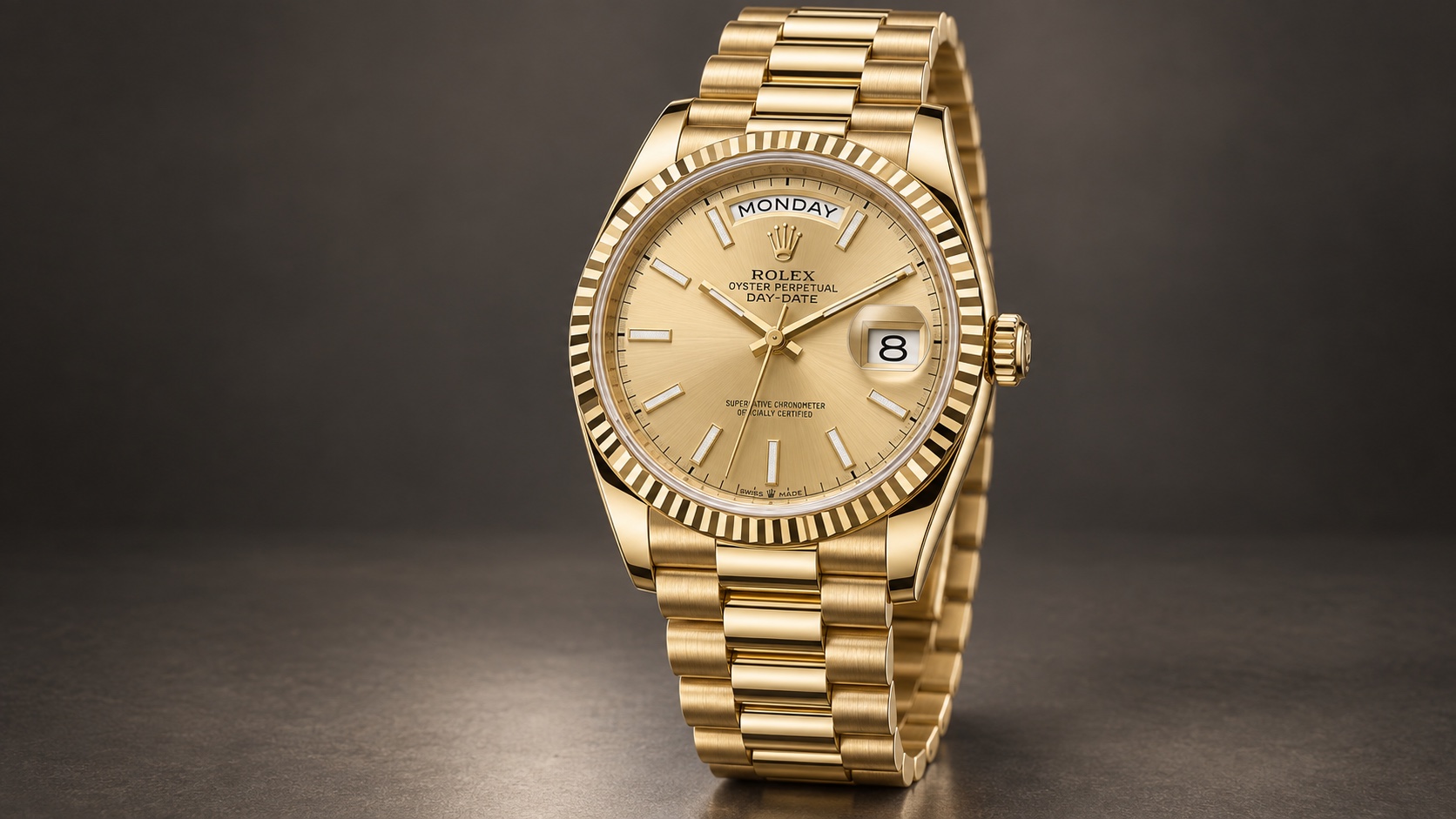
A day-date watch shows the day of the week as well as the date of the month. On the selected Rolex Day-Date 36, the weekday appears in full across a curved aperture at twelve, while the date sits at three beneath a Cyclops magnifier.
Those displays answer different questions. Monday tells you where you are in the week; eight tells you which numbered day of the month it is. A busy working routine may make both useful, while someone who only checks the date may prefer less calendar information.
Rolex’s arrangement also gives the dial a recognisable shape. The curved weekday is a major design feature, not merely a second small window added wherever space remains.
Pointer date uses a hand and a numbered scale
The Oris Big Crown Pointer Date uses an additional central hand to indicate the day of the month around the outside of the dial. On the black reference discussed here, that hand is blue, making it easier to distinguish from the ordinary time hands.
The scale runs through the month’s date numerals. Read the dedicated hand against that scale instead of looking for a date aperture. It is neither a seconds hand nor a GMT hand, even though all three functions can place an extra central hand on a watch.
A pointer date makes the calendar part of the dial’s overall composition. Whether that feels clearer than a window depends on your preference for finding one enlarged numeral or reading a hand against a wider scale.
Big date gives the numeral more prominence
The Mido TV Big Date places a large date display at twelve. Its rounded rectangular case frames the dial, and the prominent calendar becomes a visual centrepiece within that frame. The watch makes a feature of information that other designs try to minimise.
Big date describes the enlarged presentation. It does not mean the watch automatically knows the lengths of all months. Nor does it add a weekday simply because the display is larger. Read the actual listed functions rather than inferring calendar sophistication from the size of the window.
The watches behind the displays
| Reference | Calendar display | Case and movement |
|---|---|---|
| Rolex Day-Date 128238-0045 | Full weekday at 12; date at 3 | 36 mm yellow gold; 3255 automatic; approximately 70 hours |
| Oris 01 754 7798 4064-07 8 20 06 | Central pointer hand; outer date scale | 40 mm steel; 754-1 automatic; 41 hours |
| Mido M049.526.11.041.00 | Large date at 12 | 40 mm wide × 39.2 mm long; Caliber 80; up to 80 hours |
The reserve figures affect how often the displays may need resetting in a watch rotation. The Oris’s 41-hour reserve is much shorter than the other two stated reserves. All figures assume the relevant wound condition, so a brief wear does not necessarily prepare a watch for its full stated duration off the wrist.
Practical origins and recognisable shapes
Oris introduced the Big Crown Pointer Date in 1938 for airmen wearing gloves. The prominent crown addressed operation, while the pointer calendar supplied a distinct way to present useful information. The current model keeps that idea within a new case and H-link bracelet design.
Mido points to television-shaped watches from 1973, 1980 and 2000 as ancestors of its modern TV case. The Big Date is therefore built around a recurring shape in the company’s catalogue. Its large calendar helps organise that unusual dial space, linking a practical display with a recognisable historical outline.
Setting remains reference-specific
Calendar adjustments need the correct movement instructions, including any restricted setting period. A different display can make two watches look unrelated while their ownership questions remain similar: how to establish AM and PM, how to correct the date, and what to do after a shorter month.
Do not infer an annual or perpetual calendar from a hand, a full weekday or a large numeral. Those terms describe additional calendar capabilities that must be explicitly specified. None should be added to a description merely because the dial looks complicated.
Which display would you enjoy using?
Choose a day-date when the weekday genuinely helps your routine. Consider a pointer date when you like information distributed around the dial and enjoy the extra hand. A big date deserves attention when a prominent numeral is the feature you want to see immediately.
Then look beyond the calendar. Gold and steel, round and shaped cases, bracelet design and reserve all change the purchase. The most satisfying calendar is one you read naturally on a watch whose wider design you already enjoy.
Based on manufacturer information. Specifications and sources checked on 8 September 2026.
Sources: Rolex yellow-gold Day-Date 36; Rolex platinum Day-Date 36; Rolex Day-Date origins; Oris UK exact black Big Crown Pointer Date reference; Oris Big Crown origins and current collection development; Oris time and calendar-setting instructions; Mido UK Multifort TV Big Date M049.526.11.041.00; Mido on its historical television cases.
Image: AI-generated editorial illustration of the Rolex Day-Date 36 reference 128238-0045. Fine dial details and finishing may differ from the production watch.