A bracelet occupies more of the wrist than the watch head, yet it is easy to treat it as the part that happens to come attached. Change the link pattern and the same dial can take on a different character. Change the clasp or adjustment and the ownership experience can change just as much.
Begin by separating three things: the visible link construction, the fastening and the way length can be adjusted. Names such as Oyster and Jubilee describe recognisable bracelet families. They do not, by themselves, tell you every detail of the clasp fitted to a particular reference.
Broad links or a finer pattern?
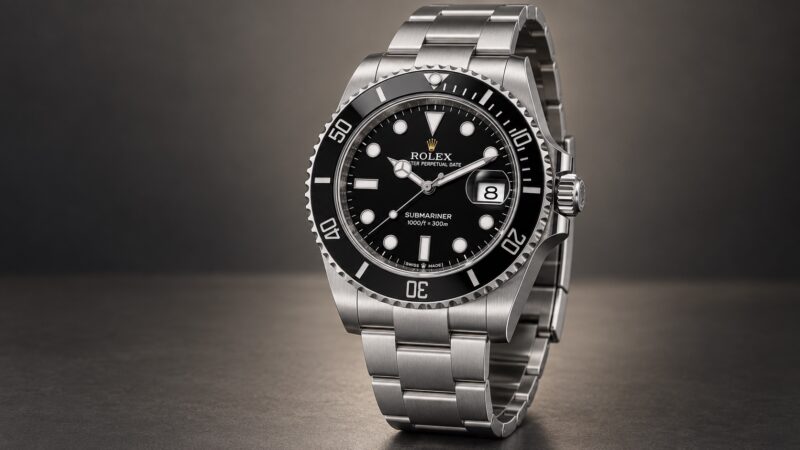
Rolex’s Oyster bracelet uses a three-piece link construction. On the steel Submariner, its broad forms suit the strong case and timing bezel. The visual effect is direct, with relatively large surfaces continuing around the wrist.
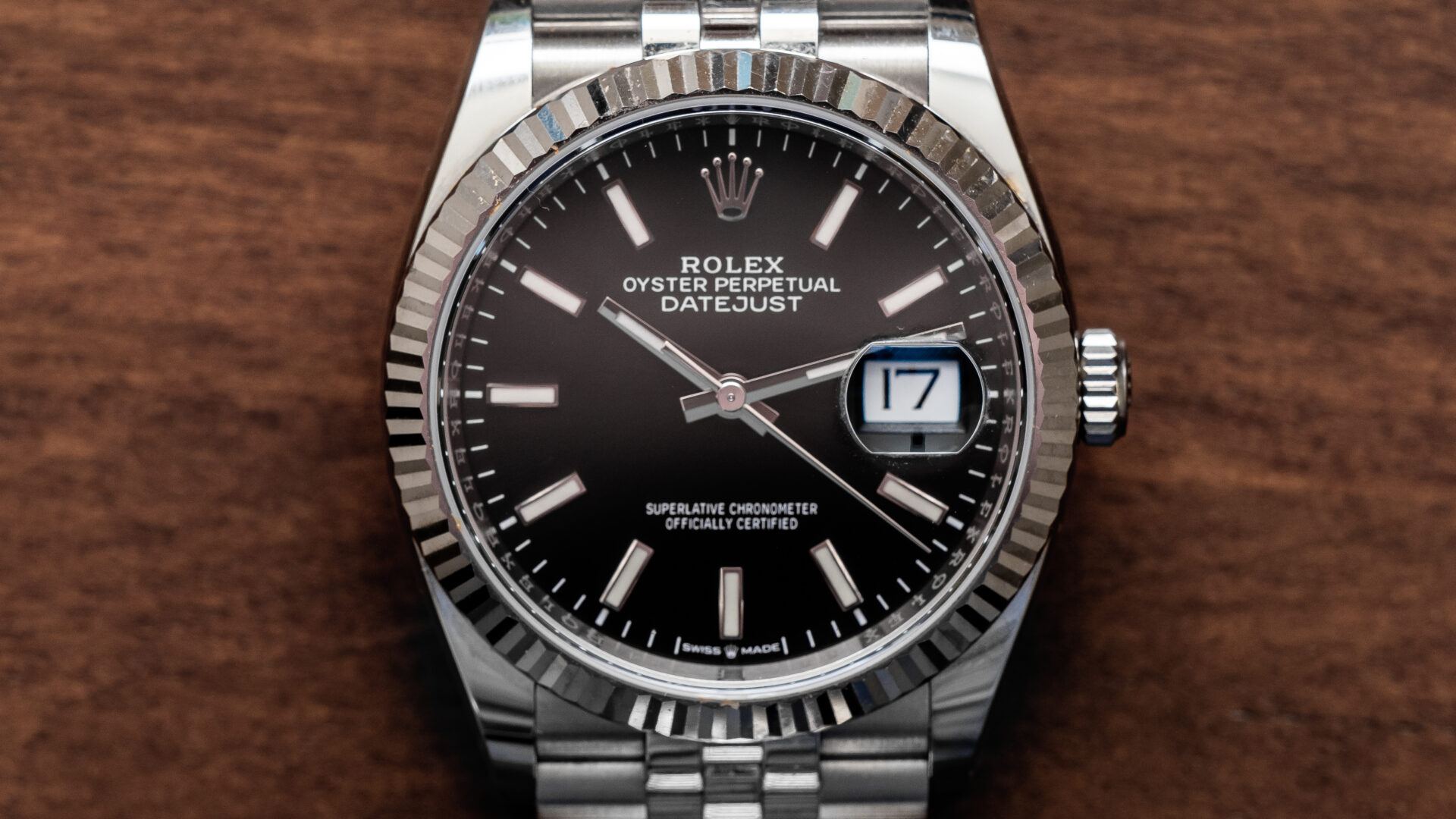
The Jubilee uses five-piece links. Its narrower central elements create a finer, more active pattern, especially beside a fluted Datejust bezel. This is a design difference you can see before considering whether either bracelet suits your wrist better.
The President is also a three-piece-link bracelet, but its rounded forms have a different identity from the Oyster. On the yellow-gold Day-Date 36 selected here, the bracelet contributes to the watch’s precious-metal appearance as strongly as the case and bezel do.
Compare the exact bracelet and clasp combination
| Watch | Bracelet | Clasp or adjustment detail |
|---|---|---|
| Submariner Date 126610LN-0001 | Oyster in Oystersteel | Oysterlock safety clasp; Glidelock |
| Datejust 36 126234-0051 | Jubilee in Oystersteel | Oysterclasp; 5 mm Easylink |
| Day-Date 36 128238-0045 | President in yellow gold | Concealed Crownclasp |
| Omega Diver 300M 210.30.42.20.06.002 | Stainless-steel mesh | Mesh configuration is central to this reference |
Notice that the selected Datejust’s Jubilee does not have a concealed Crownclasp. It uses an Oysterclasp with Easylink. Assuming a clasp from the bracelet’s name alone would therefore misdescribe a practical part of the watch.
Likewise, white Rolesor on this Datejust refers to its combination of Oystersteel and white gold, including the fluted white-gold bezel. Rolex specifies Oystersteel for this bracelet. Pale polished links should not automatically be described as white gold.
Why the Jubilee belongs in the Datejust story
Rolex introduced the Datejust in 1945 for the company’s fortieth anniversary. The Jubilee bracelet was created for that launch, and the first Datejust was offered in gold. The pairing consequently has a historical relationship as well as a recognisable appearance.
That history explains the combination without making it compulsory. The current mint-green Datejust 36 is also available on an Oyster bracelet as configuration 126234-0052. Choosing between those two versions changes the emphasis of an established design while keeping the case, dial, bezel and movement consistent.
Mesh creates another kind of surface
The Omega’s mesh bracelet is visually different from rows of conventional solid links. Its closely repeated metal pattern creates a continuous texture that works with the brushed steel dial and grey bezel. On this reference, the bracelet is a defining part of the monochrome look.
Omega introduced the relevant no-date Diver 300M group in 2024, drawing inspiration from its 007 Edition. The mesh is therefore part of a deliberate model treatment, alongside the domed crystal and alternative dial materials. It should be judged with the watch head rather than treated as a minor accessory.
Adjustment deserves as much attention as appearance
A bracelet must be sized for the wearer. Removable links establish the main length, while a clasp may provide a smaller adjustment or extension. The exact system determines what can be changed conveniently after the main sizing has been done.
The Submariner’s Glidelock and the Datejust’s Easylink are different arrangements. Rolex’s Submariner guide describes approximately 2 mm Glidelock increments over around 20 mm; the selected Datejust offers an approximately 5 mm Easylink extension. Read those as reference-specific facilities, not a universal rule for every watch carrying a familiar bracelet name.
During a fitting, check where the clasp sits and how the bracelet begins to curve beyond the case. A link pattern you like in a close-up may still need a different configuration to sit comfortably. The watch should be assessed at a realistic length, with the fastening properly centred.
What to check on a used bracelet
Ask how many links are included and whether the bracelet and clasp are correct for the reference. Missing links can complicate fitting. A substituted clasp can change both the appearance and the adjustment options, even if the watch head is otherwise as described.
Choose the pattern you enjoy, then verify the materials, fastening and fit. Those details turn a bracelet from an attractive strip of metal into a well-understood part of the watch you intend to wear.
Based on manufacturer information. Specifications and sources checked on 8 September 2026.
Sources: Rolex 126610LN specifications; Rolex Submariner timeline; Rolex Submariner collection; Rolex Jubilee configuration; Rolex Oyster configuration; Rolex Datejust history; Rolex yellow-gold Day-Date 36; Rolex platinum Day-Date 36; Rolex Day-Date origins; Omega steel-dial Diver specifications; Omega detailed measurements; Omega 2024 Diver launch; Rolex Glidelock adjustment specification.
Image: Rolex Datejust 36 reference 126234 on Jubilee, shown with a black dial to illustrate bracelet and bezel design; the main article compares mint-green configurations. Photograph by Ajay Suresh (ajay_suresh), CC BY 2.0. Rolex Datejust 36 reference 126234 on Jubilee, shown with a black dial to illustrate bracelet and bezel design; the main article compares mint-green configurations. Photograph by Ajay Suresh (ajay_suresh), CC BY 2.0. Source. Original downloaded unchanged. Resized for web display.