A chronograph adds an elapsed-time measuring function to a watch that still tells the time of day. It can time a short task, a journey segment or an event you want to measure. The extra hands are not decoration, but understanding which one does what makes the dial much easier to read.
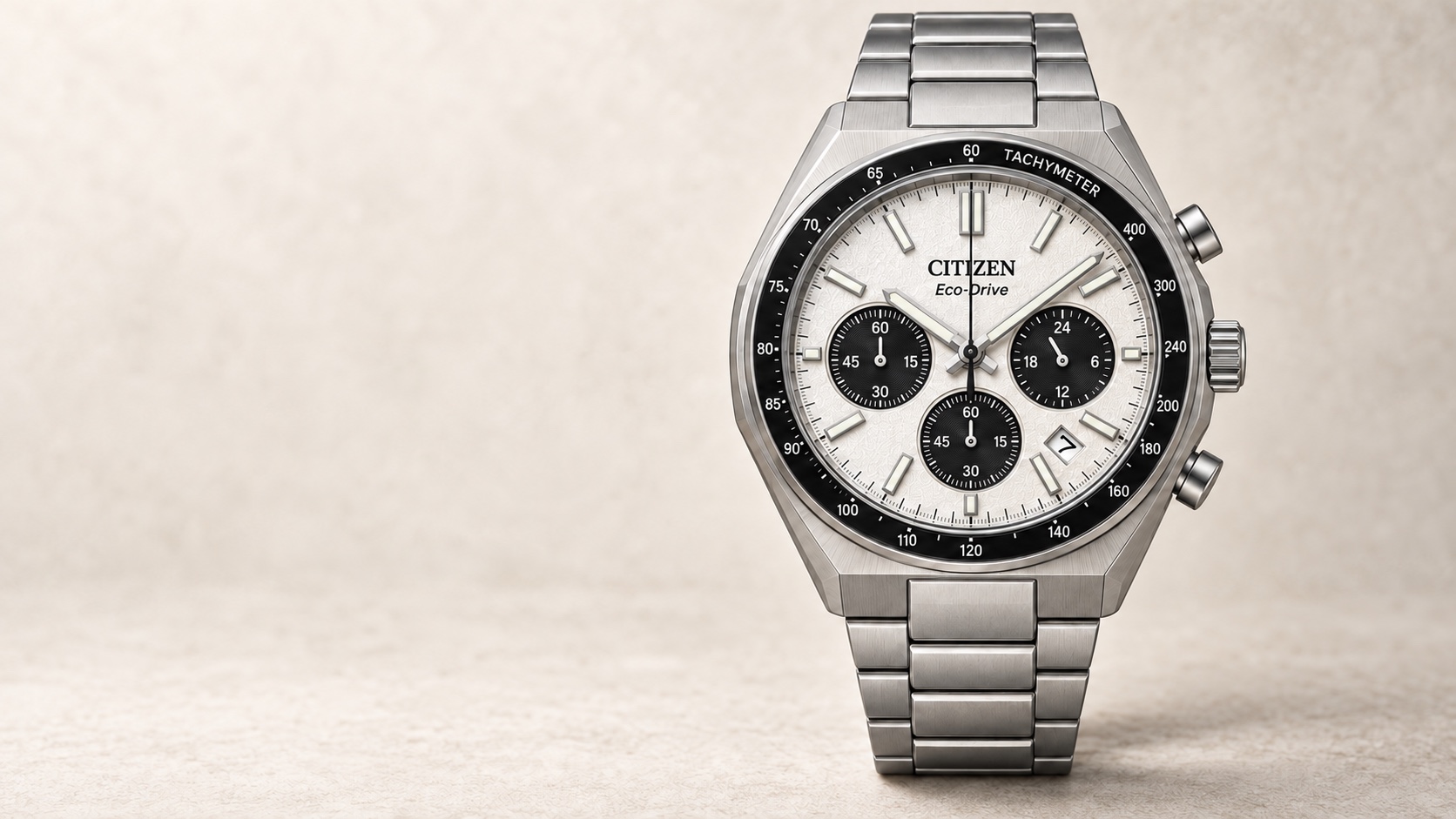
The first thing to establish is the counter layout. A dial with two small circles does not necessarily measure the same duration as another two-counter watch, and three circles do not necessarily mean three chronograph counters. The Citizen Zenshin CA4610 and Tudor Black Bay Chrono provide useful examples.
Separate ordinary time from elapsed time
The main hour and minute hands continue displaying the time of day. The chronograph has its own elapsed-seconds indication and one or more additional counters, depending on the movement. A running-seconds subdial may also be present, serving the ordinary time display.
On many analogue chronographs, the long central seconds hand belongs to the stopwatch function and rests at its reset position when that function is unused. A smaller seconds display shows that the watch is running. A stationary central hand is therefore not enough to conclude that the watch has stopped.
The way to resolve the dial is to identify each hand in the manufacturer’s diagram. Do that before judging how complicated the watch looks. Once the displays have clear jobs, the arrangement often becomes much more straightforward.
Two watches with different counter choices
| Feature | Tudor Black Bay Chrono M79360N-0014 | Citizen Zenshin CA4610-85A |
|---|---|---|
| Movement | MT5813 automatic | B620 Eco-Drive quartz |
| Elapsed-minute display | 45-minute counter | 60-minute chronograph |
| Other dial information | Running seconds; date at 6 | Running seconds; 24-hour indication; date |
| Case diameter | 41 mm | 42.5 mm in Citizen Europe listing |
| Controls | Screw-down pushers | Conventional pushers |
| Power | Approximately 70-hour mechanical reserve | Light-powered; stated conditions apply |
The Citizen’s 24-hour subdial is part of the time-of-day display, not an extra elapsed-hour counter. Its B620 chronograph can indicate up to 59 minutes 59.8 seconds and automatically stops after one hour of continuous operation. That makes it a poor choice if the specific task you want to time requires several uninterrupted hours.
The Tudor specifies a 45-minute counter. That is a distinct scale to learn, particularly if you are accustomed to a 30-minute totaliser. Its two-counter appearance does not tell you the counter capacity without reading the specification.
Start, stop, read, reset
A conventional two-pusher chronograph uses controls for starting and stopping the measurement, with a separate reset action. Citizen’s B620 manual identifies those functions in its component diagram. Start with the chronograph reset, begin the measurement when your event begins, stop it at the end, and read the elapsed seconds together with the relevant totaliser.
Before operating any watch, check its exact instructions. The Tudor’s screw-down pushers need their specified operating arrangement, and the watch’s water-resistance rating does not mean that every control can be used in every circumstance. The correct sequence belongs to the reference, especially when a chronograph has specialised functions beyond an ordinary start-stop-reset system.
For routine use, clarity matters more than how impressive the dial looks. A clearly separated minute counter may be more valuable to you than an additional scale you rarely consult. Consider the interval you actually want to measure and whether the dial makes that interval easy to follow.
A sporting history explains the modern Tudor
Tudor introduced its first chronograph, the Oysterdate, in 1970. Its diving-watch history began earlier, in 1954. The Black Bay Chrono combines elements from those two strands: the large Snowflake hour hand is associated with the diver family, while the pushers, counters and fixed tachymeter belong to chronograph timing.
That mixture explains the watch’s character. It is not simply a diver with more hands added. The broad hour hand, contrasting counters and external scale create a deliberate visual tension between ordinary time and elapsed time. A buyer attracted to that combination may enjoy the design precisely because it feels substantial and busy; someone prioritising the easiest possible stopwatch readout may prefer a quieter arrangement.
Chronograph and chronometer mean different things
A chronograph measures an interval. Chronometer refers to a timekeeping certification, with the relevant standard depending on the certifying system. The Black Bay Chrono’s MT5813 is COSC certified and also has a chronograph function. Those are two separate attributes of the same movement.
A watch can be a chronometer without a stopwatch function, or a chronograph without that certification. When a sales description mixes the terms, look for the actual movement specification rather than assuming that one word implies the other.
Choose around the interval, then the watch
For short everyday measurements, either arrangement may be useful. The Citizen brings light-powered quartz operation and a titanium case and bracelet. The Tudor offers an automatic column-wheel chronograph with a vertical clutch, alongside its distinctive opaline dial and black counters. These are different ownership propositions around a shared timing idea.
Choose the chronograph whose counter capacity, display and controls fit what you want to time. Then decide whether its design and movement are what you want to wear. An elapsed-time function is most satisfying when you understand it well enough to use it without thinking about the dial as a collection of mysterious circles.
Based on manufacturer information. Specifications and sources checked on 8 September 2026.
Sources: Black Bay Chrono opaline specifications; Black Bay Chrono movement and history; Citizen UK: CA4610-85A; Citizen Europe: CA4610-85A; Citizen: Zenshin 2024 introduction; Citizen: technology and Promaster history; Citizen: Eco-Drive 50 years of innovation; Citizen B620 instructions and chronograph limits; Tudor chronograph operating tutorial.
Image: AI-generated illustration. Fine details may differ from the watch.