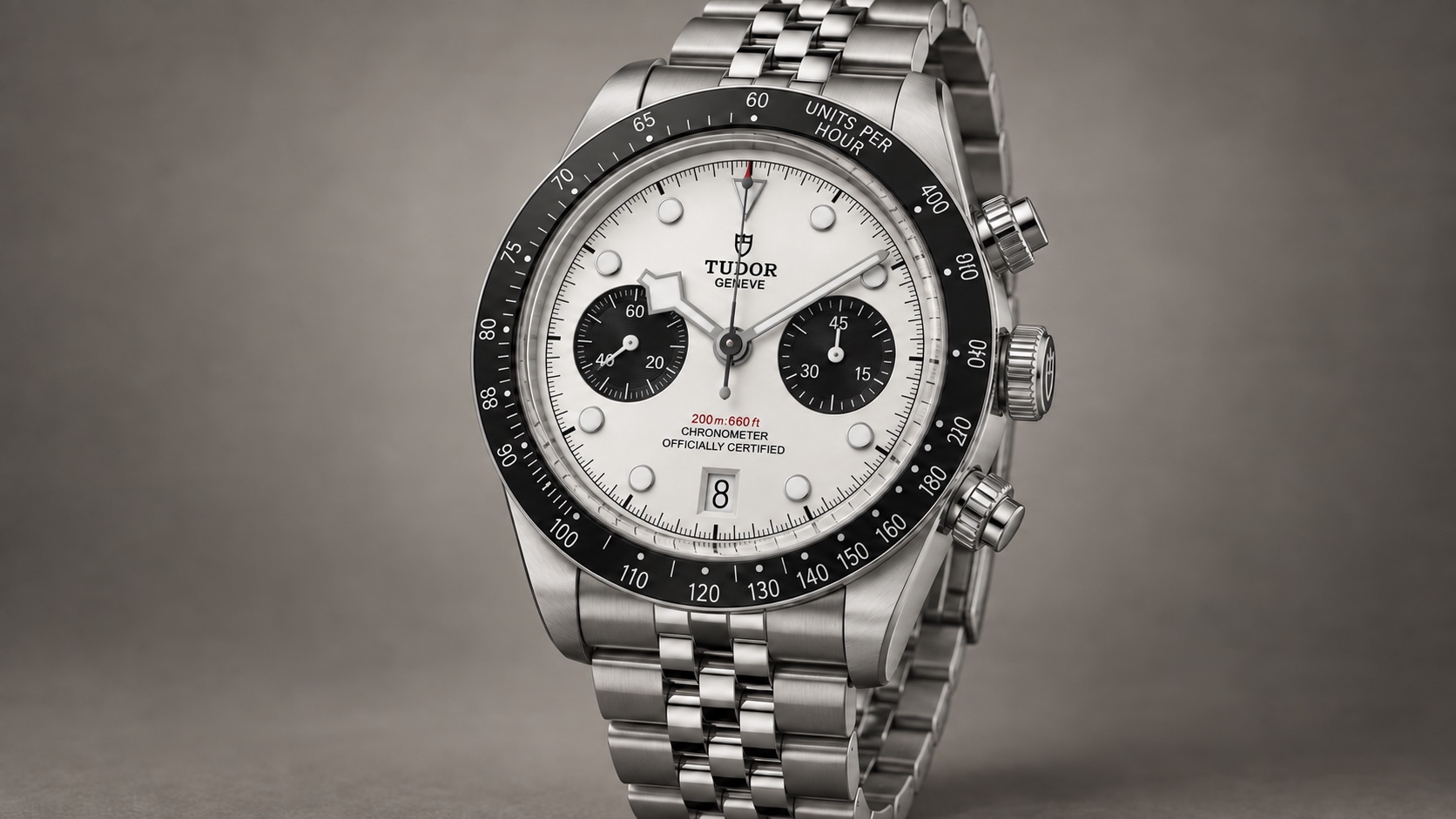
Start the chronograph on the Zenith and its long hand circles the dial in ten seconds. Start the Tudor and you read a more conventional central seconds display. That visible difference is the heart of this comparison.
The watches share a 41 mm diameter, light dials and dark bezels, but they are not interchangeable versions of the same stopwatch. Tudor combines its dive-watch identity with a chronograph. Zenith makes its high-frequency movement an unusually conspicuous part of the display.
The references compared
| Feature | Tudor M79360N-0014 | Zenith 03.3100.3600/69.M3100 |
|---|---|---|
| Case diameter | 41 mm | 41 mm |
| Movement | MT5813 automatic; COSC | El Primero 3600 automatic |
| Reserve | Approximately 70 hours | Approximately 60 hours |
| Chronograph reading | Conventional central seconds; 45-minute counter | Central tenth-seconds; 60-second and 60-minute counters |
| Central timing hand | One-minute sweep | One revolution in 10 seconds |
| Bezel | Black aluminium tachymeter | Black ceramic; tenth-second scale |
| Calendar | Date at 6 | Date at 4:30 |
| Water resistance | 200 m | 10 ATM |
| Bracelet / back | Five-link steel; T-fit / closed | Steel / sapphire display |
Specifications: Black Bay Chrono opaline specifications; Chronomaster Sport exact reference.
Tudor’s mixed sporting roots and Zenith’s El Primero lineage
Tudor’s chronograph history began in 1970, separate from the diving watches it had introduced in 1954. The Black Bay Chrono brings those strands together: a Snowflake hour hand belongs to the dive-watch vocabulary, while the tachymeter and counters point towards elapsed-time measurement.
The Chronomaster Sport arrived in 2021, drawing on the El Primero lineage that began in 1969 and several later design references. Zenith combined the coloured-counter tradition with a modern ceramic bezel and calibre 3600. The historical difference still matters. Tudor deliberately mixes two sporting identities, whereas Zenith uses a contemporary exterior to emphasise a particular development of its chronograph mechanism.
The Zenith rewards learning a different display
The Chronomaster Sport’s central timing hand makes one revolution in ten seconds. The ceramic bezel provides a tenth-second scale, while the counter at three records elapsed seconds and the counter at six records elapsed minutes. Running seconds sit at nine.
That arrangement makes fractional timing visually prominent. It also asks you to stop treating the long hand as an ordinary minute-long stopwatch sweep. If operating the mechanism is part of why you want a chronograph, that difference can be the strongest reason to choose it.
The Tudor uses a 45-minute chronograph counter alongside the conventional central seconds indication. It is the more familiar starting point for someone who prefers to read elapsed time without learning a faster sweep.
The bezels are measuring different things
Tudor’s fixed black anodised aluminium insert carries a tachymeter. Zenith’s black ceramic bezel carries the tenth-second scale that supports the fast central hand. Their similar colours disguise different purposes.
Choose according to the type of display you enjoy using. A tachymeter is part of the traditional motorsport chronograph appearance, while the Zenith scale makes the mechanism’s timing resolution central to the watch’s face.
Do not treat a tenth-second indication as a promise that a human can manually start and stop every event with that precision. It describes what the watch can display. The enjoyable part may simply be watching the mechanism work and understanding the scale.
Two quite different light dials
The Tudor’s opaline dial has two black counters and a date at six. Its broad Snowflake hour hand introduces a recognisable shape, though it can visually cross a considerable part of a counter as the time changes.
The Zenith uses three differently coloured counters and a date at 4:30. The face contains more separate information, but that layout also makes its timing system legible as a complete arrangement.
Read both from normal viewing distance. A magnified photograph can make every detail look equally clear; the relevant question is how you distinguish ordinary time from the chronograph information when wearing the watch.
Bracelet and construction complete the choice
This Tudor reference has a five-link steel bracelet with T-fit adjustment. It adds a more decorative link pattern to the sporty case. The watch is 14.4 mm thick, so a fitting should include its profile as well as the matching 41 mm diameter.
The Zenith supplies a steel bracelet and a sapphire display back. Seeing the El Primero architecture is part of its appeal if your interest extends beyond the dial-side performance.
Tudor publishes 200 m water resistance and approximately 70 hours of reserve. Zenith specifies 10 ATM and approximately 60 hours. Those favour the Tudor numerically, while its screw-down pushers add another operation before using the chronograph.
Which mechanism do you want to own?
Choose the Tudor when the Snowflake hand, panda arrangement, adjustable five-link bracelet and familiar timing display form the watch you want. Its dive-watch influence is a feature to enjoy, not an accidental styling complication.
Choose the Zenith when the ten-second sweep and visible El Primero movement are central to the attraction. It makes the act of timing more distinctive. The strongest choice follows the mechanism and display you want to use, rather than the shared diameter and dark bezel.
Based on manufacturer information. Specifications checked on 8 September 2026.
Image: AI-generated editorial illustration of the Tudor Black Bay Chrono M79360N-0014 on its five-link bracelet. Fine dial typography, bezel markings and finishing remain approximate.


