A manual watch asks you to turn its crown to keep it running. An automatic adds a mechanism that can wind the movement as you wear it. That sounds like a straightforward contest between effort and convenience, but it leaves out why someone might deliberately choose the manual watch.
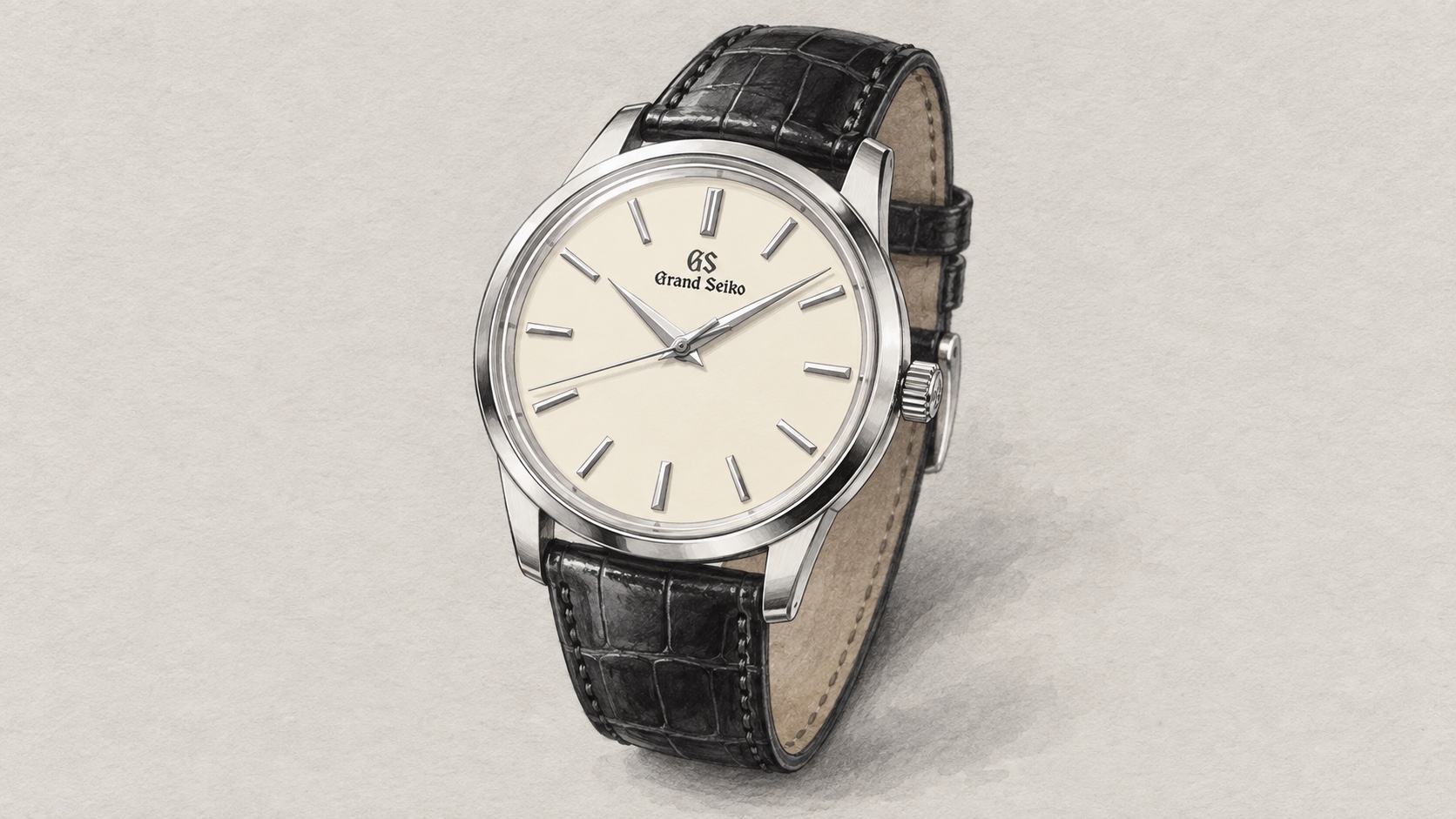
The choice is about how you want to interact with a mechanical object. The Grand Seiko SBGW231 makes winding part of a quiet, simple dress-watch design. The Rolex Datejust 36 brings automatic winding to a calendar watch intended for regular use. Both store energy in a mainspring; the difference is how that energy gets there.
What changes inside the watch?
Turning the crown of a manually wound watch transfers energy into the mainspring through the winding mechanism. As the spring releases that energy, the movement regulates its delivery to drive the hands. Wearing the watch does not replenish the reserve merely because your arm is moving.
An automatic adds an oscillating weight, commonly called a rotor. Wrist movement makes that weight move, and the winding system transfers energy to the mainspring. Rolex’s description of its Perpetual rotor explains that path through reversing wheels and a gear train. The rotor supplies energy; it does not replace the movement’s time-regulating components.
Automatic therefore describes the winding system, not a promise that the watch will always show the right time. A watch left unworn can stop. A watch that receives too little movement may not reach its full reserve. Many automatics also allow winding through the crown, but the instructions for the exact calibre should guide how you start it.
Why self-winding became such an important idea
Rolex introduced its patented Perpetual rotor in 1931. Its historical importance lies in making the wearer’s ordinary movement useful to a wristwatch that would otherwise require regular crown winding. The idea changed the relationship between the watch and its owner: keeping it running could become part of wearing it.
That development did not make manual winding obsolete. The SBGW231 shows why the older approach still has a place. Its 9S64 movement sits behind an uncluttered dial without a date display, and the watch offers approximately 72 hours of reserve. The appeal is a deliberate combination of simplicity, mechanical involvement and a particular design, rather than an attempt to imitate an automatic at a lower price.
Two watches make the difference tangible
| Feature | Grand Seiko SBGW231 | Rolex Datejust 36 126234-0051 |
|---|---|---|
| Winding | Manual; calibre 9S64 | Automatic; calibre 3235 |
| Published reserve | Approximately 72 hours | Approximately 70 hours |
| Case diameter | 37.3 mm | 36 mm |
| Calendar | No date | Date with Cyclops lens |
| Supplied band | Crocodile leather strap | Jubilee bracelet |
The reserve figures are close. The manual watch is not necessarily the one that needs attention sooner. What differs is the way you replenish it. The SBGW231 needs crown winding; the Datejust can collect energy through wear. A long manual reserve gives flexibility between winding sessions without changing the basic routine.
Choose the task you actually enjoy
Manual winding suits an owner who likes a brief interaction with the watch before putting it on. A simple display can also make restarting straightforward after time away. With the SBGW231, there is no date to correct, so the interaction is centred on winding and setting the time.
An automatic suits someone who wants a mechanical watch to remain ready through regular wear. The Datejust adds a useful calendar, which makes its everyday role different from the Grand Seiko’s. If it stops for long enough, that calendar becomes another setting to restore. Automatic winding reduces a routine; it does not remove every ownership task.
A collection of several watches changes the calculation. Even an automatic may spend too long off the wrist to remain running. In that situation, choosing a manual watch is less of a departure than it sounds, because restarting is already part of the way you use the collection.
What winding does not tell you
Manual or automatic does not by itself rank a watch’s accuracy, finishing or quality. Those depend on the specific movement and watch. Nor does a rotor automatically make a watch too thick. Compare the documented dimensions of the references you are considering instead of turning a construction choice into a universal sizing rule.
The same applies to the display. A sweeping seconds hand does not tell you that a watch winds automatically. Both manual and automatic mechanical movements can use a central seconds display. Look at the calibre description, particularly when a seller uses mechanical and automatic as if they meant exactly the same thing.
The better choice is the routine you want to keep
Choose manual winding if touching the crown and keeping track of the reserve feels like part of the pleasure of ownership. Choose automatic if you want regular wear to do more of that work. If both routines sound inconvenient, a quartz or light-powered watch deserves consideration before you commit to a mechanical movement.
Neither choice needs an enthusiast’s justification. A manual Grand Seiko can be a deliberate preference, and an automatic Datejust can be an equally deliberate preference for convenience. The useful question is whether the watch’s routine adds something you want to your day.
Based on manufacturer information. Specifications and sources checked on 8 September 2026.
Sources: Grand Seiko UK boutique SBGW231; Seiko 2011 introduction of calibre 9S64; Grand Seiko US boutique SBGW231; Rolex Jubilee configuration; Rolex Oyster configuration; Rolex Datejust history; Rolex on the Perpetual rotor and its 1931 introduction.
Image: AI-generated editorial illustration of the Grand Seiko SBGW231. Design details are approximate; this is not a product photograph.