With some watches, the bracelet is the most recognisable part. A few links emerging from a cuff are enough to suggest the design before the dial appears. That is the appeal of an integrated bracelet: the watch seems to continue around the wrist instead of ending at a pair of lugs.
The term sounds technical, but its meaning is often visual. An integrated design can still have a detachable bracelet. What matters to the eye is the transition between the case and the first links, and whether their shapes and finishes read as one composition. Understanding that distinction makes the history more interesting and the buying decision more practical.
Integrated bracelets existed before the 1970s sports watch
Audemars Piguet’s bracelet history describes an earlier world of elaborate jewellery watches, including metal bracelets attached directly to cases. Its archive also acknowledges Omega’s 1964 integrated-bracelet patent. The category did not suddenly appear with one famous steel watch in the following decade.
The Royal Oak of 1972 brought together steel, a sports-watch identity and the surface treatment associated with elaborate jewellery bracelets. Gérald Genta’s case and bracelet were conceived together. The first link’s geometry continued the case, although screws allowed the bracelet to be separated. This is why “integrated” cannot simply mean permanently welded together.
The Royal Oak matters here as a change in emphasis. The bracelet was no longer a quiet means of carrying an expensive watch. It became a large part of what made the watch worth looking at. Alternating surfaces, narrowing links and the junction with the case offered detail well beyond the dial.
From a continuous shape to an interchangeable system
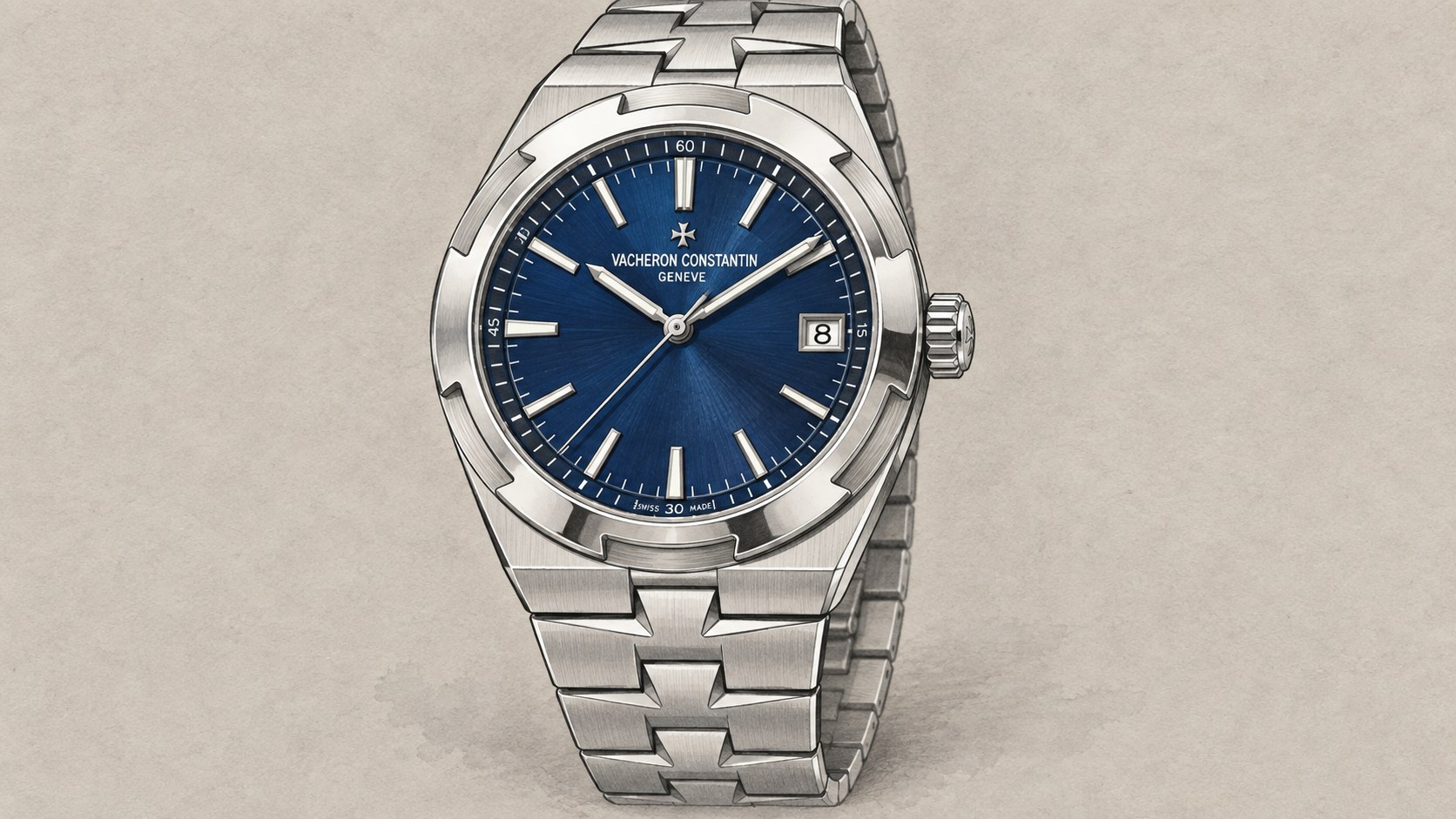
Vacheron Constantin’s collection history places the 222 in 1977 and the Overseas in 1996. Those dates describe related chapters, not one unchanged watch. The contemporary Overseas combines its distinctive bracelet with a system that lets the wearer alter the attachment and retain a recognisable case design.
The blue 4520V/210A-B128 is supplied with steel, dark-blue calfskin and dark-blue rubber options. This develops the integrated idea in a useful direction. The visual connection can be strong without making one material compulsory. The same watch can emphasise the bracelet’s repeating metal shapes or the simpler line of a strap.
For a buyer, that flexibility changes the question from whether an integrated watch can ever take a strap to which compatible alternatives actually exist. A case-specific attachment remains part of the design. The important distinction is between easy interchangeability within a system and unlimited compatibility with ordinary straps.
The Aikon has its own route into the category
Maurice Lacroix connects the Aikon to its Calypso collection of the 1990s. The Aikon arrived in 2016 with quartz power and an exchangeable strap system, before the family expanded into different movements, sizes and materials. That history gives its prominent bezel claws a more specific context than a generic reference to 1970s sports watches.
The current blue 39mm automatic keeps a strong case-and-bracelet outline, but its six bezel elements and textured dial create their own rhythm. It is a useful reminder that an integrated bracelet is a design approach, not a requirement to reproduce the same octagon. Cases, bezels and links can speak several different visual languages.
Three current integrated bracelet watches in numbers
| Exact reference | Diameter × thickness | Movement and reserve | Water resistance | Attachment detail |
|---|---|---|---|---|
| Vacheron Constantin Overseas 4520V/210A-B128 | 41 × 10.69mm | 5100 automatic; 60 hours | 150m | Steel bracelet; supplied calfskin and rubber alternatives |
| Christopher Ward Twelve C12-40ADA1-S00B0-B0 | 40 × 9.95mm | SW200-1 automatic; 38 hours | 100m | Steel bracelet; 3mm total clasp micro-adjustment |
| Maurice Lacroix Aikon AI6007-SS002-430-1 | 39 × 11mm | ML115 automatic; 38 hours | 200m | Steel bracelet with Easy Change System |
The Christopher Ward Twelve in Nordic Blue adds a sharply faceted twelve-sided bezel and a densely textured dial. At 9.95mm thick, this steel reference offers a comparatively slim published profile. Its current bracelet includes 3mm of total micro-adjustment, a small specification with direct relevance when deciding how the bracelet will be sized.
The Aikon Automatic Date 39mm has a slightly smaller case diameter and a higher stated water-resistance rating. Those facts do not establish a universal winner. The Twelve’s facets, the Aikon’s rounded bezel with claws and the Overseas’ shaped links offer visibly different answers to the same challenge.
Look beyond the dial when you choose
On an integrated design, the first links deserve as much attention as the dial colour. See where they start to articulate, how the bracelet narrows and whether the clasp offers the adjustment you need. Case diameter alone leaves out a substantial part of the object you are buying.
Also decide whether the bracelet is essential to your attraction. If it is, a beautifully coordinated fixed visual identity may be the whole point. If you regularly change straps, the supply and price of compatible options become part of the purchase decision from the beginning.
The history offers a better way to compare these watches than arranging them by resemblance to the Royal Oak. Integrated bracelets draw on jewellery, sports-watch construction and modern attachment systems. Choose the composition you enjoy, then check that its practical details support the way you want to use it.
Based on the manufacturers’ published information. Sources and specifications checked on 8 September 2026.
Image: AI-generated editorial illustration of the Vacheron Constantin 4520V/210A-B128. Fine dial details and finishing may differ from the production watch.