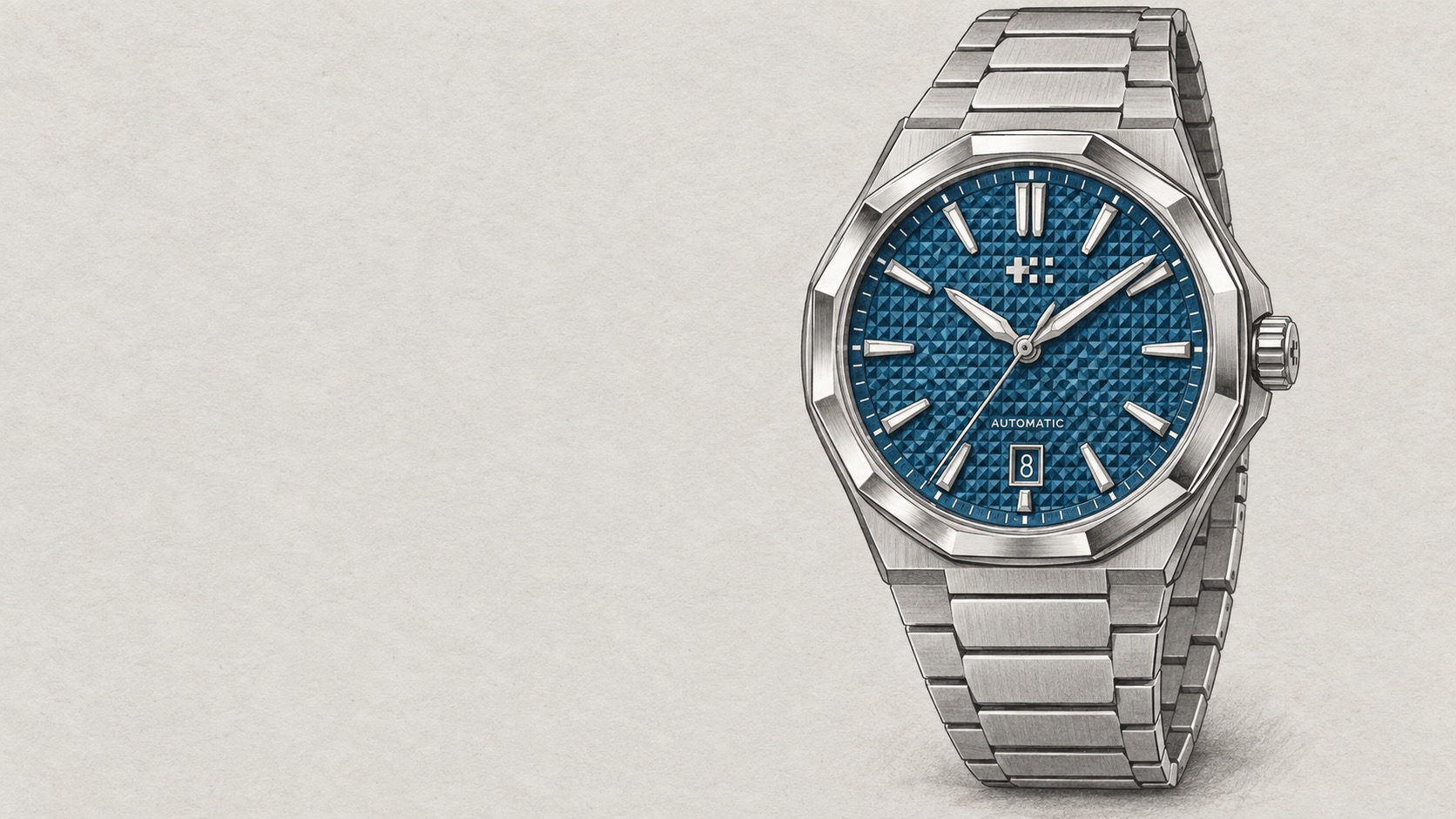
The PRX and The Twelve are easy to group together as steel watches with integrated-looking bracelets. That description is useful only as a starting point. The blue PRX pairs a relatively simple round bezel and broad case shoulders with a long reserve. The Nordic Blue Twelve adds a twelve-sided bezel, a more elaborate dial pattern and a different bracelet adjustment proposition.
Both selected models are forty-millimetre automatics. Choose between the actual case, bracelet and movement packages, rather than assuming they are interchangeable ways to buy the same style. The PRX has a clear reserve advantage; The Twelve offers concrete details that may matter more to someone choosing the watch chiefly as a piece of metal design.
The references compared
| Feature | PRX Powermatic 80 | The Twelve 40 |
|---|---|---|
| Reference | T137.407.11.041.00 | C12-40ADA1-S00B0-B0 |
| Case / bracelet | Steel | Steel |
| Diameter / thickness | 40mm / 10.93mm | 40mm / 9.95mm |
| Movement | Powermatic 80 automatic | Sellita SW200-1 automatic |
| Reserve | Up to 80 hours | 38 hours |
| Water resistance | 10 bar | 10 bar |
| Dial | Blue waffle pattern; date | Nordic Blue geometric pattern; date |
| Clasp detail | Butterfly with push-buttons | Bracelet micro-adjustment: 3mm |
Two histories behind the decision
Tissot explicitly links the PRX’s case shape to 1978. That gives its broad shoulders and continuous bracelet a direct connection to the brand’s own late-twentieth-century catalogue. Christopher Ward places The Twelve within the wider integrated sports-watch tradition and connects its design exploration to the earlier C20 Lido. The contemporary Twelve adds its dodecagonal bezel and a dial motif derived from the twin-flags logo. These histories matter because the comparison need not become a search for resemblance to a much more expensive watch. Each maker offers a specific design story, and the most useful question is how successfully the current case, face and bracelet work together on their own terms.
An eighty-hour reserve is a real Tissot distinction
The PRX’s stated reserve is more than twice the Twelve’s thirty-eight hours. That can be valuable if the watch regularly spends a couple of days off the wrist and you prefer to find it still running. It is a concrete difference, not simply a larger number to decorate a specification table.
The Twelve’s SW200-1 remains a conventional automatic choice for someone who wears it frequently or is untroubled by resetting it. A shorter reserve does not cancel the attraction of its exterior. It does mean that a buyer motivated primarily by the movement’s ability to wait between outings has a strong reason to favour the PRX. The Tissot’s Nivachron spring is another model-specific feature, although neither point substitutes for liking its dial.
The Twelve makes more of the bezel and bracelet
The Twelve’s twelve-sided frame produces a different sequence of edges from the PRX’s circular bezel. Its patterned dial and articulated bracelet continue that more faceted approach. The PRX lets the broad case shoulders and rows of bracelet links establish most of the geometry around a simpler frame.
Christopher Ward’s listed three millimetres of bracelet micro-adjustment is a useful detail to examine in the current configuration. Tissot lists a butterfly clasp with push-buttons for this PRX. Those descriptions should not be treated as identical adjustment systems. Someone who values the Twelve’s clasp provision has a specific reason to prefer it beyond a general impression of extra refinement.
Two blue textures create different amounts of activity
The PRX’s waffle dial offers a relatively regular grid beneath straightforward markers. The Twelve’s repeating geometric surface is more conspicuously three-dimensional, with the twin-flags idea contributing to the pattern. Neither adds a new complication; the difference is in how much the background participates in the design.
That makes an ordinary-distance comparison particularly useful. If the Twelve’s surface becomes the main reason to look at it, the design is doing its job. If you prefer the PRX’s broader, calmer shapes, a more complicated texture is not automatically an improvement. Both include a date, so this is largely a choice about decoration and the arrangement of surfaces rather than information.
The same diameter does not make the same object
The Twelve is thinner on the published figures, but the full bracelet and its first links remain part of the shape. A fitting should include the exact bracelets, with attention to their articulation and clasp position. Neither watch is completely described by the forty-millimetre label.
Choose the PRX when its broad 1970s-derived case, blue grid and long reserve make a satisfying complete package. Choose The Twelve when the polygonal frame, Nordic Blue texture and bracelet details are the attractions you would otherwise keep missing. For a price decision, compare current delivered offers for these exact steel automatics. Mixing in titanium Twelve variants or quartz PRX models would answer a different question.
Specifications and sources checked on 8 September 2026. PRX specifications and 1978 design; The Twelve specifications and design; The Twelve handbook.
Image: AI-generated editorial illustration of Christopher Ward C12-40ADA1-S00B0-B0. Design details are approximate; this is not a product photograph.


