A dress watch can look almost unchanged across decades: round case, leather strap, readable dial. Look closer and the proportions, movement and relationship to daily use can be very different. Restraint is not a fixed case size, and a thin watch need not have an empty dial.
Three families provide a useful route through this history. Patek Philippe’s Calatrava shows how decoration can become part of a restrained design. Jaeger-LeCoultre’s Master Control joins classical appearance to automatic winding and a testing programme. Vacheron Constantin’s Patrimony explores how a larger dial can retain the quietness of older watches. None tells the whole history of formal timekeeping; together they reveal why it continues to change.
Calatrava established a vocabulary, not one permanent design
Patek Philippe dates the first Calatrava, reference 96, to 1932. Its round case, applied markers and small seconds became recurring elements, but the collection was never confined to one bezel. In 1934, the 96D added the raised hobnail pattern known as Clous de Paris.
The 3919 of 1985 combined that bezel with Roman numerals and straight lugs. The 5119 followed in 2006 with a larger 36 mm case. When the 6119 arrived in 2021, it grew again to 39 mm while returning to applied markers and curved lugs associated with earlier Calatravas.
This is evolution by selection. The newer watch does not reproduce one ancestor wholesale. It borrows elements from different points in the family, then rearranges them for a new scale. That is why calling it simply vintage-inspired misses the designer’s work between the historical references.
A quiet dial can sit inside a decorated frame
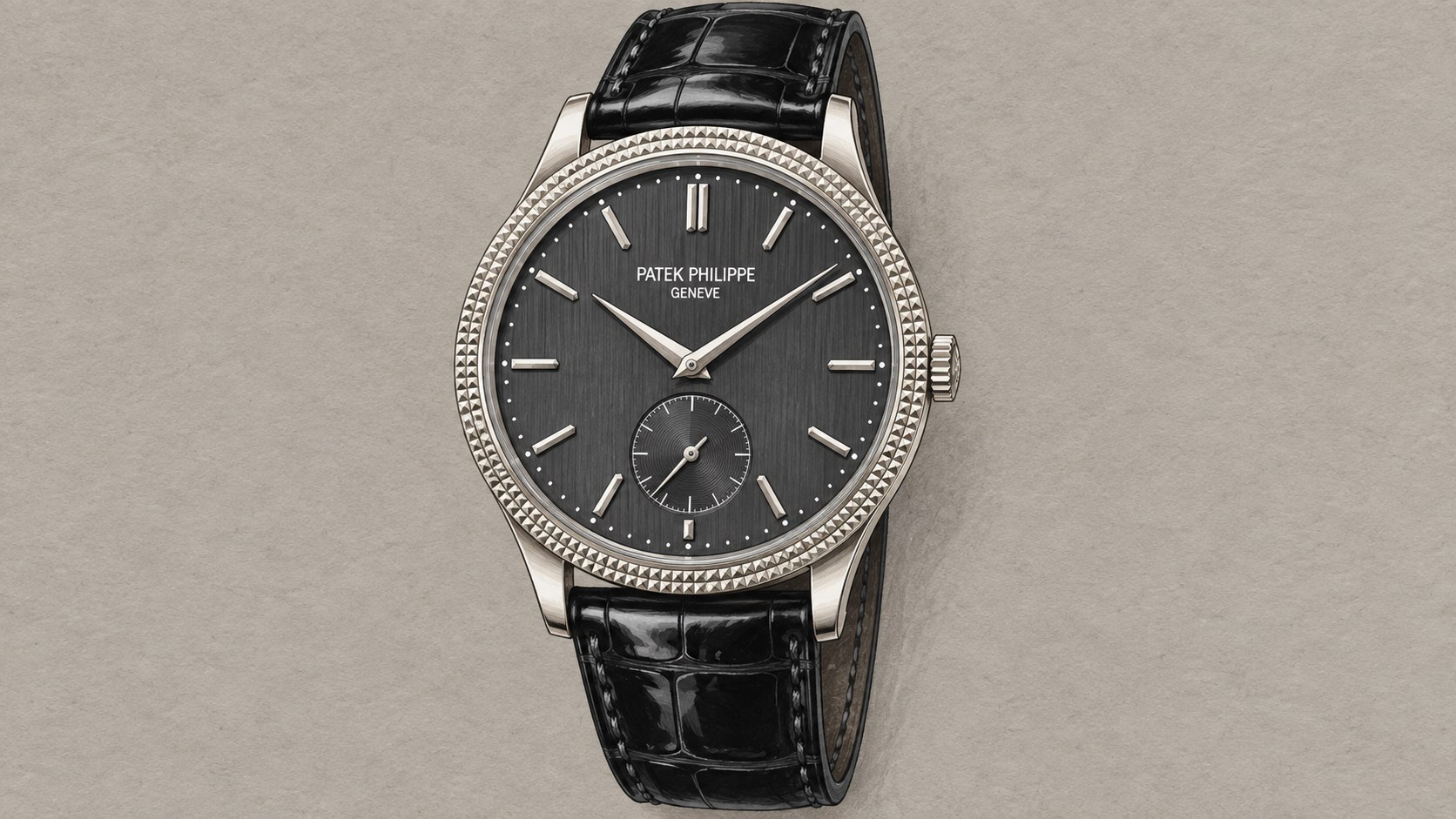
The current white-gold 6119G-001 pairs a charcoal dial with a vertically brushed surface and a small-seconds register. Its hobnail bezel is visibly decorative, yet the display remains focused on time. Ornament and restraint coexist because they occupy different parts of the composition.
Its 30-255 PS movement also shows that a familiar-looking watch can contain new engineering. The manually wound calibre uses two barrels in parallel and offers a minimum 65-hour reserve while measuring 2.55 mm thick. The case is 8.08 mm from crystal to back. These figures describe a particular solution to thinness and running time, not a universal dress-watch requirement.
A buyer who enjoys surface detail may therefore find the Calatrava more compelling than a completely smooth two-hand watch. Someone wanting the bezel to disappear visually may draw the opposite conclusion. Neither preference needs a rule about how many decorative features formal wear allows.
Master Control made the classical watch a technical proposition
Jaeger-LeCoultre launched Master Control in 1992, looking back to its designs of the 1950s. The name referred to the company’s 1,000 Hour Control programme, which examined the movement and the complete watch. Heritage here included a quality-testing approach as well as the shape of a dial.
The Q4018421 carries that family forward with a steel case, automatic calibre 899 and 70 hours of reserve. Central seconds and a date make it more informative than the two-hand Patrimony, without giving it the visual equipment of a sports watch. At 40 mm across and 8.78 mm thick, it offers a contemporary footprint with a relatively shallow profile.
Its light-brown Novonappa calfskin strap also changes the reading of the watch. The manufacturer lists an additional black alligator strap, giving the same case a different presentation. The useful lesson is not that one colour obeys etiquette and another breaks it. A strap can make a classical watch feel appropriate to more of the owner’s actual week.
Patrimony increased the canvas while reducing the display
Vacheron Constantin dates the modern Patrimony collection to 2004. Its heritage account connects the slender cases, short lugs and pearl-like minute track to the company’s 1950s watches, while identifying the larger 40 mm scale as a design challenge. A historical language was being translated, rather than preserved at its original size.
Reference 81180/000R-B518 puts two hands over a midnight-blue dial inside a pink-gold case just 6.79 mm thick. The manual calibre 1400 provides approximately 38 hours of reserve. There is no date window or seconds display competing with the hour markers.
That reduction changes ownership as well as appearance. You give up a visible running indication and calendar in exchange for a particularly spare composition. Its shorter reserve also asks for more frequent attention than the other two watches if they are wound fully and left aside. Simplicity at the front does not automatically mean the least interaction for the owner.
Modern examples reveal several definitions of elegance
| Modern watch and reference | Case diameter × thickness | Movement and reserve | Display and character |
|---|---|---|---|
| Patek Philippe Calatrava 6119G-001 | 39 × 8.08 mm; white gold | Manual 30-255 PS; minimum 65 hours | Small seconds; charcoal dial; hobnail bezel |
| Jaeger-LeCoultre Master Control Date Q4018421 | 40 × 8.78 mm; steel | Automatic 899; 70 hours | Central seconds and date; silvered-grey dial |
| Vacheron Constantin Patrimony 81180/000R-B518 | 40 × 6.79 mm; pink gold | Manual 1400; approximately 38 hours | Hours and minutes; midnight-blue dial |
These watches are all round and restrained, but their similarities should not hide the choice. The Calatrava places detail in its bezel and movement. Master Control adds practical indications and self-winding. Patrimony gives more of its dial to uninterrupted space.
The history of the dress watch is therefore more useful as a set of design possibilities than a list of prohibitions. Decide how much information you want, how you feel about winding, and which proportions suit your wrist and clothes. The enduring idea is a composed watch. Its size, materials and level of decoration have always left room for interpretation.
Based on manufacturer information. Specifications checked on 8 September 2026.
Sources: Calatrava 6119G specifications; 6119 design development and history; Calibre 30-255 architecture; Current Master Control Date reference; Vacheron Constantin Patrimony 81180/000R-B518; Jaeger-LeCoultre: Master Control origins and 1,000 Hour Control; Vacheron Constantin heritage: Patrimony in 2004 and its 1950s influences.
Image: AI-generated editorial illustration of the Patek Philippe 6119G-001. Fine dial details and finishing may differ from the production watch.