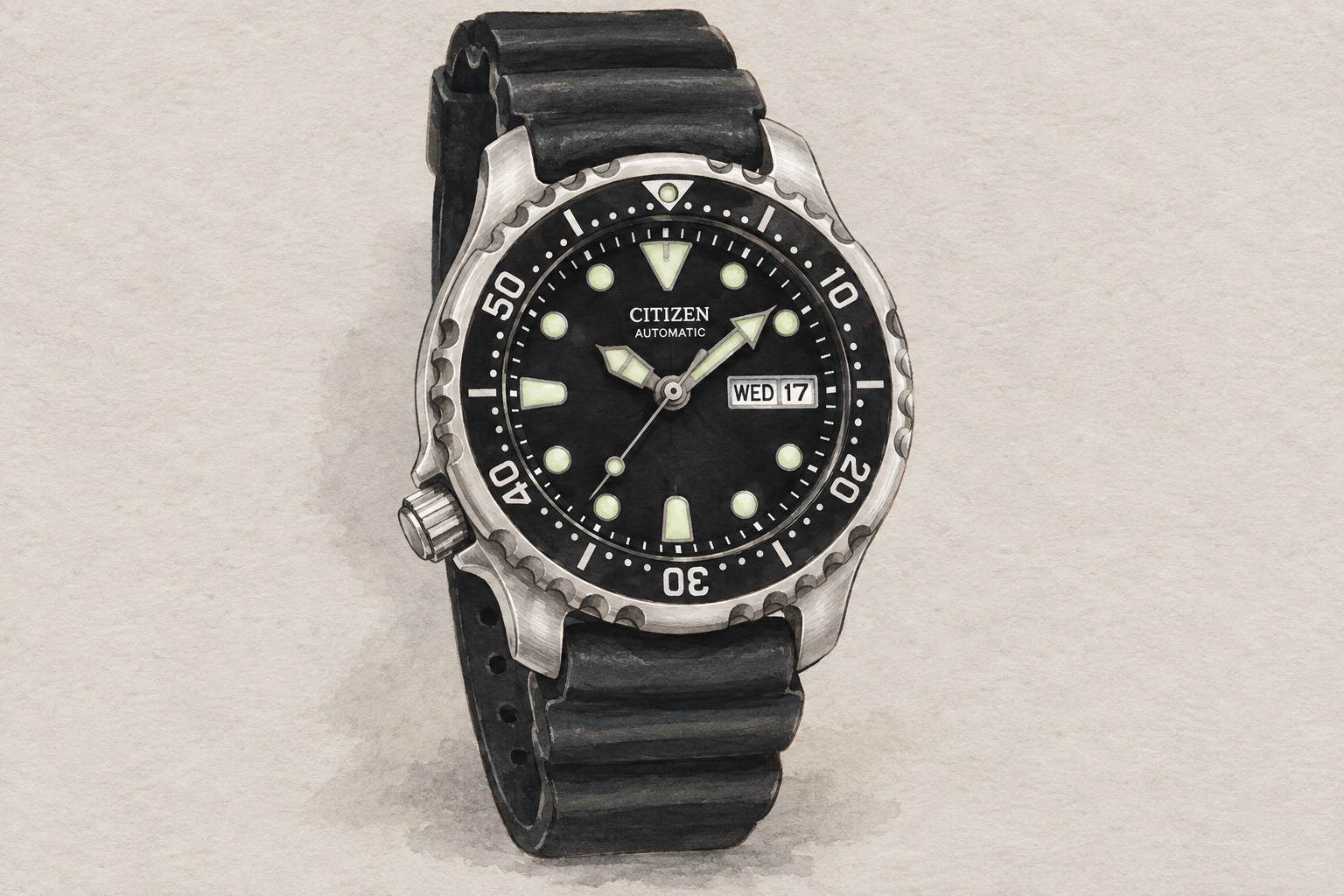
The Citizen NY0040 and Casio Duro can look like two ways to buy the same thing: a black analogue watch with a rotating bezel and a flexible strap. Their most important difference appears when you leave them in a drawer. The Casio carries on; the Citizen eventually asks you to restart a mechanical movement.
Choose the NY0040-09EC if that mechanism is part of the pleasure. Choose the MDV-106-1AV if you want a simple watch ready whenever you need it. Case shape and controls may refine the decision, but neither should distract from the kind of ownership you actually want.
The references compared
| Feature | Citizen NY0040-09EC | Casio MDV-106-1AV |
|---|---|---|
| Movement | 8204 automatic | Battery quartz |
| Case width | 42 mm diameter | 44.2 mm published width |
| Thickness | 12 mm | 12.1 mm |
| Weight | 94 g | 92 g |
| Stored energy | About 40 hours | About 3 years on SR626SW |
| Water resistance | 20 bar | 200 m |
| Crystal | Crystal glass | Mineral |
| Calendar | Day and date | Date |
| Supplied strap | Black urethane | Black resin |
Specifications: Citizen Europe: NY0040-09EC product specifications; Casio Canada MDV-106-1AV specifications.
How the Promaster and Duro families developed
Citizen’s design archive records the related NY0040-09W in 1997, explaining its rounded surfaces and bezel contours through the needs of the wearer. That earlier version used a different movement from today’s European 8204 reference, but the design intentions help explain the family’s unusual appearance.
The Casio belongs to a continuing MDV family whose later MDV-107 catalogue record preserves the straightforward combination of analogue hands, rotating bezel and a substantial water rating. The 107 record is not an original launch date for the 106. Together these histories show two forms of continuity: Citizen develops a distinctive mechanical-diver shape, while Casio keeps the affordable analogue format focused on a few useful features.
Similar weight, different outline
The Citizen is narrower on the published figures, at 42 mm across against Casio’s 44.2 mm case width. Their thicknesses are almost identical, and the stated weights differ by only 2 g. A buyer expecting the automatic to be dramatically heavier will not find support for that assumption here.
The Casio also publishes a 48.5 mm case length. Citizen’s exact page does not provide a clearly labelled comparable span. The useful comparison is therefore the complete outline on your wrist, not an invented rule that the smaller diameter must fit better.
The Citizen’s crown sits low on the left side. That gives it a recognisable appearance and a different setting routine. Try the controls with the watch off your wrist and decide whether their position is a benefit for how you wear it. The Casio keeps a more familiar right-side crown arrangement.
What the movement changes
Citizen’s European reserve fields disagree slightly between 40 and 42 hours. For a buying decision, approximately 40 hours conveys the useful reality: a long unworn weekend can outlast the reserve. Regular wear supplies energy to the automatic mechanism, and occasional resetting is part of the arrangement.
The Casio’s quoted battery life is approximately three years. It avoids that winding routine, although a battery change will eventually be needed. Its published accuracy is ±20 seconds per month, making the specification easy to understand for someone who wants predictable everyday timekeeping.
The Citizen adds a day display alongside the date. That may earn its place if you regularly consult both. The Casio’s simpler calendar gives the dial one less piece of information to accommodate. Neither is a universal advantage; it depends on what you actually read.
The bezel is useful beyond swimming
Both provide an elapsed-time reference without a digital mode or extra set of hands. You can mark a starting minute and check the interval later. It is useful for something you intend to watch, rather than an alarm that will call you back automatically.
The published water ratings are substantial, but the exact Citizen is a Promaster diving model while the Casio’s rating alone should not be expanded into an unverified certification. For regular water use, the condition of the seals and the instructions for the actual watch matter more than an enthusiastic nickname.
Which one should you buy?
No verified current GBP price is used for either exact suffix here. Compare actual UK offers, including the included strap and support, rather than treating a price from another region as your likely total.
The Citizen makes the stronger choice for a buyer who wants to begin or continue mechanical ownership and likes its distinctive case. The Casio is the more direct choice for an occasional watch, a spare or someone who values readiness above movement interest. Buy the routine you want to live with, and the rest of the comparison becomes much simpler.
Based on manufacturer information. Specifications checked on 8 September 2026.
Image: AI-generated editorial illustration of the Citizen NY0040-09EC. Design details are approximate; this is not a product photograph.


