A quartz watch can be interesting because it keeps very good time without help, or because it regularly obtains a correction from somewhere else. Those are different achievements. They may produce a similarly reassuring glance at the dial, but the engineering and ownership questions are not the same.
Grand Seiko’s 9F family makes the first route its central proposition. Casio’s Oceanus T200 combines quartz timekeeping with radio reception and a Bluetooth connection. Comparing them explains why the phrase high-precision quartz deserves more detail than an assumption that every battery-powered watch is essentially identical.
Grand Seiko pursued quartz precision before 9F
The first quartz Grand Seiko was the 95GS of 1988, rated to within ten seconds per year. Grand Seiko’s historical account describes selected crystals and electronic compensation, but also notes that the watch lacked the broad hands associated with its mechanical designs.
When 9F appeared in 1993, its task extended beyond reducing rate error. It combined the annual accuracy ambition with enough torque to move larger hands, controlled their behaviour and provided a rapid date change. A movement hidden beneath the dial was being developed partly to preserve the brand’s visible character.
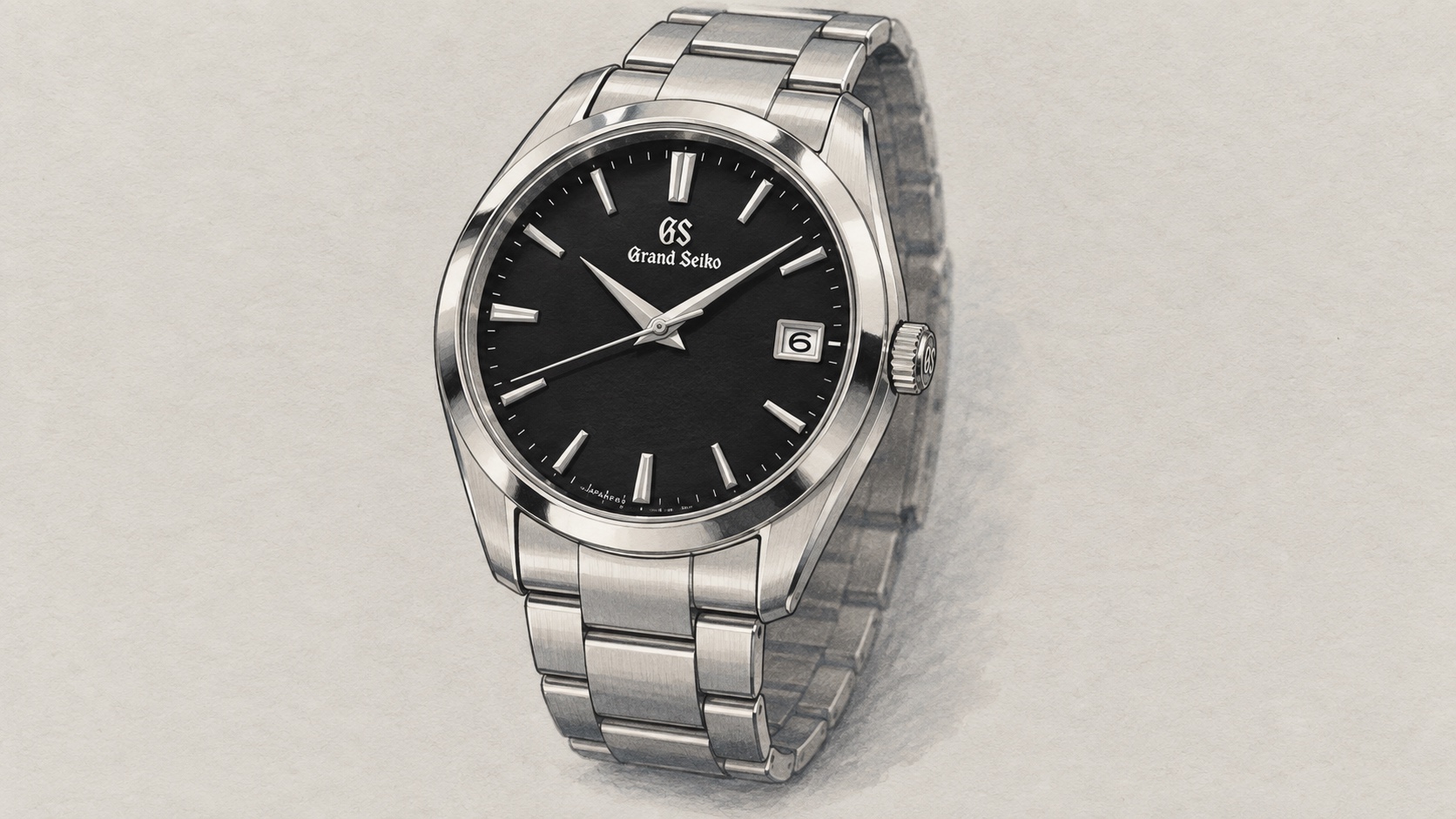
The family continued to evolve. Grand Seiko introduced the GMT-equipped 9F86 in 2018, followed by 9F85 in 2020. The latter retained independent adjustment of the hour hand without adding a separate GMT display. That distinction is central to understanding today’s SBGP011: it is a three-hand watch with a date and a useful adjustment function, not a two-time-zone watch.
Temperature compensation addresses the oscillator
Grand Seiko describes a three-month ageing process for its quartz oscillators before selection. The movement’s electronics are matched to the individual crystal’s temperature characteristics. Internal temperature is measured 540 times each day, allowing the circuit to compensate for the resulting variation.
This is continuous work inside the watch. It does not require the wearer to receive a broadcast or pair a phone. It also makes the published unit meaningful: SBGP011’s 9F85 is specified at ±10 seconds per year, rather than the monthly tolerance quoted for many quartz watches.
The specification describes a tolerance, not a promise that every example will lose exactly ten seconds on the last day of each year. A watch can run closer to reference time, and the observed result belongs to that individual watch and its conditions. A short observation is also a poor basis for predicting a full year of performance, particularly if the conditions later change.
Precision also has to reach the hands
9F’s Twin Pulse Control Motor delivers two rapid pulses per second, supplying the torque needed for its heavier hands. The two movements appear to the eye as a single one-second step. A backlash-control mechanism uses a small spring to steady the seconds hand after it advances. Separate hand axes help prevent interference during adjustment.
These mechanisms address the visible result of timekeeping. A stable oscillator would be less satisfying if the hands quivered or were difficult to place accurately. Yet the twin pulses should not be confused with a continuously sweeping seconds hand. The apparent one-second tick is part of how this quartz system works.
The 9F85’s independently adjustable hour hand preserves the running time when changing the local hour. For travel or a seasonal clock change, that means less reason to disturb a carefully set minute and seconds display. It improves interaction with the existing time reference rather than adding another one to the dial.
Oceanus takes accuracy beyond the individual oscillator
Casio dates the modern Oceanus line to the OCW-500 in 2004, bringing solar power and radio-controlled timekeeping into a metal chronograph. The T200 applies the broader idea to a simpler three-hand watch. Its module 5596 can correct the time through Multiband 6 radio reception or a compatible Bluetooth connection.
Without those corrections, Casio specifies ±15 seconds per month. A successfully synchronised watch can therefore show reference time very closely even though its unaided rate specification differs substantially from the Grand Seiko’s. It would be misleading to call that the same engineering achievement, or to assess its everyday usefulness solely by the unaided number.
The current OCW-T200S-1AJF also needs careful identification. Its case and bracelet are stainless steel with titanium-carbide surface treatment. That treatment does not make it a titanium watch. Other Oceanus references use different materials, and the family name is not a complete specification.
Two modern answers to keeping a watch ready
| Modern watch and reference | Case and dimensions | Timekeeping approach | Power specification |
|---|---|---|---|
| Grand Seiko SBGP011 | Steel; 40 mm wide × 10.6 mm thick; 47 mm lug to lug | 9F85 quartz; ±10 seconds per year; independent hour adjustment | Battery; approximately 3 years |
| Casio Oceanus OCW-T200S-1AJF | Steel; 49.5 mm long × 41.4 mm wide × 10.7 mm thick | Module 5596; radio and Bluetooth correction; ±15 seconds per month without correction | Solar; 5 months normal operation or 20 months power saving from full charge |
The power figures need their labels. Grand Seiko quotes approximately three years from a replaceable battery. Casio’s five-month figure describes normal operation after a full solar charge; the longer figure depends on power saving. It is not twenty months of unrestricted normal use, nor a promised lifespan for the rechargeable cell.
Choose the 9F approach if a self-contained annual accuracy specification and its particular hand-control engineering appeal. Choose the Oceanus approach if light charging and automatic correction fit your routine, allowing for reception conditions and phone compatibility. Both make quartz worth examining closely. Their histories show that progress can mean improving the watch’s internal reference, or improving its access to an external one.
Based on manufacturer information. Specifications checked on 8 September 2026.
Sources: Grand Seiko UK boutique SBGP011; Grand Seiko GS9 Club movement history; Grand Seiko calibre 9F85; Grand Seiko Japan SBGP011; Casio Japan OCW-T200S-1AJF specifications; Casio Oceanus module 5596 English manual; Grand Seiko: 9F temperature compensation and hand-control mechanisms; Casio watch history: the 2004 Oceanus OCW-500.
Image: AI-generated editorial illustration of the Grand Seiko SBGP011. Design details are approximate; this is not a product photograph.