A G-Shock’s raised bezel is easy to read as styling. The protruding guards, recessed glass and broad resin surfaces give the watch an immediately recognisable outline. But the design began with a problem inside the case: how to stop an impact reaching the parts that kept the time.
The answer was more interesting than making everything thicker. G-Shock history follows the relationship between protection and size, then the search for ways to add functions or change the shape without losing that original purpose. A square digital model and a slim analogue-digital one share the idea while taking different routes to it.
1983: protect the module, not just the outside
Casio’s account of Kikuo Ibe’s development work describes an early dead end: adding more cushioning made prototypes larger without solving every failure. The breakthrough came from thinking about a watch suspended inside a rubber ball. The first G-Shock, the DW-5000C, reached the market in 1983.
In the resulting hollow-case approach, the module was supported at limited points, reducing contact with the surrounding case. Resin provided both an exterior and a buffer. Raised areas helped keep impacts away from the glass and buttons, while the curved band attachment helped protect the back. The shape followed a coordinated protection system.
This is the important distinction between looking robust and designing how force reaches the movement. A broad case can advertise strength, but the arrangement inside it is what gives the exterior a purpose. The original development story is about that relationship rather than simply the quantity of material.
1995: a round G-Shock develops a different identity
The 6900 series debuted in 1995, taking the family away from the original square outline. Its circular case, three graphic displays and large front light button became a separate set of recognisable features. Casio describes a design organised around concentric forms, including the bezel and button guards.
The front button is a useful example of function becoming identity. It has a straightforward operating purpose, yet it also gives the watch a focal point outside the LCD. The surrounding protection and rounded case make it appear deliberately prominent rather than merely attached to the edge.
The later GW-6900-1JF brought Tough Solar and Multi Band 6 radio reception to that format in 2009. Casio now marks this original Japanese reference as production complete and links to a GW-6900U successor. The older model remains useful in the history, but its electroluminescent backlight should not be confused with the updated watch’s specification.
2019: the GA-2100 reduces the bulk
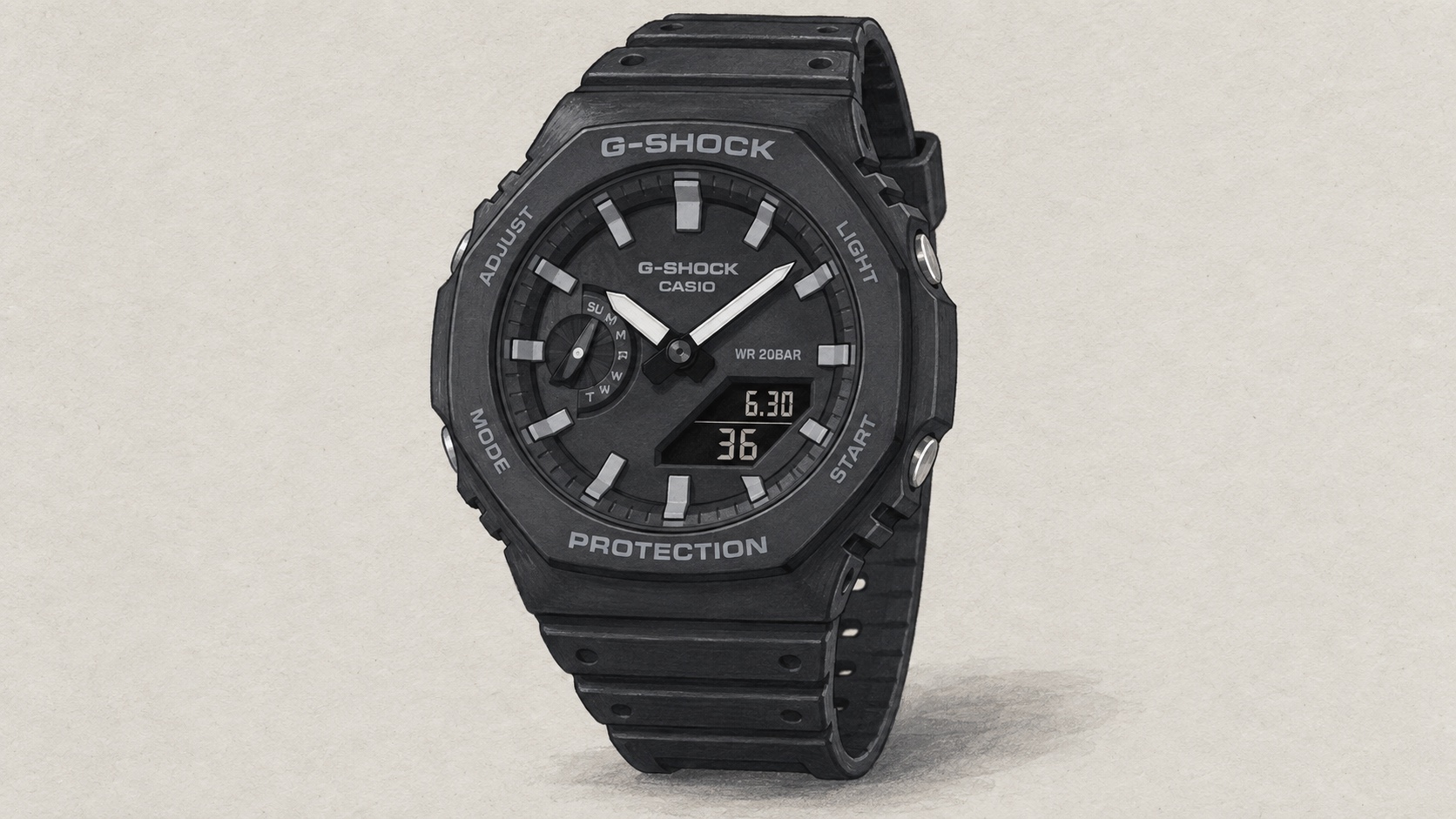
Casio dates the GA-2100’s introduction to 2019. Its octagonal outline recalls the first G-Shock, but the analogue-digital dial and slimmer profile make it a different object. Carbon Core Guard uses a carbon-fibre-reinforced resin case to protect the module while allowing a compact structure.
The exact GA-2100-1AER is 11.8mm thick and weighs 51g. It uses ordinary replaceable batteries, with an approximate three-year life, rather than solar charging. The related GA-B2100 added solar and Bluetooth in 2022, so that extra letter is a meaningful part of the reference.
This development shows why there is no single ideal G-Shock shape. A thinner analogue-digital model can appeal to someone who dislikes the visual bulk of a round 6900. Another wearer may prefer the directness of a larger digital display and a conspicuous light button. The protection concept accommodates both preferences.
Three exact references show the trade-offs
| Reference | Length × width × thickness; weight | Case construction | Power and time adjustment | Display and distinction |
|---|---|---|---|---|
| GA-2100-1AER | 48.5 × 45.4 × 11.8mm; 51g | Carbon-reinforced resin / resin | Battery quartz; about three years | Analogue-digital; no solar or Bluetooth |
| GW-6900-1JF | 53.2 × 50 × 17.7mm; 63g | Resin | Tough Solar; Multi Band 6 radio reception | Digital; electroluminescent backlight; original Japanese reference |
| GW-M5610U-1ER | 46.7 × 43.2 × 12.7mm; 52g | Resin | Tough Solar; Multi Band 6 radio reception | Digital square; LED backlight |
All three references have a stated 200m water-resistance rating. The GW-M5610U-1ER combines the square digital format with solar charging, radio-controlled time adjustment and an LED backlight. Its 43.2mm width sits below that of either other example, while its 12.7mm thickness sits between them.
Those dimensions tell a more useful story than calling every G-Shock oversized. The 6900 in the table is substantially thicker than the GA-2100, even though both express the same broader brand idea. Case shape and display preference can matter more to a buying decision than choosing whichever reference has the most imposing photograph.
Durability is a design brief, not the whole buying decision
Once the engineering has attracted you, choose the interface you want to live with. An analogue-digital face provides familiar hands and a small screen. A digital square prioritises a direct numerical readout. A 6900 adds more visual structure and a larger overall case. There is no need to treat one of these as the authentic choice and the others as compromises.
Then separate convenience from protection. Solar charging and radio reception can reduce routine intervention, but they are different features from the shock-resistant case. The battery-powered GA-2100 does not become conceptually incomplete because it lacks them.
G-Shock endured by keeping a clear engineering purpose while allowing its appearance to change. That makes the history especially useful to a buyer: choose the dimensions, display and power system that suit your day, rather than assuming that the biggest watch must be the best expression of the idea.
Based on the manufacturers’ published information. Sources and specifications checked on 8 September 2026.
Image: AI-generated editorial illustration of the Casio GA-2100-1AER. Design details are approximate; this is not a product photograph.