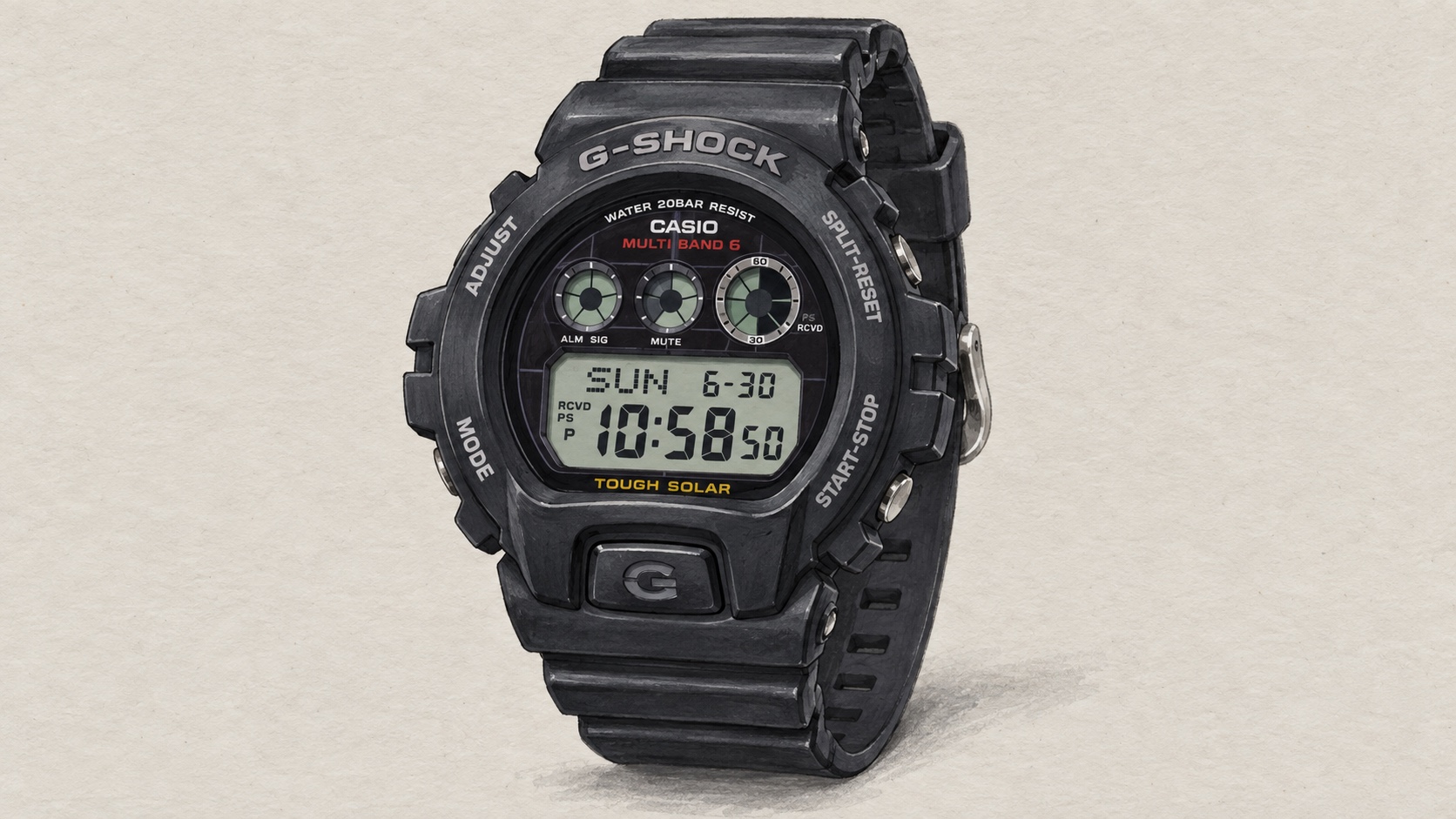
The GW-6900 combines a conspicuously rounded G-Shock case with an ownership routine designed to need relatively little intervention. Tough Solar maintains its energy from light, while Multi Band 6 can correct the time from radio signals. The functions quietly reduce chores inside a watch that makes no attempt to look discreet.
There is now an extra buying question: this guide concerns the original GW-6900-1JF, which Casio’s Japanese page marks as production complete. The later GW-6900U is a separate reference. If you are comparing remaining stock or a used original, the price and condition need to justify choosing that exact version.
Based on Casio’s published information. Specifications checked on 8 September 2026.
The exact reference
| Reference | Original GW-6900-1JF; not the later GW-6900U |
|---|---|
| Case dimensions | 53.2 × 50 × 17.7 mm, length × width × thickness |
| Weight | 63 g |
| Construction | Shock resistant; resin case and strap |
| Glass | Mineral |
| Water resistance | 200 m |
| Power | Tough Solar |
| Reserve without further light | About nine months in normal use; 26 months in power saving |
| Time correction | Multi Band 6; UK and German transmitters supported |
| Unsynchronised accuracy | ±15 seconds per month |
| Functions | World time, stopwatch, countdown timer, five alarms |
| Backlight | Blue-green electroluminescent |
| Catalogue status | Production complete in Japan |
Specification source: Casio Japan original GW-6900-1JF.
The three circles came before the solar movement
The 6900 family began in 1995 with the DW-6900-1V. Its round case, three circular display elements and prominent front button offered a very different silhouette from the square original G-Shock. Casio’s collection history describes those elements as enduring design features, carried through many later colours and collaborations.
The GW-6900 arrived in 2009, adding radio-controlled timekeeping and Tough Solar to that established format. Casio Japan dates this original reference to June of that year. The official 6900 timeline records the technical step, while the design history explains why the visual outline remained recognisable. It is useful to separate the older case-family story from the later power and time-correction features when deciding which 6900 to buy.
Solar and radio solve different problems
Tough Solar deals with energy. Casio quotes around nine months of normal operation from a full charge without further light, or around 26 months in power-saving conditions. Those are different use states, so the larger figure is not an assurance of more than two years of unrestricted daily operation in a drawer.
Multi Band 6 deals with time correction. The original Japanese reference supports the UK and German transmitters as well as the other regions in its specification. Setting London as the relevant home city gives a UK wearer an appropriate starting point; actual reception still depends on location and conditions.
When a signal is unavailable, the watch continues running as an ordinary quartz timekeeper, with a quoted ±15 seconds per month. Radio reception is therefore a useful maintenance aid rather than the mechanism that keeps the display advancing from one second to the next.
The case is the first buying decision
The 53.2 × 50 × 17.7 mm dimensions describe a substantial watch. The 63 g weight means it is not heavy in the same way as a large steel watch, but the tall case remains prominent. This is a model for someone who enjoys that rounded, layered G-Shock appearance.
The front light button is part of the visual identity as well as an operating control. Together with the side guards and circular display elements, it creates a deliberately three-dimensional face. A buyer seeking a watch to disappear beneath fitted sleeves should begin with that physical reality.
The resin strap’s stated fit range is 145–205 mm. That helps rule out an unsuitable overall length, but it does not describe the amount of space the tall case occupies on top of the wrist. Compare the actual shape with a watch you already find comfortable rather than treating the weight as the whole fit story.
Useful digital tools without a smartphone relationship
The GW-6900 includes a stopwatch, countdown timer, world time and five alarms, one with a snooze function. That is a practical collection for ordinary routines: a workout interval, a reminder, or a second city while travelling. The display and buttons handle those tasks directly.
There is no Bluetooth connection in this reference. If your aim is a watch that can function independently of a smartphone, that is an advantage rather than a missing step. If you prefer configuring multiple alarms on a phone screen, a connected model may be easier for your particular use.
The three circular elements are part of a characteristic digital layout, not three analogue chronograph subdials. Learn the ordinary time display and the modes you actually use, then decide whether the visual arrangement helps or distracts. A memorable design still has to work as information.
Original or updated?
Casio links the old model directly to the GW-6900U-1JF successor. The original uses a blue-green electroluminescent backlight; the updated reference has an LED light. This is a concrete distinction to verify when a retailer abbreviates either watch to GW-6900.
For someone buying the original used, the condition of the resin exterior and the rechargeable power system matters more than a general reputation for toughness. Ask how it has been stored, whether it maintains a charge and whether replacement exterior parts have been fitted. A watch from this long-running model family may have a very different personal history from another example.
No current GBP price is assumed for the Japanese reference. Compare the delivered offer and warranty with the updated model available to you. Nostalgia for the original lighting effect can be a valid preference, but it should be a conscious one.
The square alternative
The GW-M5610U-1 brings solar power and radio correction to a more compact square outline. It is the relevant comparison when you like the reduced-maintenance idea but find the 6900 case too tall or broad.
Choose between the two shapes before debating minor functions. The original GW-6900 makes the most sense when you actively want its rounded display and prominent front button. If you prefer the square, the older 6900’s reputation is not a reason to argue yourself into the wrong case.
The verdict
Buy an original GW-6900 when its specific design and electroluminescent light appeal, and the actual example is well documented and sensibly priced against its successor. The solar and radio functions remain useful.
For a straightforward new purchase, compare the updated reference first. For a smaller footprint, compare the square alternative. The original is still an interesting watch, but choosing it now should be an exact-reference decision rather than an automatic response to the family name.
Image: AI-generated editorial illustration of the Casio GW-6900-1JF. Design details are approximate; this is not a product photograph.


