The most useful outdoor watch may be the one with fewer functions. If you need a timer, alarms and a display that stays ready between walks, a solar G-Shock square can be a more coherent choice than a large sensor watch. If you want bearings, pressure trends and altitude information on the wrist, the Mudmaster provides a different set of tools.
The original GW-6900 adds a third possibility: similar solar and radio convenience in a much rounder, taller design. These watches share a published 200m water rating, but their power systems and everyday proportions are far from interchangeable.
Decide which problem you want solved
| Exact reference | Case length × width × height | Weight | Power and correction | Distinction |
|---|---|---|---|---|
| GG-B100-1A3ER | 55.4 × 51.3 × 19.4mm | 92g | CR2025 battery; Bluetooth | Compass, pressure/altitude, temperature, steps |
| GW-M5610U-1ER | 46.7 × 43.2 × 12.7mm | 52g | Tough Solar; Multi Band 6 | Compact digital timing tools |
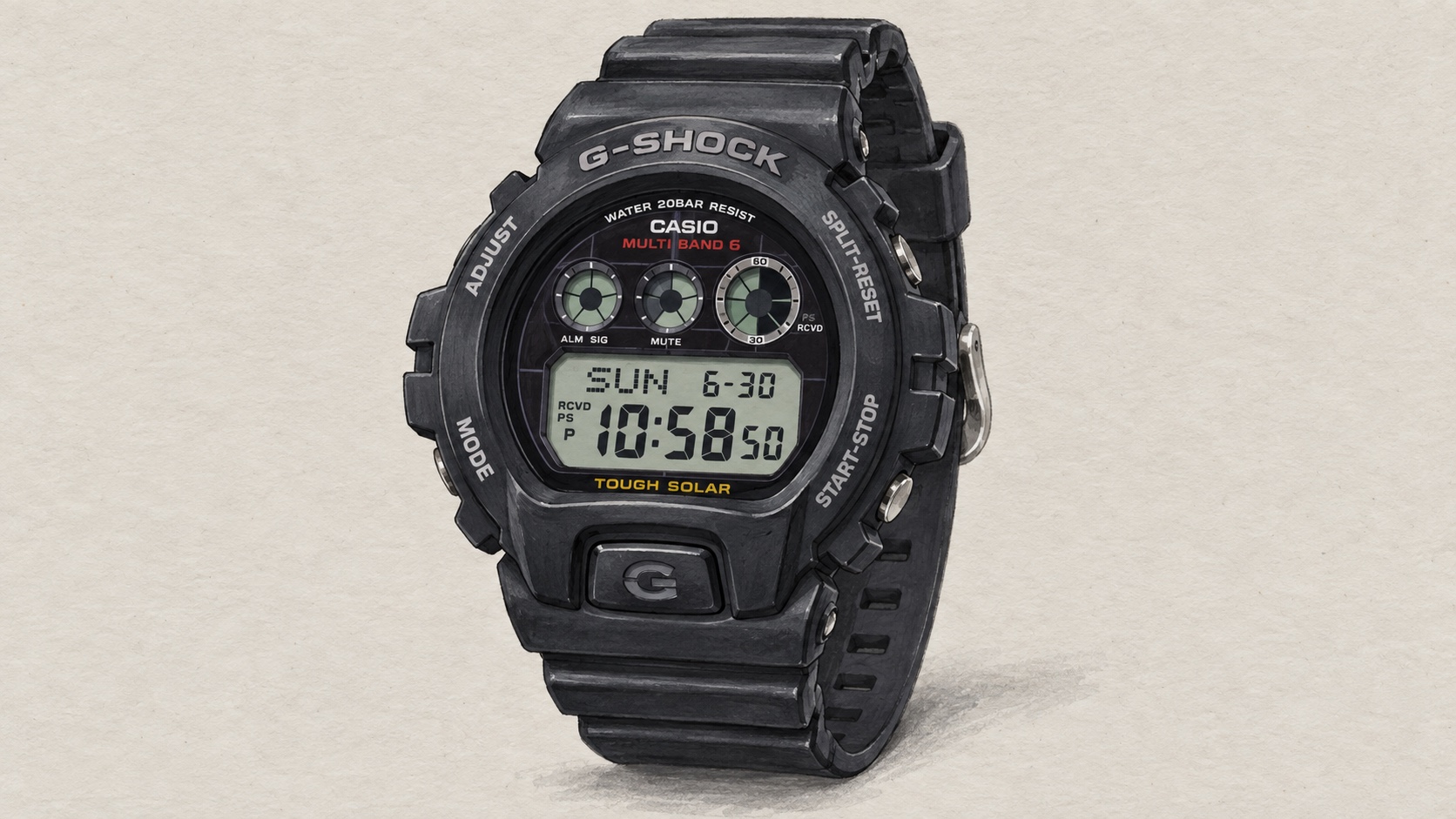
| GW-6900-1JF, original | 53.2 × 50 × 17.7mm | 63g | Tough Solar; Multi Band 6 | Three-circle design; production complete |
The table’s dimensions are complete case measurements, not round-watch diameters. They show why the 52g square deserves attention before assuming that outdoor capability requires the largest outline.
The shapes came from different chapters
The 6900 family began in 1995, with its three circles and prominent front button establishing a recognisable alternative to G-Shock’s square appearance. The GW-6900 brought solar charging and radio correction to that format in 2009. Mudmaster followed as a family in 2015, with the GG-B100 joining Casio’s carbon-construction development in 2019. Its sensors and phone link express a different brief from the earlier digital timing format. These histories explain why a shared G-Shock name does not imply the same features beneath the protective exterior.
The Mudmaster gives you instruments to learn
The GG-B100 offers compass, pressure-derived altitude, temperature and step counting. Those functions can make a walk more interesting and put useful information directly on the wrist. Their value depends on being willing to understand how they obtain that information.
Altitude is calculated from pressure, so changing weather can affect the result; calibration against known elevation is part of correct use. Temperature needs time away from body heat to represent the surrounding air. A sensor list is therefore the beginning of the ownership routine, not the end of it.
Mission Log combines watch altitude data with GPS route information from a smartphone. The watch does not independently record a satellite track. If you intend to leave the phone behind, that distinction should shape your choice before a map graphic in a product description catches your imagination.
The square concentrates on staying ready
The GW-M5610U uses Tough Solar for energy and Multi Band 6 for time correction. Those solve different tasks: light replenishes the rechargeable battery, while successful radio reception corrects the clock. A watch can have enough energy while failing to receive a signal in a particular room.
Its ordinary tools include a countdown timer, stopwatch, world time and alarms. For timing a break, setting a reminder or keeping another city available, that may be all you need. At 12.7mm thick, it is also a substantially less tall object than either rounded alternative.
Do not leave a solar watch permanently covered in a dark box. Keep its face exposed to suitable light and follow Casio’s temperature precautions while charging. Radio reception also has environmental limits, so try a stable position near a window when automatic correction proves unreliable.
The original 6900 is now an exact-reference purchase
Casio Japan marks the GW-6900-1JF as production complete. The later GW-6900U is a separate model. Remaining stock or a used original can still appeal, but the condition and actual reference deserve attention before paying for the familiar shape.
The original combines Tough Solar, Multi Band 6 and a blue-green electroluminescent backlight. Casio quotes about nine months without further light in normal use, or 26 months under power-saving conditions. Those are different operating states. Its 17.7mm thickness is equally worth checking if the watch will spend most days beside jacket cuffs rather than exposed over outdoor clothing.
Choose the routine you will maintain
The GG-B100 uses a replaceable CR2025 battery with an approximate two-year life; it is not solar. The solar alternatives reduce the need for routine battery changes, but rechargeable cells, straps and seals still deserve care. All three require sensible cleaning after dirt accumulates.
Choose the Mudmaster if learning and using the sensors is part of the attraction. Choose the GW-M5610U if compactness and practical timing tools meet the brief. Choose the original GW-6900 if its rounded shape is the reason you want it and the specific example justifies buying a discontinued reference. Equipment is useful when its functions match the outing, not when the catalogue list is longest.
Based on manufacturer information. Specifications checked on 8 September 2026.
Sources: Casio UK GG-B100-1A3ER specifications; Casio Carbon G-Shock Line Up 2019; Casio module 5594 operation guide; Casio UK: GW-M5610U-1ER specifications; Casio module 3495: charging; Casio module 3495: reception location; Casio Japan original GW-6900-1JF; Casio 6900 collection development timeline; Casio UK 6900 design history; Casio Japan updated GW-6900U-1JF; Casio UK on the Mudmaster family's 2015 introduction.
Image: AI-generated editorial illustration of the Casio GW-6900-1JF. Design details are approximate; this is not a product photograph.


