An easy-to-read watch should answer the time question before you start admiring its details. Large numerals help, but they are only part of the story. Hand shape, contrast, reflections, dial clutter and the distance at which you normally glance at your wrist all affect the result.
These three watches approach clarity differently. The Panerai Luminor Marina gives its main hands a broad canvas, the Radiomir Quaranta reduces the case size, and the original Casio GW-6900 uses a digital display inside a protective resin case. They are candidates for different tastes and routines, rather than a ranking based solely on diameter.
Panerai Luminor Marina: space for the main display
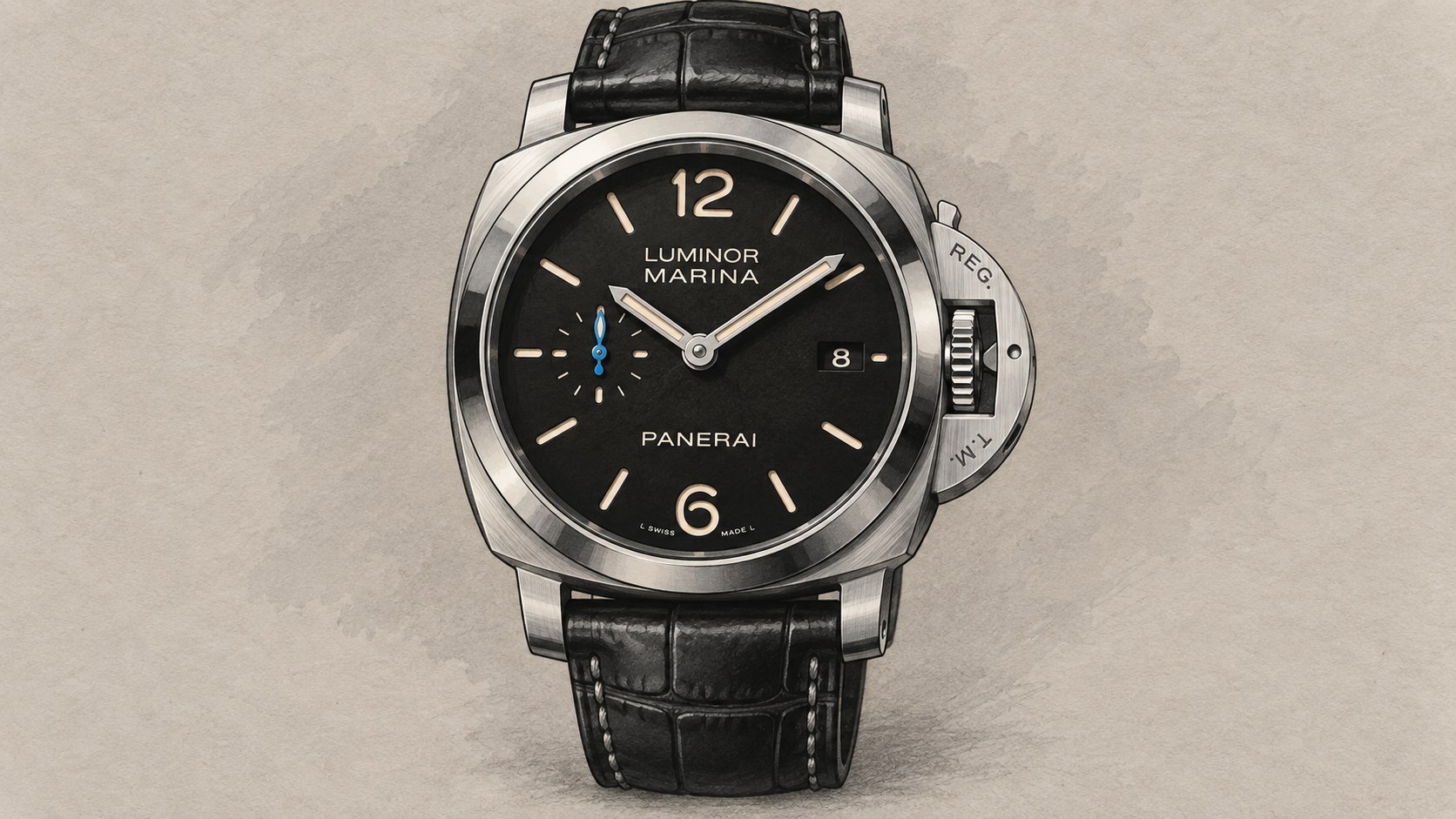
PAM03312 combines a black sandwich dial with prominent luminous numerals and markers. Small seconds sits at nine and the date at three, leaving the main hour and minute hands to do the most obvious work. Its 44 mm steel case and large crown bridge are substantial design commitments. Choose it if that scale is part of the appeal, then check that the watch remains centred and manageable on your wrist.
Panerai’s Luminor name began with luminous-material development in 1949; the familiar crown-protecting device emerged later. The modern watch carries that instrument-oriented design into a newer P.980 automatic movement and 500 m water-resistance specification. Its history explains the emphasis on visible forms, but does not prove that every reader will find this particular dial easiest.
Radiomir Quaranta: the same broad language, less case
The green PAM01573 retains large numerals, a date and small seconds in a 40 mm polished-steel case. Without the Luminor bridge, the outline is quieter. Its sun-brushed dial introduces another consideration: a surface that looks rich in photographs may change its apparent contrast as light moves across it. Check several angles instead of judging a single front-facing image.
Radiomir’s name traces to Panerai’s early luminous-instrument work, including a 1916 patent record. The Quaranta is a contemporary adaptation of that history, with automatic winding and a dark-brown alligator strap. It is worth considering if you want the brand’s graphic identity without assuming that its diving heritage makes every modern reference equally suited to water use.
Casio GW-6900: numerals instead of hands
The original GW-6900-1JF gives the time digitally, with a blue-green electroluminescent backlight and a prominent front light button. Tough Solar and Multi Band 6 reduce charging and time-correction chores when the conditions for light exposure and reception are met. Digital information can be easier for some people, but the display window occupies only part of the large case.
The 6900 family dates to 1995, while this solar radio-controlled version arrived in 2009. Casio now marks the original Japanese reference as production complete and links a later GW-6900U successor. Treat an original as a remaining-stock or used purchase, checking its actual module, condition and lighting system rather than assuming every 6900 has the same specification.
| Watch | Case and movement | Display and water rating |
|---|---|---|
| Luminor Marina PAM03312 | 44 mm steel; automatic P.980; 3 days | Black sandwich dial; 500 m |
| Radiomir Quaranta PAM01573 | 40 mm steel; automatic P.900; 3 days | Green sun-brushed dial; 50 m |
| Original GW-6900-1JF | 53.2 × 50 × 17.7 mm; solar digital quartz | Digital with EL light; 200 m |
Try this at the counter
Read the time with your arm in its normal position, then angle the watch as you would while walking or sitting at a desk. Identify the minute hand immediately. On a digital model, check the size of the main numerals without leaning in. Use the light control and see whether you can operate it comfortably.
Also check the date if you rely on it. A watch can have excellent hour and minute visibility while giving the calendar a tiny window. A simple dial with a badly sized date display may therefore solve only half your everyday problem. Remove protective stickers during a proper demonstration if the retailer permits, since they can add misleading reflections.
Choose the kind of clarity you need
The Luminor is the bold mechanical option, the Radiomir gives a smaller and more decorative interpretation, and the Casio offers explicit digital information with a different maintenance routine. None should be bought merely because a close-up makes the display look large. The most useful test is whether you can read the information you need promptly and comfortably in the conditions where you will actually use it.
Based on manufacturer information. Specifications and sources checked on 8 September 2026.
Sources: Current Luminor Marina comparison; Luminor history and 2025 movement update; Panerai explanation of the crown-protecting device; Radiomir Quaranta PAM01573 specifications; Panerai Radiomir prototype and name history; Radiomir Quaranta collection context; Casio Japan original GW-6900-1JF; Casio 6900 collection development timeline; Casio UK 6900 design history; Casio Japan updated GW-6900U-1JF.
Image: AI-generated editorial illustration of the Panerai PAM03312. Fine dial details and finishing may differ from the production watch.


