A field watch often looks like the answer to a request for less: fewer reflective surfaces, fewer complications and a dial that gives the hands plenty of room. Yet put a Hamilton Khaki Field beside a Tudor Ranger and the simplicity takes different forms. One fills the dial with two sets of numbers. The other leaves most hour positions to uncomplicated markers.
That variety is the useful starting point. Field-watch design is not one universal legibility standard applied to every modern watch. It is a collection of choices inherited from military and expedition timekeeping, then adapted for buyers who may spend far more time reading a railway timetable than crossing open country.
Hamilton: a military layout carried into a modern watch
Hamilton describes the Khaki Field Mechanical H69439931 as a recreation of a 1960s forebear. The current watch combines a black dial, clearly separated Arabic hours and an inner 24-hour scale with a hand-wound movement. Its textile strap and steel case keep the overall presentation direct.
The inner scale reveals a trade-off that is easy to overlook. Extra numbers can be useful when you want a 24-hour reference, but they occupy space. The result is not as empty as the term “simple field watch” might suggest. Its effectiveness comes from separating the two rings and giving the hands distinct shapes, rather than removing every piece of information.
The modern H-50 movement also changes the ownership proposition. Its stated 80-hour reserve is part of a current specification, not evidence that the historic watch had the same capability. Heritage can preserve a recognisable layout while updating what happens behind it.
Ranger history separates the name from the expedition
Tudor registered the Ranger name in 1929, but its own collection history distinguishes that name from the watches carried on the British North Greenland Expedition of 1952 to 1954. Those were Oyster Prince watches without Ranger on the dial. The familiar Ranger arrangement of luminous 3, 6, 9 and 12 numerals on black developed in the 1960s.
The present 39mm Ranger arrived in 2022, marking the expedition’s 70th anniversary. It celebrates that connection through a later design language and a modern automatic movement. Keeping those chapters separate produces a better history than imagining the current watch on an explorer’s wrist seventy years earlier.
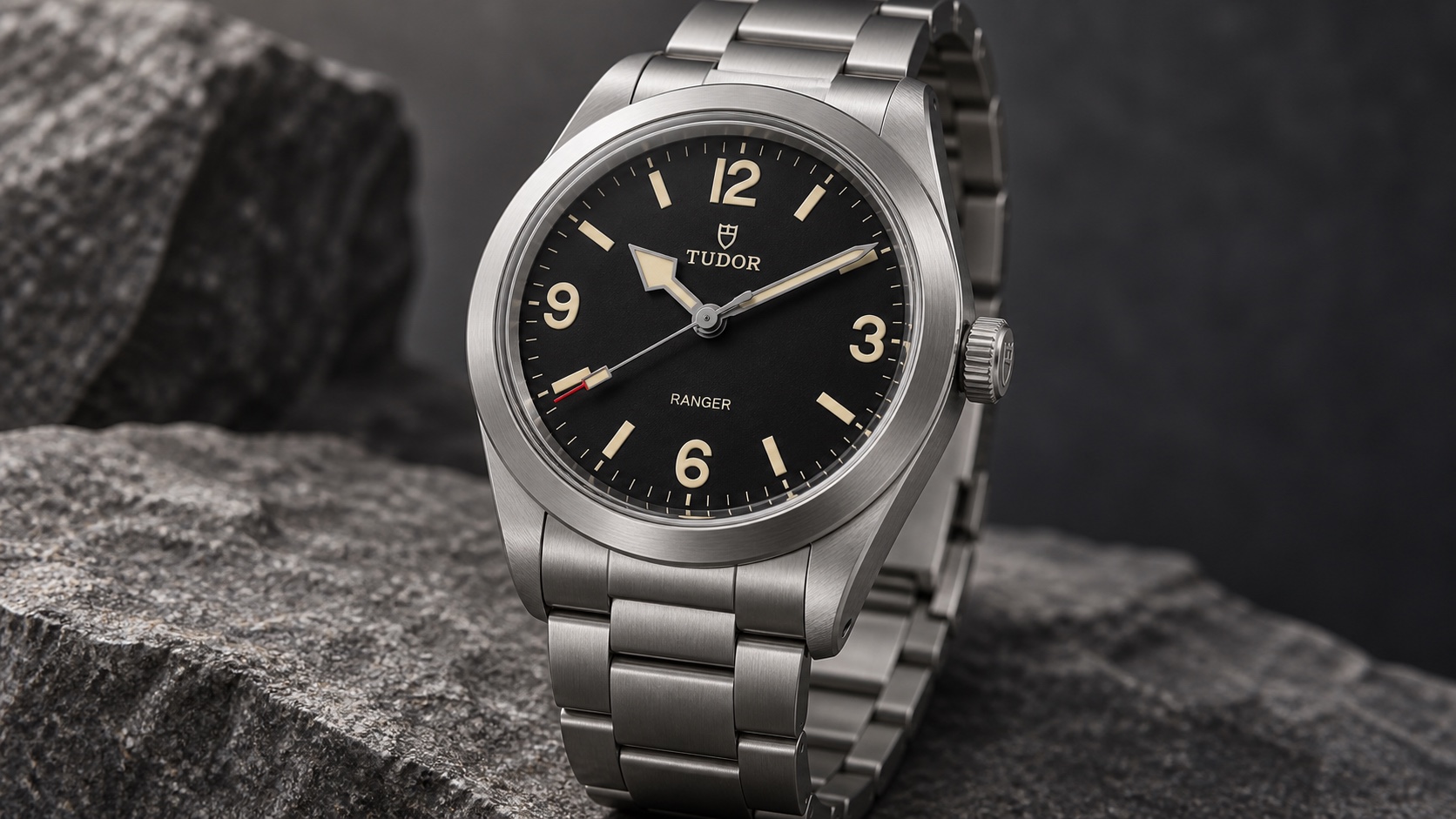
Its dial makes a different choice from the Hamilton. Four large numerals provide orientation, while the remaining markers preserve open space. There is no inner 24-hour ring or date window. For someone who wants the quickest possible impression of where the hands point, that visual restraint may be more appealing than a fuller military-style scale.
Contrast, orientation and the amount of information
Three useful questions emerge from these designs. Can you distinguish the hands from the dial? Can you identify the top of the watch quickly? And does the information you actually use stand out from the information you rarely need? They apply whether your preferred watch costs hundreds or thousands.
Large Arabic numerals are one answer, not the only answer. A strongly differentiated hour hand can be just as important. A minute track placed where the minute hand reaches gives a clear relationship between pointer and scale. Meanwhile, adding a second set of numerals can help one reader and distract another.
Colour also does two jobs. Pale markings against black create a strong visual contrast, while cream-coloured details can suggest age. Those are separate effects. A heritage colour scheme may be attractive, but its resemblance to an older watch does not by itself establish superior readability.
Three present-day field-watch interpretations
| Exact reference | Case dimensions | Power and reserve | Water resistance | Dial and construction emphasis |
|---|---|---|---|---|
| Hamilton Khaki Field Mechanical H69439931 | 38 × 9.5mm; 47mm lug-to-lug | H-50 hand-wound; 80 hours | 50m | Full Arabic hours; inner 24-hour scale; no date |
| Tudor Ranger M79950-0001 | 39 × 12mm | MT5402 automatic; about 70 hours | 100m | Arabic 3, 6, 9 and 12; no date |
| Timex Field Post Solar TW2V00200 | 36 × 12mm | Solar quartz; up to four months fully charged | 100m | Arabic hours; military-inspired dial; sapphire crystal |
The Ranger on its steel bracelet includes Tudor’s T-fit adjustment clasp, making the attachment a substantial part of the modern package. The Hamilton uses a simpler textile strap and a slimmer published case profile. Different priorities sit behind their superficially similar black dials.
The Timex Field Post Solar 36mm shows how the same broad idea can move beyond mechanical power. It uses solar quartz, anti-reflective sapphire and a brown leather strap. Timex’s Field Post design account describes a military-inspired dial, while the exact product listing states up to four months of operation from a full charge. Here, the practical appeal includes reducing how often you need to wind or reset a watch.
Choose useful simplicity, not a costume
If the appeal is winding a watch and reading a full military-style scale, the Hamilton has a coherent reason to exist. If you prefer an open dial and a steel bracelet with convenient adjustment, the Ranger follows a different route. If setting and winding are chores you would rather minimise, the Timex deserves attention.
The history of field watches is most useful when it sharpens those distinctions. A clear dial remains a good idea in ordinary life. You do not need an expedition to justify it, and you do not need every historical feature to make it work for you.
Based on the manufacturers’ published information. Sources and specifications checked on 8 September 2026.
Image: AI-generated editorial illustration of the Tudor Ranger 39 reference M79950-0001. Fine dial details, hand shapes and finishing may differ from the production watch.