A dive watch can tell you something before you read its name. The broad numbered ring around the dial promises a purpose: turn it, line it up, measure an interval. It gives a simple three-hand watch a second job without adding another hand or covering the dial with counters.
That useful bit of design also does much of the visual work. Remove the bezel from a Submariner or Fifty Fathoms and the watch loses more than a timing function. Its proportions, outline and character change. The history of the dive-watch bezel explains how a practical control became one of watchmaking’s most recognisable shapes.
The 1950s problem: reading an interval at a glance
In Blancpain’s account of the Fifty Fathoms’ development, Jean-Jacques Fiechter approached the watch as a diver as well as the company’s director. A rotating ring let the minute hand show elapsed time against a chosen starting point. He also recognised the weakness in that arrangement: accidentally moving the ring would change the reading. His original solution was a bezel that had to be pressed before it could turn.
This detail matters because an early timing bezel was more than a painted scale. It needed a way to preserve the chosen reference point. Blancpain’s account places the bezel alongside contrasting luminous indications and improved sealing, parts of a coordinated answer to an underwater problem. Its original push-to-turn mechanism should not be confused with the unidirectional system on the current watch.
Rolex dates the Submariner’s introduction to 1953, with a rotating bezel among its defining features. The useful historical point is the shared requirement, rather than a contest to award every modern feature to a single watch. A wearer needed to distinguish the time of day from the duration of an activity, quickly and on the same display.
Why the ring stayed when the job changed
An elapsed-time bezel is an unusually approachable complication. Its moving part is outside the case, so the dial can remain comparatively spare. A large minute hand, a prominent zero marker and readable spacing tell a coherent visual story. Even when you are timing a walk instead of a dive, the same arrangement makes sense.
The ring also creates a strong border. It can make the dial look smaller within the overall case diameter, while giving the watch a more substantial outline. That is why two watches with the same published diameter can appear very different when one has a broad timing bezel and the other has a thin polished rim.
These are reasons to study the proportions, rather than treating the bezel as an automatic badge of toughness. Its material, width, printing and relationship to the crystal influence the design. A glossy insert and a domed surface tell a different visual story from a restrained metal ring, even when both carry minute markings.
Three present-day interpretations of the timing bezel
| Exact reference | Case | Bezel | Movement and reserve | Water resistance |
|---|---|---|---|---|
| Rolex Submariner Date 126610LN-0001 | 41mm steel | 60-minute unidirectional; black ceramic insert | 3235 automatic; about 70 hours | 300m |
| Blancpain Fifty Fathoms 5010 1130 NABA | 42.3mm steel; 14.3mm thick | Unidirectional; domed sapphire insert | 1315 automatic; 120 hours | 300m |
| Oris Divers Sixty-Five 01 733 7771 3154-07 8 19 15 | 38mm bronze | External rotating timing bezel | 733-1 automatic; 41 hours | 100m |
The current Submariner Date uses a black Cerachrom ceramic insert and a unidirectional 60-minute scale. Its Oyster bracelet and Glidelock clasp make the watch a complete steel sports-watch proposition. The date lens adds another conspicuous visual feature, so this is not simply the early no-date concept reproduced with newer materials.
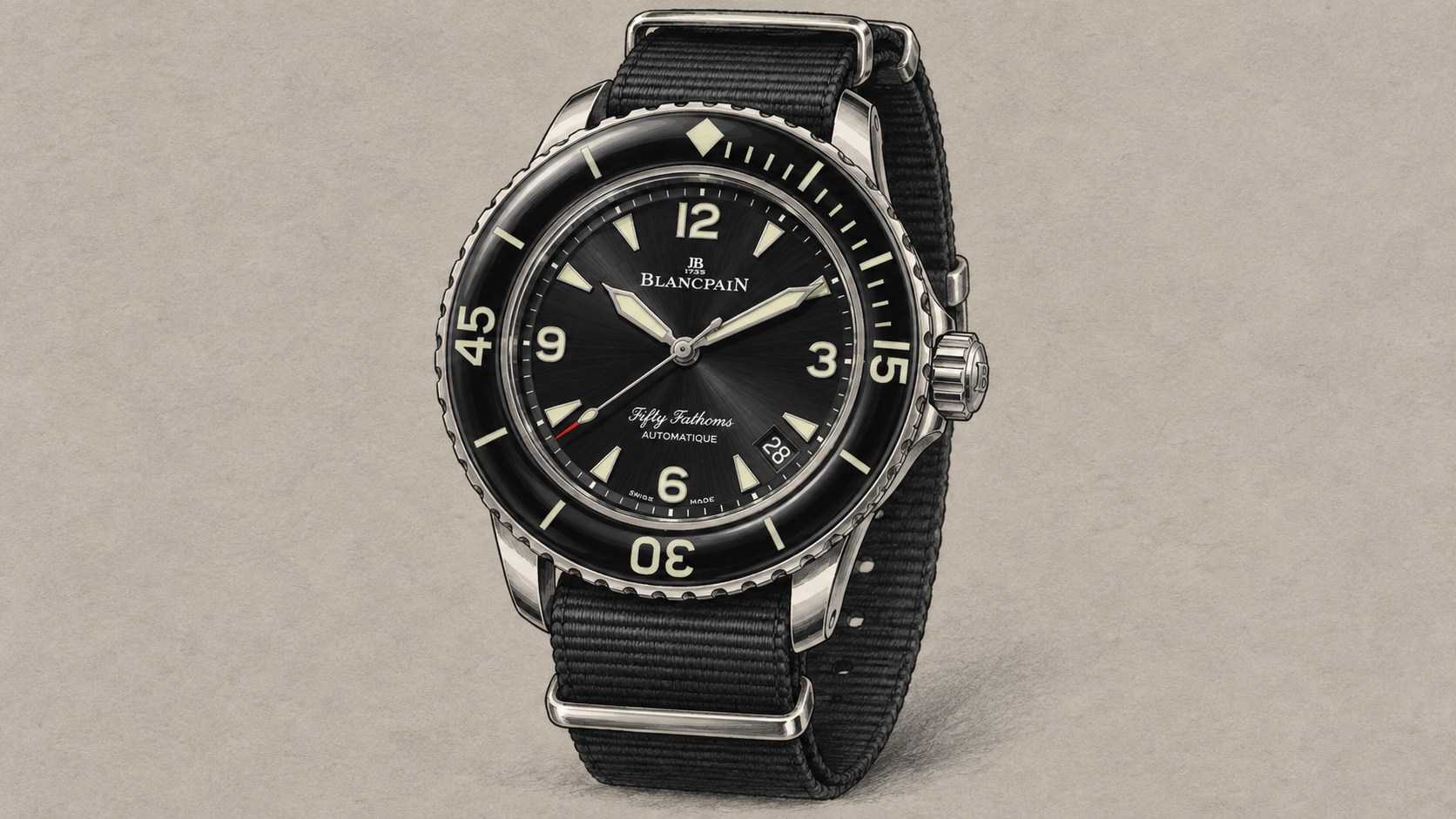
The steel Fifty Fathoms 5010 keeps the timing ring particularly prominent. Its domed sapphire insert, polished case and black NATO strap create a different balance of reflective surfaces and utilitarian attachment. Blancpain also gives it a five-day movement reserve. Bezel ancestry alone would miss those substantial differences in the modern watches.
The bronze Oris Divers Sixty-Five takes the idea in a smaller, warmer-coloured direction. Oris traces the collection to its 1965 diver and 2015 revival. The present 38mm bronze reference uses a matching bracelet and a steel case back. Its 100m rating and 41-hour reserve differ from both watches above, despite the immediately familiar diving outline.
What this history changes about choosing a dive watch
Start with the element that attracts you. If you want an everyday timing control, concentrate on whether the scale is clear and the marker easy to distinguish. If the attraction is the silhouette, look at the ring’s width against the dial and at the case from an angle. Those questions are more revealing than simply choosing the largest depth number.
Then consider the rest of the watch. The Submariner’s ceramic ring, the Fifty Fathoms’ sapphire dome and the Oris’ bronze construction belong to three different packages. Movement reserve, case dimensions and bracelet design remain important after the historical connection has caught your attention.
The bezel endured because function and appearance reinforce each other. You can enjoy its origins without pretending every office day is an expedition. The best choice is the watch whose timing display and overall design still appeal when the story has been put aside.
Based on the manufacturers’ published information. Sources and specifications checked on 8 September 2026.
Image: AI-generated editorial illustration of the Blancpain 5010 1130 NABA. Fine dial details and finishing may differ from the production watch.