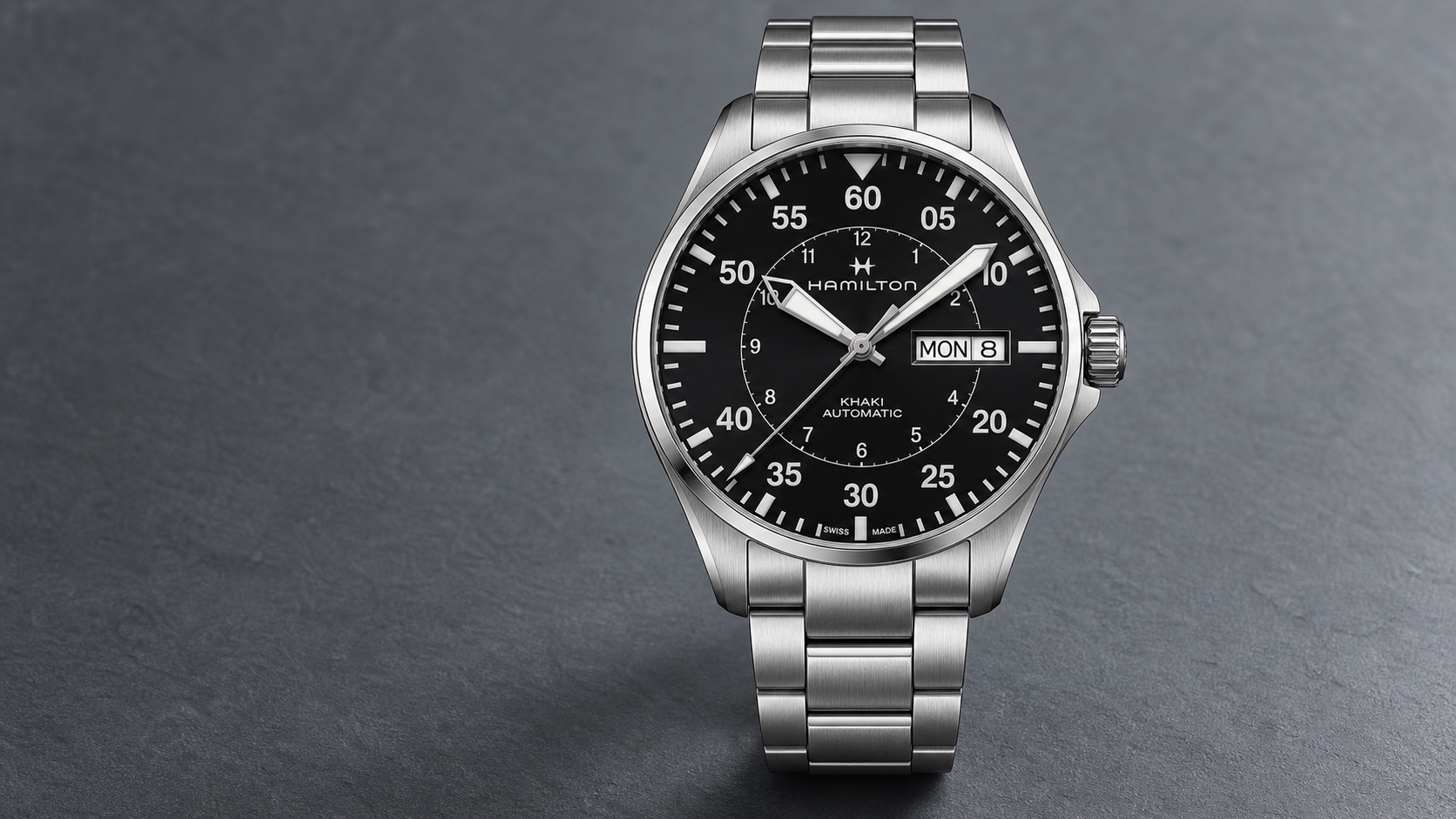
The Hamilton Pilot Day Date puts more calendar information into a larger steel watch. The IWC Mark XX reduces the size, extends the reserve and supplies a simpler black-dial watch on leather. Both use aviation design as a starting point, but their everyday priorities are different.
Hamilton’s H64615135 also has a recognisable film connection through Interstellar. That may begin your interest, but the purchase still needs to work as a 42 mm day-date automatic. The IWC should earn its place through the watch itself for the same reason.
The references compared
| Feature | Hamilton H64615135 | IWC IW328201 |
|---|---|---|
| Diameter | 42 mm | 40 mm |
| Thickness | 11.85 mm | 10.8 mm |
| Movement | H-40 automatic; Nivachron spring | 32111 automatic |
| Reserve | 80 hours | 120 hours |
| Calendar | Day and date | Date |
| Water resistance | 10 bar | 10 bar |
| Crystal | Sapphire; anti-reflective treatment | Convex sapphire; pressure-drop secured |
| Attachment | Steel bracelet; folding clasp | Black calfskin; EasX-CHANGE |
| Lug width | 20 mm | 20 mm |
Specifications: Hamilton Pilot Day Date specifications; Mark XX exact specifications.
Aviation history and a modern film connection
Hamilton traces its aviation connection to 1918, including the early US airmail service, with further airline associations in the following decades. The modern Khaki Aviation family draws on that information-focused tradition. H64615135 adds its individual association with Cooper in the 2014 film Interstellar.
The Mark XX continues a line connected with IWC’s 1948 Mark 11. That earlier instrument influenced the restrained layout and emphasis on reading time clearly. The current watch uses modern automatic architecture and a long reserve rather than reproducing the original equipment unchanged. These histories explain why the dials look purposeful, while leaving room to choose the calendar and proportions that suit an ordinary working day.
Do you use the day as well as the date?
The Hamilton’s additional day indication is a practical reason to choose it. If you frequently need to orient yourself within the working week, the extra information may be more useful than another decorative detail.
The Mark XX keeps a date but omits the day. Its Arabic numerals and more restrained display make the face the quieter of this pairing. It is a stronger starting point if you prefer the time to dominate.
Look at the dial from arm’s length and identify what your eye reads first. More information is only beneficial if you want it often enough to justify the space it occupies.
The IWC reduces both width and height
The Mark XX measures 40 mm across and 10.8 mm thick. The Hamilton is 42 mm across and 11.85 mm thick. Unlike comparisons where a smaller watch is also taller, the IWC reduces both headline dimensions here.
That gives it a clear reason to be tried first if broad pilot watches have felt intrusive under sleeves or beside your hand. The Hamilton may be more appealing if you want its large dial and steel bracelet to be a visible part of your clothing.
The supplied attachments change the overall impression too. A black leather strap lets the IWC case stand apart; Hamilton’s bracelet carries the steel surface around the wrist. Judge those complete configurations rather than treating attachment choice as an afterthought.
Five days versus more than three
The Hamilton’s H-40 offers 80 hours of reserve. The IWC calibre 32111 extends that to 120 hours, or five days, from full wind. Both already provide more rotation flexibility than many shorter-reserve automatics.
The IWC’s additional 40 hours matters if you regularly leave the watch for several days. If you alternate only overnight, the Hamilton’s reserve may already cover your needs comfortably.
Both are automatic movements, so their normal routine depends on wearing and winding. Decide whether the extra duration would change how you use the watch, rather than valuing it only as a larger number on the table.
The practical details deserve attention
Both publish 10-bar water resistance and use sapphire. IWC specifies that its crystal is secured against displacement during a pressure drop, a construction detail tied to the pilot-watch brief.
The Mark XX also includes EasX-CHANGE for changing the supplied attachment. Both watches have 20 mm lug widths, but the IWC system is a particular convenience to assess if you expect to switch straps often.
The Hamilton’s bracelet and folding clasp are part of its appeal as an everyday package. Try its fit before deciding that the film connection alone is enough. A watch associated with a character still needs to sit properly on the person buying it.
Which pilot watch suits your routine?
Choose the Hamilton if the larger information-rich dial, day-date calendar and bracelet are what you want. Its 80-hour reserve already gives a strong practical foundation, and the cinema association can add enjoyment to a watch that works for you.
Choose the Mark XX if reduced width and height, a quieter dial, easy strap changes and a five-day reserve justify your preference. The meaningful comparison is between those specific benefits. Aviation history gives each watch context, but it cannot decide how much dial and calendar you want on your wrist.
Based on manufacturer information. Specifications checked on 8 September 2026.
Image: AI-generated editorial illustration of the Hamilton Khaki Aviation Pilot Day Date 42mm, reference H64615135. Fine design details may differ from the production watch.


